

491
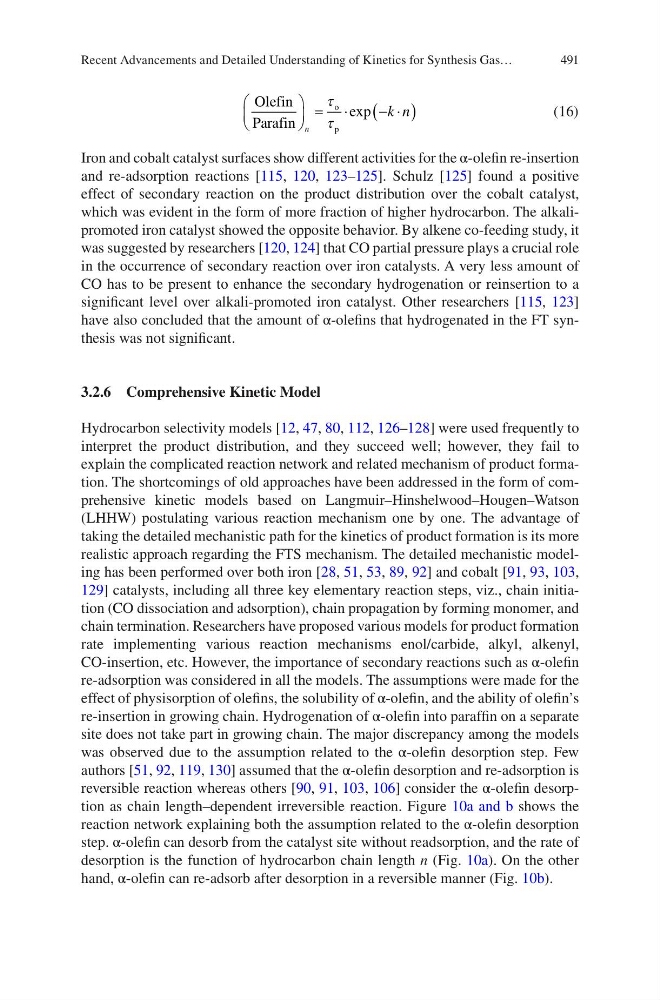
Olefin
Parafin
o
p
= ⋅
− ⋅
(
)
n
k n
τ
τ
exp
(16)
Iron and cobalt catalyst surfaces show different activities for the α-olefin re- insertion
and re-adsorption reactions [115, 120, 123–125]. Schulz [125] found a positive
effect of secondary reaction on the product distribution over the cobalt catalyst,
which was evident in the form of more fraction of higher hydrocarbon. The alkalipromoted iron catalyst showed the opposite behavior. By alkene co-feeding study, it
was suggested by researchers [120, 124] that CO partial pressure plays a crucial role
in the occurrence of secondary reaction over iron catalysts. A very less amount of
CO has to be present to enhance the secondary hydrogenation or reinsertion to a
significant level over alkali-promoted iron catalyst. Other researchers [115, 123]
have also concluded that the amount of α-olefins that hydrogenated in the FT synthesis was not significant.
3.2.6 Comprehensive Kinetic Model
Hydrocarbon selectivity models [12, 47, 80, 112, 126–128] were used frequently to
interpret the product distribution, and they succeed well; however, they fail to
explain the complicated reaction network and related mechanism of product formation. The shortcomings of old approaches have been addressed in the form of comprehensive kinetic models based on Langmuir–Hinshelwood–Hougen–Watson
(LHHW) postulating various reaction mechanism one by one. The advantage of
taking the detailed mechanistic path for the kinetics of product formation is its more
realistic approach regarding the FTS mechanism. The detailed mechanistic modeling has been performed over both iron [28, 51, 53, 89, 92] and cobalt [91, 93, 103,
129] catalysts, including all three key elementary reaction steps, viz., chain initiation (CO dissociation and adsorption), chain propagation by forming monomer, and
chain termination. Researchers have proposed various models for product formation
rate implementing various reaction mechanisms enol/carbide, alkyl, alkenyl,
CO-insertion, etc. However, the importance of secondary reactions such as α-olefin
re-adsorption was considered in all the models. The assumptions were made for the
effect of physisorption of olefins, the solubility of α-olefin, and the ability of olefin’s
re-insertion in growing chain. Hydrogenation of α-olefin into paraffin on a separate
site does not take part in growing chain. The major discrepancy among the models
was observed due to the assumption related to the α-olefin desorption step. Few
authors [51, 92, 119, 130] assumed that the α-olefin desorption and re-adsorption is
reversible reaction whereas others [90, 91, 103, 106] consider the α-olefin desorption as chain length–dependent irreversible reaction. Figure 10a and b shows the
reaction network explaining both the assumption related to the α-olefin desorption
step. α-olefin can desorb from the catalyst site without readsorption, and the rate of
desorption is the function of hydrocarbon chain length n (Fig. 10a). On the other
hand, α-olefin can re-adsorb after desorption in a reversible manner (Fig. 10b).
Recent Advancements and Detailed Understanding of Kinetics for Synthesis Gas…
Olefin
Parafin
o
p
= ⋅
− ⋅
(
)
n
k n
τ
τ
exp
(16)
Iron and cobalt catalyst surfaces show different activities for the α-olefin re- insertion
and re-adsorption reactions [115, 120, 123–125]. Schulz [125] found a positive
effect of secondary reaction on the product distribution over the cobalt catalyst,
which was evident in the form of more fraction of higher hydrocarbon. The alkalipromoted iron catalyst showed the opposite behavior. By alkene co-feeding study, it
was suggested by researchers [120, 124] that CO partial pressure plays a crucial role
in the occurrence of secondary reaction over iron catalysts. A very less amount of
CO has to be present to enhance the secondary hydrogenation or reinsertion to a
significant level over alkali-promoted iron catalyst. Other researchers [115, 123]
have also concluded that the amount of α-olefins that hydrogenated in the FT synthesis was not significant.
3.2.6 Comprehensive Kinetic Model
Hydrocarbon selectivity models [12, 47, 80, 112, 126–128] were used frequently to
interpret the product distribution, and they succeed well; however, they fail to
explain the complicated reaction network and related mechanism of product formation. The shortcomings of old approaches have been addressed in the form of comprehensive kinetic models based on Langmuir–Hinshelwood–Hougen–Watson
(LHHW) postulating various reaction mechanism one by one. The advantage of
taking the detailed mechanistic path for the kinetics of product formation is its more
realistic approach regarding the FTS mechanism. The detailed mechanistic modeling has been performed over both iron [28, 51, 53, 89, 92] and cobalt [91, 93, 103,
129] catalysts, including all three key elementary reaction steps, viz., chain initiation (CO dissociation and adsorption), chain propagation by forming monomer, and
chain termination. Researchers have proposed various models for product formation
rate implementing various reaction mechanisms enol/carbide, alkyl, alkenyl,
CO-insertion, etc. However, the importance of secondary reactions such as α-olefin
re-adsorption was considered in all the models. The assumptions were made for the
effect of physisorption of olefins, the solubility of α-olefin, and the ability of olefin’s
re-insertion in growing chain. Hydrogenation of α-olefin into paraffin on a separate
site does not take part in growing chain. The major discrepancy among the models
was observed due to the assumption related to the α-olefin desorption step. Few
authors [51, 92, 119, 130] assumed that the α-olefin desorption and re-adsorption is
reversible reaction whereas others [90, 91, 103, 106] consider the α-olefin desorption as chain length–dependent irreversible reaction. Figure 10a and b shows the
reaction network explaining both the assumption related to the α-olefin desorption
step. α-olefin can desorb from the catalyst site without readsorption, and the rate of
desorption is the function of hydrocarbon chain length n (Fig. 10a). On the other
hand, α-olefin can re-adsorb after desorption in a reversible manner (Fig. 10b).
Recent Advancements and Detailed Understanding of Kinetics for Synthesis Gas…