

489
3.2.5 Non-ASF Model for Hydrocarbon Selectivity
The deviation from the ASF distribution reported in the literature can be attributed
to secondary reactions after chain terminations. Chain terminates via β-hydrogen
elimination or α-hydrogenation yielding alkene and alkanes, respectively. Secondary
reactions are mainly hydrogenation, hydrogenolysis of the primary product, or the
re-insertion into the growing chain. It has been previously reported that the rate of
re-insertion and hydrogenation increases with chain length and alter the distributions of higher hydrocarbon [116]. A number of product selectivity models are proposed to describe the varied FT product spectrum [28, 47, 51, 53, 54, 89, 92, 112,
117]. However, the basis of the modeling is divided over the secondary reaction of
α-olefin. The first argument is that the primarily formed α-olefins readsorb and
hydrogenate to form alkane. Some researcher has observed that the re-adsorbed
α-olefin re-inserted in growing chain to form longer chain hydrocarbon. The
researchers have presented three different explanations for the enhanced probability
of re-insertion of α-olefin with chain length. The increased reinsertion can be attributed to enhanced diffusivity [15, 18, 100, 118, 119] effect, chain length–dependent
solubility [120, 121] and/or physisorption effect [12, 99, 122]. The physisorption
effect has been reported as a primary reason for the decreased olefin to paraffin ratio
with chain length. In order to address the effect, an exponential term has been
included in most of the models related to the rate of α-olefin desorption [15, 100,
118]. Various non-ASF product distribution models were developed based on each
explanation.
The deviation from ASF distributions was firstly addressed by Van der Laan [47,
122] and co-workers. They introduce the concept of α-olefin re-adsorption during
the reaction, and it depends on the chain length. They reported that the olefin readsorption rate increases with the chain length because the strength of the physisorbed
molecule on the catalyst active site and solubility in the liquid medium of longchain molecules increases with chain length, henceforth, their probability of readsorption increases. They proposed the α-olefin re-adsorption product distribution
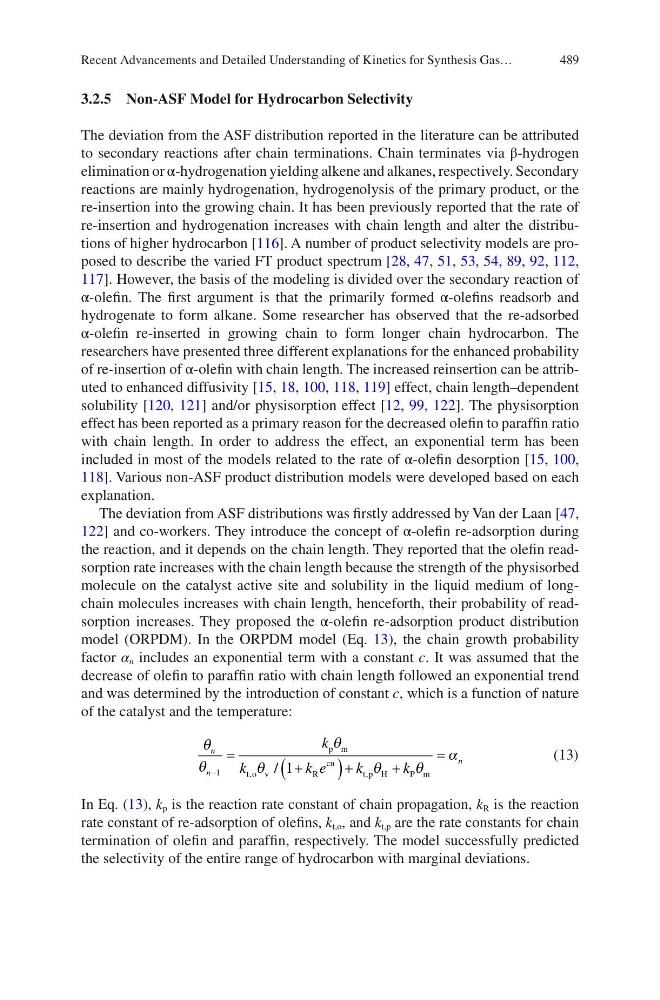
model (ORPDM). In the ORPDM model (Eq. 13), the chain growth probability
factor α n includes an exponential term with a constant c. It was assumed that the
decrease of olefin to paraffin ratio with chain length followed an exponential trend
and was determined by the introduction of constant c, which is a function of nature
of the catalyst and the temperature:
θ
θ
θ
θ
θ
θ
α
n
n
n
k
k
ke
k
k
−
=
+
(
) +
+
=
1
1
p m
t o v
R
cn
t p H
P m
,
,
/
(13)
In Eq. (13), k p is the reaction rate constant of chain propagation, k R is the reaction
rate constant of re-adsorption of olefins, k t,o , and k t,p are the rate constants for chain
termination of olefin and paraffin, respectively. The model successfully predicted
the selectivity of the entire range of hydrocarbon with marginal deviations.
Recent Advancements and Detailed Understanding of Kinetics for Synthesis Gas…
3.2.5 Non-ASF Model for Hydrocarbon Selectivity
The deviation from the ASF distribution reported in the literature can be attributed
to secondary reactions after chain terminations. Chain terminates via β-hydrogen
elimination or α-hydrogenation yielding alkene and alkanes, respectively. Secondary
reactions are mainly hydrogenation, hydrogenolysis of the primary product, or the
re-insertion into the growing chain. It has been previously reported that the rate of
re-insertion and hydrogenation increases with chain length and alter the distributions of higher hydrocarbon [116]. A number of product selectivity models are proposed to describe the varied FT product spectrum [28, 47, 51, 53, 54, 89, 92, 112,
117]. However, the basis of the modeling is divided over the secondary reaction of
α-olefin. The first argument is that the primarily formed α-olefins readsorb and
hydrogenate to form alkane. Some researcher has observed that the re-adsorbed
α-olefin re-inserted in growing chain to form longer chain hydrocarbon. The
researchers have presented three different explanations for the enhanced probability
of re-insertion of α-olefin with chain length. The increased reinsertion can be attributed to enhanced diffusivity [15, 18, 100, 118, 119] effect, chain length–dependent
solubility [120, 121] and/or physisorption effect [12, 99, 122]. The physisorption
effect has been reported as a primary reason for the decreased olefin to paraffin ratio
with chain length. In order to address the effect, an exponential term has been
included in most of the models related to the rate of α-olefin desorption [15, 100,
118]. Various non-ASF product distribution models were developed based on each
explanation.
The deviation from ASF distributions was firstly addressed by Van der Laan [47,
122] and co-workers. They introduce the concept of α-olefin re-adsorption during
the reaction, and it depends on the chain length. They reported that the olefin readsorption rate increases with the chain length because the strength of the physisorbed
molecule on the catalyst active site and solubility in the liquid medium of longchain molecules increases with chain length, henceforth, their probability of readsorption increases. They proposed the α-olefin re-adsorption product distribution
model (ORPDM). In the ORPDM model (Eq. 13), the chain growth probability
factor α n includes an exponential term with a constant c. It was assumed that the
decrease of olefin to paraffin ratio with chain length followed an exponential trend
and was determined by the introduction of constant c, which is a function of nature
of the catalyst and the temperature:
θ
θ
θ
θ
θ
θ
α
n
n
n
k
k
ke
k
k
−
=
+
(
) +
+
=
1
1
p m
t o v
R
cn
t p H
P m
,
,
/
(13)
In Eq. (13), k p is the reaction rate constant of chain propagation, k R is the reaction
rate constant of re-adsorption of olefins, k t,o , and k t,p are the rate constants for chain
termination of olefin and paraffin, respectively. The model successfully predicted
the selectivity of the entire range of hydrocarbon with marginal deviations.
Recent Advancements and Detailed Understanding of Kinetics for Synthesis Gas…