

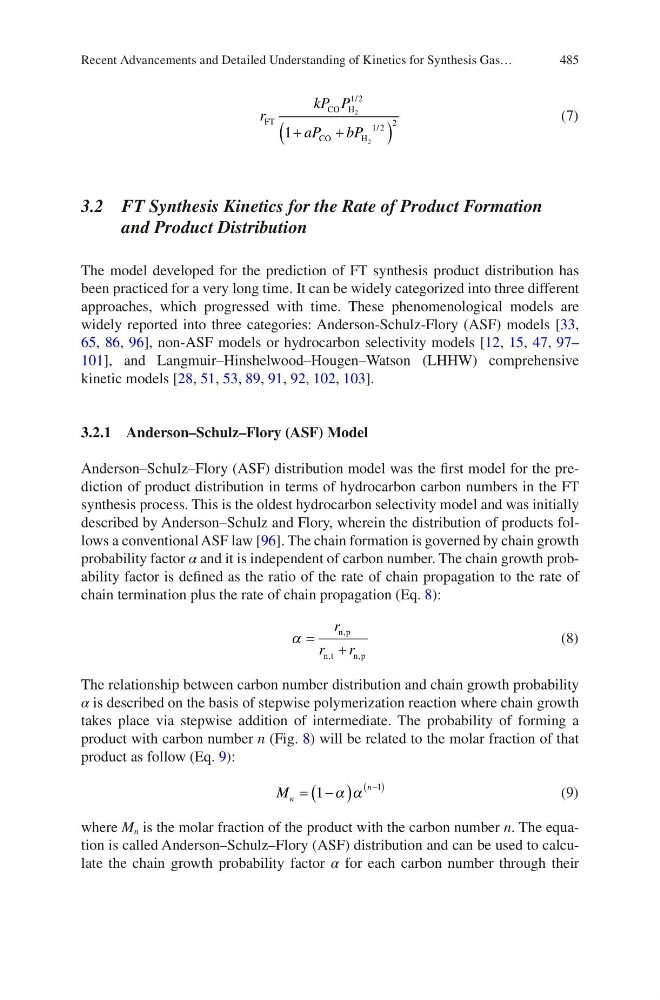
485
r
kP P
aP
bP
FT
CO H
CO
H
2
2
1 2
1 2
2
1
/
/
+
+
(
)
(7)
3.2 FT Synthesis Kinetics for the Rate of Product Formation
and Product Distribution
The model developed for the prediction of FT synthesis product distribution has
been practiced for a very long time. It can be widely categorized into three different
approaches, which progressed with time. These phenomenological models are
widely reported into three categories: Anderson-Schulz-Flory (ASF) models [33,
65, 86, 96], non-ASF models or hydrocarbon selectivity models [12, 15, 47, 97–
101], and Langmuir–Hinshelwood–Hougen–Watson (LHHW) comprehensive
kinetic models [28, 51, 53, 89, 91, 92, 102, 103].
3.2.1 Anderson–Schulz–Flory (ASF) Model
Anderson–Schulz–Flory (ASF) distribution model was the first model for the prediction of product distribution in terms of hydrocarbon carbon numbers in the FT
synthesis process. This is the oldest hydrocarbon selectivity model and was initially
described by Anderson–Schulz and Flory, wherein the distribution of products follows a conventional ASF law [96]. The chain formation is governed by chain growth
probability factor α and it is independent of carbon number. The chain growth probability factor is defined as the ratio of the rate of chain propagation to the rate of
chain termination plus the rate of chain propagation (Eq. 8):
α =
+
r
r
r
n p
n t
n p
,
,
,
(8)
The relationship between carbon number distribution and chain growth probability
α is described on the basis of stepwise polymerization reaction where chain growth
takes place via stepwise addition of intermediate. The probability of forming a
product with carbon number n (Fig. 8) will be related to the molar fraction of that
product as follow (Eq. 9):
M n
n
= −
(
)
−
( )
1
1
α α
(9)
where M n is the molar fraction of the product with the carbon number n. The equation is called Anderson–Schulz–Flory (ASF) distribution and can be used to calculate the chain growth probability factor α for each carbon number through their
Recent Advancements and Detailed Understanding of Kinetics for Synthesis Gas…
r
kP P
aP
bP
FT
CO H
CO
H
2
2
1 2
1 2
2
1
/
/
+
+
(
)
(7)
3.2 FT Synthesis Kinetics for the Rate of Product Formation
and Product Distribution
The model developed for the prediction of FT synthesis product distribution has
been practiced for a very long time. It can be widely categorized into three different
approaches, which progressed with time. These phenomenological models are
widely reported into three categories: Anderson-Schulz-Flory (ASF) models [33,
65, 86, 96], non-ASF models or hydrocarbon selectivity models [12, 15, 47, 97–
101], and Langmuir–Hinshelwood–Hougen–Watson (LHHW) comprehensive
kinetic models [28, 51, 53, 89, 91, 92, 102, 103].
3.2.1 Anderson–Schulz–Flory (ASF) Model
Anderson–Schulz–Flory (ASF) distribution model was the first model for the prediction of product distribution in terms of hydrocarbon carbon numbers in the FT
synthesis process. This is the oldest hydrocarbon selectivity model and was initially
described by Anderson–Schulz and Flory, wherein the distribution of products follows a conventional ASF law [96]. The chain formation is governed by chain growth
probability factor α and it is independent of carbon number. The chain growth probability factor is defined as the ratio of the rate of chain propagation to the rate of
chain termination plus the rate of chain propagation (Eq. 8):
α =
+
r
r
r
n p
n t
n p
,
,
,
(8)
The relationship between carbon number distribution and chain growth probability
α is described on the basis of stepwise polymerization reaction where chain growth
takes place via stepwise addition of intermediate. The probability of forming a
product with carbon number n (Fig. 8) will be related to the molar fraction of that
product as follow (Eq. 9):
M n
n
= −
(
)
−
( )
1
1
α α
(9)
where M n is the molar fraction of the product with the carbon number n. The equation is called Anderson–Schulz–Flory (ASF) distribution and can be used to calculate the chain growth probability factor α for each carbon number through their
Recent Advancements and Detailed Understanding of Kinetics for Synthesis Gas…