

484
CO conversion (3–91%). However, CO 2 inhibition was significant and different for
different conversion levels. Although several studies have been reported over Fe or
Co catalysts, very few kinetic studies have been done for Fe-Co bimetallic catalysts
till date. A wide range of bimetallic catalysts have been tested in kinetic modeling
by Mirzaei and co-workers, viz., Fe-Co-Mn, Fe-Co-Ni, and Co-Ni catalysts [71, 77,
78, 94, 95]. Various routes for monomer formation and carbon chain propagation
paths were exercised for FT synthesis kinetic model development. They reported
that the different values of the kinetic parameters and activation energies could be
attributed to catalyst preparation methods and the formation of active phases of a
metal catalyst. However, the detailed explanation and the effect of bimetallic phase
formation on kinetics were lacking in their study.
Pant et al. [79] investigated the synergistic effect of Fe-Co bimetallic catalyst on
the kinetics of FT synthesis reactions. The rate model for the rate of CO consumption was developed using Langmuir–Hinshelwood–Hougen–Watson (LHHW)
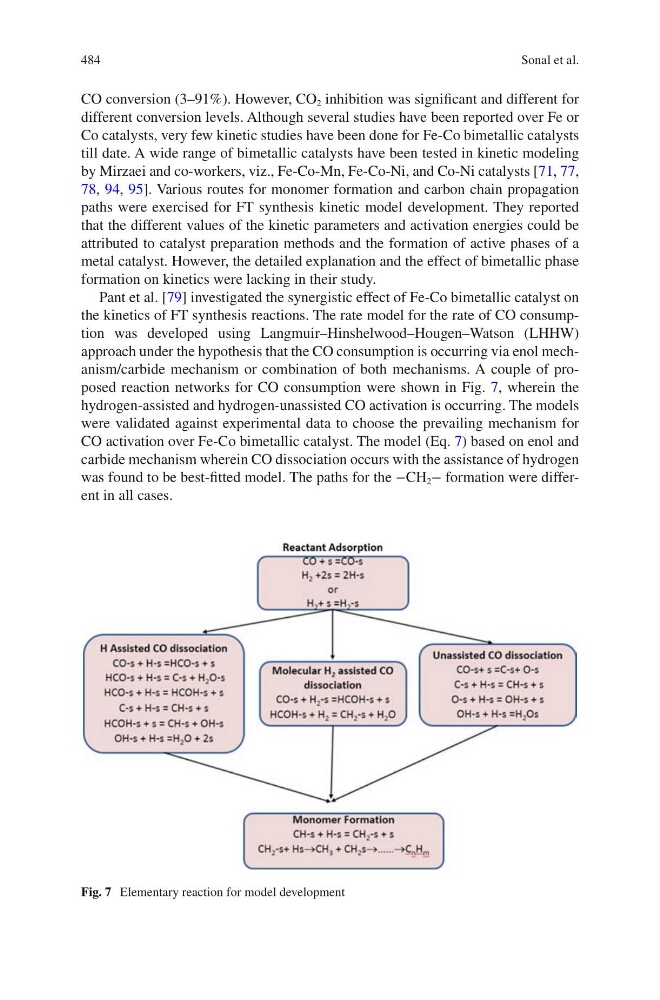
approach under the hypothesis that the CO consumption is occurring via enol mechanism/carbide mechanism or combination of both mechanisms. A couple of proposed reaction networks for CO consumption were shown in Fig. 7, wherein the
hydrogen-assisted and hydrogen-unassisted CO activation is occurring. The models
were validated against experimental data to choose the prevailing mechanism for
CO activation over Fe-Co bimetallic catalyst. The model (Eq. 7) based on enol and
carbide mechanism wherein CO dissociation occurs with the assistance of hydrogen
was found to be best-fitted model. The paths for the −CH 2 − formation were different in all cases.
Fig. 7 Elementary reaction for model development
Sonal et al.
CO conversion (3–91%). However, CO 2 inhibition was significant and different for
different conversion levels. Although several studies have been reported over Fe or
Co catalysts, very few kinetic studies have been done for Fe-Co bimetallic catalysts
till date. A wide range of bimetallic catalysts have been tested in kinetic modeling
by Mirzaei and co-workers, viz., Fe-Co-Mn, Fe-Co-Ni, and Co-Ni catalysts [71, 77,
78, 94, 95]. Various routes for monomer formation and carbon chain propagation
paths were exercised for FT synthesis kinetic model development. They reported
that the different values of the kinetic parameters and activation energies could be
attributed to catalyst preparation methods and the formation of active phases of a
metal catalyst. However, the detailed explanation and the effect of bimetallic phase
formation on kinetics were lacking in their study.
Pant et al. [79] investigated the synergistic effect of Fe-Co bimetallic catalyst on
the kinetics of FT synthesis reactions. The rate model for the rate of CO consumption was developed using Langmuir–Hinshelwood–Hougen–Watson (LHHW)
approach under the hypothesis that the CO consumption is occurring via enol mechanism/carbide mechanism or combination of both mechanisms. A couple of proposed reaction networks for CO consumption were shown in Fig. 7, wherein the
hydrogen-assisted and hydrogen-unassisted CO activation is occurring. The models
were validated against experimental data to choose the prevailing mechanism for
CO activation over Fe-Co bimetallic catalyst. The model (Eq. 7) based on enol and
carbide mechanism wherein CO dissociation occurs with the assistance of hydrogen
was found to be best-fitted model. The paths for the −CH 2 − formation were different in all cases.
Fig. 7 Elementary reaction for model development
Sonal et al.