

437
These devices are diced into individual microreactors and are anodically bonded
to Pyrex glass plate which is plasma cleaned to remove all the inorganic impurities
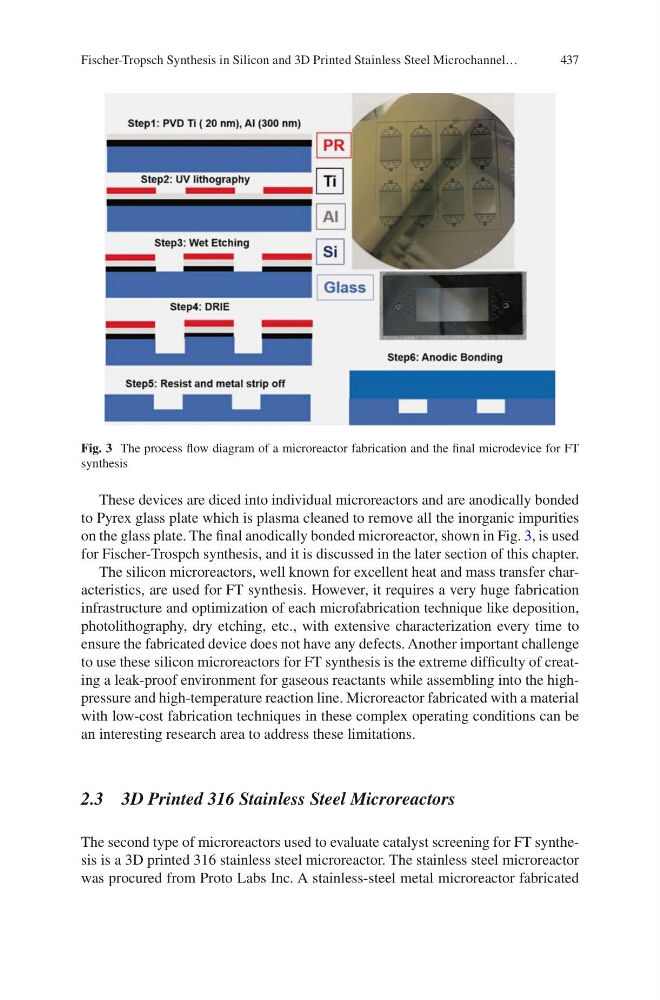
on the glass plate. The final anodically bonded microreactor, shown in Fig. 3, is used
for Fischer-Trospch synthesis, and it is discussed in the later section of this chapter.
The silicon microreactors, well known for excellent heat and mass transfer characteristics, are used for FT synthesis. However, it requires a very huge fabrication
infrastructure and optimization of each microfabrication technique like deposition,
photolithography, dry etching, etc., with extensive characterization every time to
ensure the fabricated device does not have any defects. Another important challenge
to use these silicon microreactors for FT synthesis is the extreme difficulty of creating a leak-proof environment for gaseous reactants while assembling into the highpressure and high-temperature reaction line. Microreactor fabricated with a material
with low-cost fabrication techniques in these complex operating conditions can be
an interesting research area to address these limitations.
2.3 3D Printed 316 Stainless Steel Microreactors
The second type of microreactors used to evaluate catalyst screening for FT synthesis is a 3D printed 316 stainless steel microreactor. The stainless steel microreactor
was procured from Proto Labs Inc. A stainless-steel metal microreactor fabricated
Fig. 3 The process flow diagram of a microreactor fabrication and the final microdevice for FT
synthesis
Fischer-Tropsch Synthesis in Silicon and 3D Printed Stainless Steel Microchannel…
These devices are diced into individual microreactors and are anodically bonded
to Pyrex glass plate which is plasma cleaned to remove all the inorganic impurities
on the glass plate. The final anodically bonded microreactor, shown in Fig. 3, is used
for Fischer-Trospch synthesis, and it is discussed in the later section of this chapter.
The silicon microreactors, well known for excellent heat and mass transfer characteristics, are used for FT synthesis. However, it requires a very huge fabrication
infrastructure and optimization of each microfabrication technique like deposition,
photolithography, dry etching, etc., with extensive characterization every time to
ensure the fabricated device does not have any defects. Another important challenge
to use these silicon microreactors for FT synthesis is the extreme difficulty of creating a leak-proof environment for gaseous reactants while assembling into the highpressure and high-temperature reaction line. Microreactor fabricated with a material
with low-cost fabrication techniques in these complex operating conditions can be
an interesting research area to address these limitations.
2.3 3D Printed 316 Stainless Steel Microreactors
The second type of microreactors used to evaluate catalyst screening for FT synthesis is a 3D printed 316 stainless steel microreactor. The stainless steel microreactor
was procured from Proto Labs Inc. A stainless-steel metal microreactor fabricated
Fig. 3 The process flow diagram of a microreactor fabrication and the final microdevice for FT
synthesis
Fischer-Tropsch Synthesis in Silicon and 3D Printed Stainless Steel Microchannel…