

419
to as partial oxidation [16]. With waste heat generation, this process is inefficient.
Steam reforming combined with oxidation where oxidation reaction provides the
energy required for steam reforming, this process is referred to as auto thermal
reforming. However, by reacting to a hydrocarbon with a mixture of steam and
oxygen/air, careful control of oxygen content is essential to maintain the proper
reacting temperatures [16] which may be challenging for on-board applications.
Dry (CO 2 ) reforming results in the formation of either syngas (CO and H 2 ) or carbon nanofilaments which is a marketable product as “reinforcing fillers” [17].
However, such products can hamper the performance as well as the life of the membrane. Hence, it is not suitable for membrane reformer. In comparison to all these
processes, steam reforming is an established technology known for efficient hydrogen generation [3, 18–20].
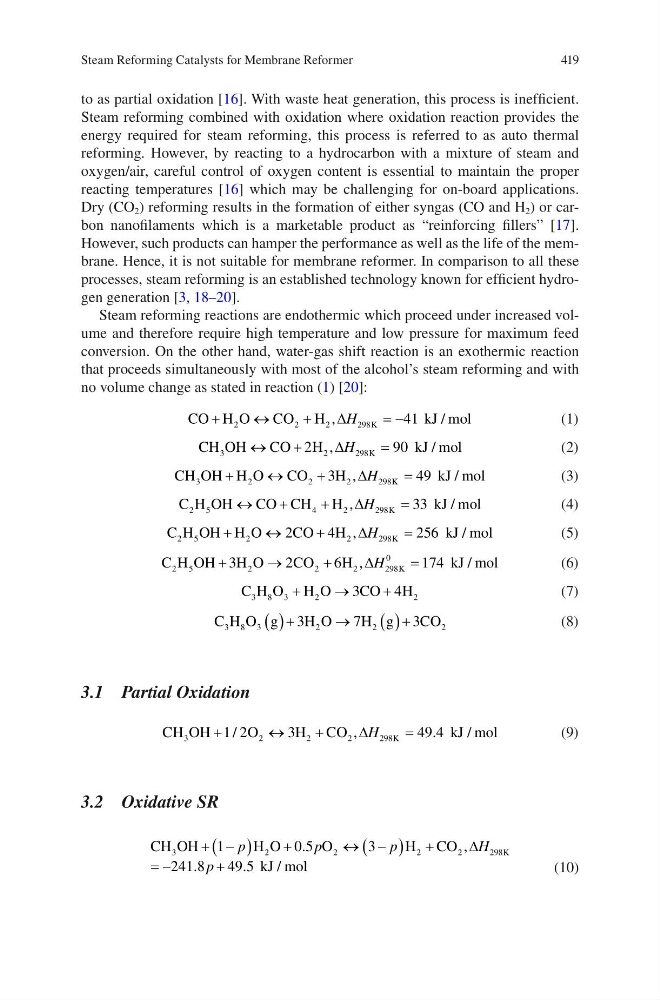
Steam reforming reactions are endothermic which proceed under increased volume and therefore require high temperature and low pressure for maximum feed
conversion. On the other hand, water-gas shift reaction is an exothermic reaction
that proceeds simultaneously with most of the alcohol’s steam reforming and with
no volume change as stated in reaction (1) [20]:
CO H O
CO H
kJ mol
K
+
«
+
=2
2
2
298
41
,
/
DH
(1)
CH OH
CO H
kJ mol
K
3
2
298
2
9 0
«
+
=
,
/
DH
(2)
CH OH H O
CO
H
kJ mol
K
3
2
2
2
298
3
4 9
+
«
+
=
,
/
DH
(3)
C H OH
CO CH H
kJ mol
K
2 5
4
2
298
33
«
+
+
=
,
/
DH
(4)
C H OH H O
CO H
kJ mol
K
2 5
2
2
298
2
4
256
+
«
+
=
,
/
DH
(5)
C H OH H O
CO
H
kJ mol
K
2 5
2
2
2
298
0
3
2
6
174
+
®
+
=
,
/
DH
(6)
C H O H O
CO H
3 8 3
2
2
3
4
+
®
+
(7)
C H O g
H O
H g
CO
3 8 3
2
2
2
3
7
3
( )+
®
( )+
(8)
3.1 Partial Oxidation
CH OH
O
H CO
k J mol
K
3
2
2
2
298
1 2
3
4 9 4
+
«
+
=
/
,
.
/
DH
(9)
3.2 Oxidative SR
CH OH
H O
O
H CO
kJ mo
K
3
2
2
2
2
298
1
05
3
241 8
49 5
+ -
( )
+
« -
(
) +
= -
+
p
p
p
H
p
.
,
.
.
/
D
l l
(10)
Steam Reforming Catalysts for Membrane Reformer
to as partial oxidation [16]. With waste heat generation, this process is inefficient.
Steam reforming combined with oxidation where oxidation reaction provides the
energy required for steam reforming, this process is referred to as auto thermal
reforming. However, by reacting to a hydrocarbon with a mixture of steam and
oxygen/air, careful control of oxygen content is essential to maintain the proper
reacting temperatures [16] which may be challenging for on-board applications.
Dry (CO 2 ) reforming results in the formation of either syngas (CO and H 2 ) or carbon nanofilaments which is a marketable product as “reinforcing fillers” [17].
However, such products can hamper the performance as well as the life of the membrane. Hence, it is not suitable for membrane reformer. In comparison to all these
processes, steam reforming is an established technology known for efficient hydrogen generation [3, 18–20].
Steam reforming reactions are endothermic which proceed under increased volume and therefore require high temperature and low pressure for maximum feed
conversion. On the other hand, water-gas shift reaction is an exothermic reaction
that proceeds simultaneously with most of the alcohol’s steam reforming and with
no volume change as stated in reaction (1) [20]:
CO H O
CO H
kJ mol
K
+
«
+
=2
2
2
298
41
,
/
DH
(1)
CH OH
CO H
kJ mol
K
3
2
298
2
9 0
«
+
=
,
/
DH
(2)
CH OH H O
CO
H
kJ mol
K
3
2
2
2
298
3
4 9
+
«
+
=
,
/
DH
(3)
C H OH
CO CH H
kJ mol
K
2 5
4
2
298
33
«
+
+
=
,
/
DH
(4)
C H OH H O
CO H
kJ mol
K
2 5
2
2
298
2
4
256
+
«
+
=
,
/
DH
(5)
C H OH H O
CO
H
kJ mol
K
2 5
2
2
2
298
0
3
2
6
174
+
®
+
=
,
/
DH
(6)
C H O H O
CO H
3 8 3
2
2
3
4
+
®
+
(7)
C H O g
H O
H g
CO
3 8 3
2
2
2
3
7
3
( )+
®
( )+
(8)
3.1 Partial Oxidation
CH OH
O
H CO
k J mol
K
3
2
2
2
298
1 2
3
4 9 4
+
«
+
=
/
,
.
/
DH
(9)
3.2 Oxidative SR
CH OH
H O
O
H CO
kJ mo
K
3
2
2
2
2
298
1
05
3
241 8
49 5
+ -
( )
+
« -
(
) +
= -
+
p
p
p
H
p
.
,
.
.
/
D
l l
(10)
Steam Reforming Catalysts for Membrane Reformer