

418
hydrogen perm selectivities and high hydrogen flux, (2) synthesis of the highly
active reforming catalyst with low CO selectivity even at high temperatures, (3)
low-temperature reforming catalysts for better integration of membrane reformer
with PEMFC, and (4) optimal arrangements of membrane and catalysts inside the
membrane reformer to achieve the desired performance. However, even after two
decades, most of these challenges are still unresolved and one needs to revisit and
modify all these steps for the commercialization of the membrane reformer. In this
book chapter, the focus is on required modification in traditional steam reforming
catalysts used for steam reforming of alcohols for their application in membrane
reformer.
3 Hydrogen Generation
Until the beginning of the renewable revolution, hydrogen has been typically recovered from gas streams where hydrogen presence is more such as gas streams at
refineries, petrochemicals plants, and ammonia plants. Normally, energy carriers
are not sources. They are produced from a primary energy source (feedstock) using
a technology. Hydrogen is a carrier; and its generation is usually accomplished
using natural gas, gasoline, methane, methanol, ethanol, and glycerol as feedstock,
by processes such as steam reforming, dry reforming, auto-thermal reforming, electrolysis, partial oxidation, cracking, etc. These processes are carried out in their
respective operating conditions, depending on their stoichiometry to produce H 2
accompanied with by-products such as CO, CO 2 , O 2 , C 2 H 4 , or CH 3 CHO, etc. [14].
Electrolysis dates back to the late 1920s when water as feedstock was first electrolyzed to produce hydrogen industrially; later water was replaced with fossil-based
feed. This process does not much have commercial impact due to the high electricity consumption (4.5–5 kW/m
3
H 2 ) [15] hindering its cost-effectiveness and carbon
formation in this process too continues to create a hazard. The reaction of primary
fuel with a quantity of oxygen inadequate for the fuel complete oxidation is referred
Pure H 2
Pump
Alcohol
Water
Mixture
CO 2 , H 2 O, etc.
Pre-heater
Catalyst bed
Membrane
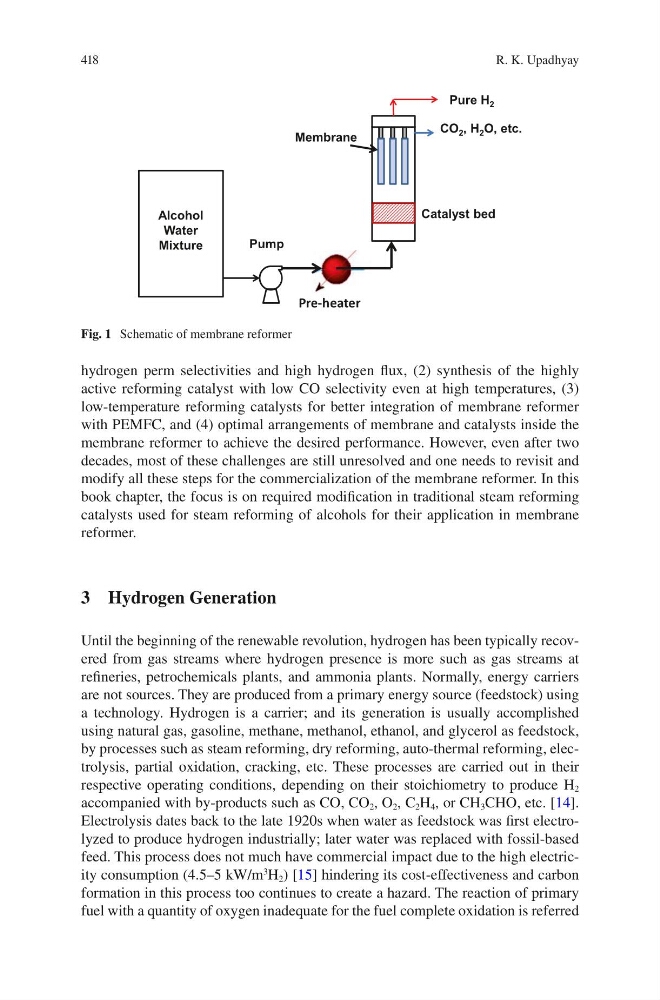
Fig. 1 Schematic of membrane reformer
R. K. Upadhyay
hydrogen perm selectivities and high hydrogen flux, (2) synthesis of the highly
active reforming catalyst with low CO selectivity even at high temperatures, (3)
low-temperature reforming catalysts for better integration of membrane reformer
with PEMFC, and (4) optimal arrangements of membrane and catalysts inside the
membrane reformer to achieve the desired performance. However, even after two
decades, most of these challenges are still unresolved and one needs to revisit and
modify all these steps for the commercialization of the membrane reformer. In this
book chapter, the focus is on required modification in traditional steam reforming
catalysts used for steam reforming of alcohols for their application in membrane
reformer.
3 Hydrogen Generation
Until the beginning of the renewable revolution, hydrogen has been typically recovered from gas streams where hydrogen presence is more such as gas streams at
refineries, petrochemicals plants, and ammonia plants. Normally, energy carriers
are not sources. They are produced from a primary energy source (feedstock) using
a technology. Hydrogen is a carrier; and its generation is usually accomplished
using natural gas, gasoline, methane, methanol, ethanol, and glycerol as feedstock,
by processes such as steam reforming, dry reforming, auto-thermal reforming, electrolysis, partial oxidation, cracking, etc. These processes are carried out in their
respective operating conditions, depending on their stoichiometry to produce H 2
accompanied with by-products such as CO, CO 2 , O 2 , C 2 H 4 , or CH 3 CHO, etc. [14].
Electrolysis dates back to the late 1920s when water as feedstock was first electrolyzed to produce hydrogen industrially; later water was replaced with fossil-based
feed. This process does not much have commercial impact due to the high electricity consumption (4.5–5 kW/m
3
H 2 ) [15] hindering its cost-effectiveness and carbon
formation in this process too continues to create a hazard. The reaction of primary
fuel with a quantity of oxygen inadequate for the fuel complete oxidation is referred
Pure H 2
Pump
Alcohol
Water
Mixture
CO 2 , H 2 O, etc.
Pre-heater
Catalyst bed
Membrane
Fig. 1 Schematic of membrane reformer
R. K. Upadhyay