

420
3.3 Dry Reforming
CH CO
H
CO
kJ mol
K
4
2
2
298
2
2
247 3
+
«
+
=
;
.
/
DH
(11)
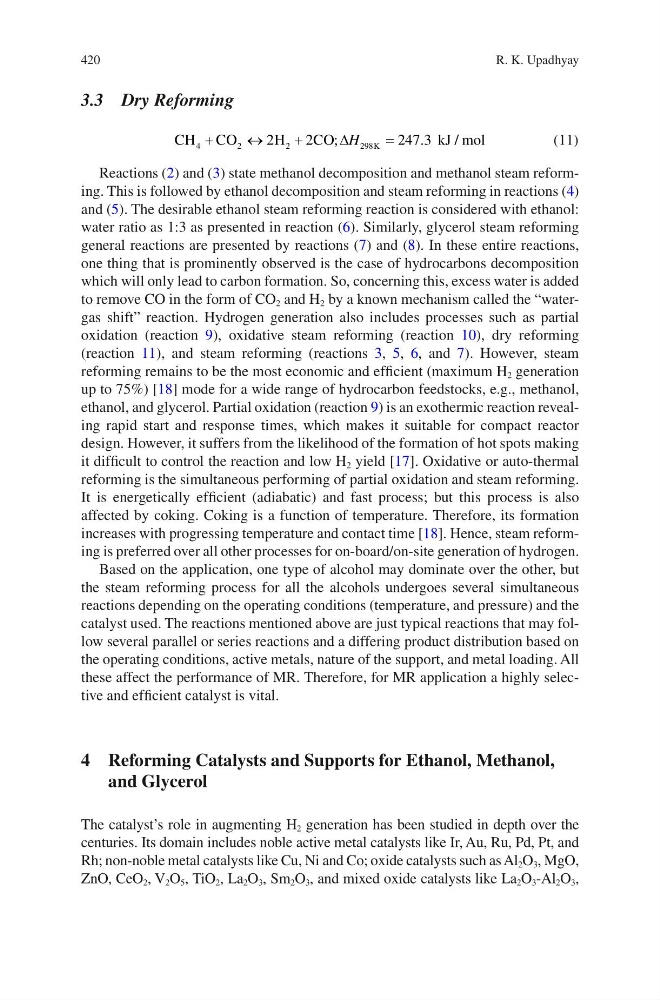
Reactions (2) and (3) state methanol decomposition and methanol steam reforming. This is followed by ethanol decomposition and steam reforming in reactions (4)
and (5). The desirable ethanol steam reforming reaction is considered with ethanol:
water ratio as 1:3 as presented in reaction (6). Similarly, glycerol steam reforming
general reactions are presented by reactions (7) and (8). In these entire reactions,
one thing that is prominently observed is the case of hydrocarbons decomposition
which will only lead to carbon formation. So, concerning this, excess water is added
to remove CO in the form of CO 2 and H 2 by a known mechanism called the “watergas shift” reaction. Hydrogen generation also includes processes such as partial
oxidation (reaction 9), oxidative steam reforming (reaction 10), dry reforming
(reaction 11), and steam reforming (reactions 3, 5, 6, and 7). However, steam
reforming remains to be the most economic and efficient (maximum H 2 generation
up to 75%) [18] mode for a wide range of hydrocarbon feedstocks, e.g., methanol,
ethanol, and glycerol. Partial oxidation (reaction 9) is an exothermic reaction revealing rapid start and response times, which makes it suitable for compact reactor
design. However, it suffers from the likelihood of the formation of hot spots making
it difficult to control the reaction and low H 2 yield [17]. Oxidative or auto-thermal
reforming is the simultaneous performing of partial oxidation and steam reforming.
It is energetically efficient (adiabatic) and fast process; but this process is also
affected by coking. Coking is a function of temperature. Therefore, its formation
increases with progressing temperature and contact time [18]. Hence, steam reforming is preferred over all other processes for on-board/on-site generation of hydrogen.
Based on the application, one type of alcohol may dominate over the other, but
the steam reforming process for all the alcohols undergoes several simultaneous
reactions depending on the operating conditions (temperature, and pressure) and the
catalyst used. The reactions mentioned above are just typical reactions that may follow several parallel or series reactions and a differing product distribution based on
the operating conditions, active metals, nature of the support, and metal loading. All
these affect the performance of MR. Therefore, for MR application a highly selective and efficient catalyst is vital.
4 Reforming Catalysts and Supports for Ethanol, Methanol,
and Glycerol
The catalyst’s role in augmenting H 2 generation has been studied in depth over the
centuries. Its domain includes noble active metal catalysts like Ir, Au, Ru, Pd, Pt, and
Rh; non-noble metal catalysts like Cu, Ni and Co; oxide catalysts such as Al 2 O 3 , MgO,
ZnO, CeO 2 , V 2 O 5 , TiO 2 , La 2 O 3 , Sm 2 O 3 , and mixed oxide catalysts like La 2 O 3 -Al 2 O 3 ,
R. K. Upadhyay
3.3 Dry Reforming
CH CO
H
CO
kJ mol
K
4
2
2
298
2
2
247 3
+
«
+
=
;
.
/
DH
(11)
Reactions (2) and (3) state methanol decomposition and methanol steam reforming. This is followed by ethanol decomposition and steam reforming in reactions (4)
and (5). The desirable ethanol steam reforming reaction is considered with ethanol:
water ratio as 1:3 as presented in reaction (6). Similarly, glycerol steam reforming
general reactions are presented by reactions (7) and (8). In these entire reactions,
one thing that is prominently observed is the case of hydrocarbons decomposition
which will only lead to carbon formation. So, concerning this, excess water is added
to remove CO in the form of CO 2 and H 2 by a known mechanism called the “watergas shift” reaction. Hydrogen generation also includes processes such as partial
oxidation (reaction 9), oxidative steam reforming (reaction 10), dry reforming
(reaction 11), and steam reforming (reactions 3, 5, 6, and 7). However, steam
reforming remains to be the most economic and efficient (maximum H 2 generation
up to 75%) [18] mode for a wide range of hydrocarbon feedstocks, e.g., methanol,
ethanol, and glycerol. Partial oxidation (reaction 9) is an exothermic reaction revealing rapid start and response times, which makes it suitable for compact reactor
design. However, it suffers from the likelihood of the formation of hot spots making
it difficult to control the reaction and low H 2 yield [17]. Oxidative or auto-thermal
reforming is the simultaneous performing of partial oxidation and steam reforming.
It is energetically efficient (adiabatic) and fast process; but this process is also
affected by coking. Coking is a function of temperature. Therefore, its formation
increases with progressing temperature and contact time [18]. Hence, steam reforming is preferred over all other processes for on-board/on-site generation of hydrogen.
Based on the application, one type of alcohol may dominate over the other, but
the steam reforming process for all the alcohols undergoes several simultaneous
reactions depending on the operating conditions (temperature, and pressure) and the
catalyst used. The reactions mentioned above are just typical reactions that may follow several parallel or series reactions and a differing product distribution based on
the operating conditions, active metals, nature of the support, and metal loading. All
these affect the performance of MR. Therefore, for MR application a highly selective and efficient catalyst is vital.
4 Reforming Catalysts and Supports for Ethanol, Methanol,
and Glycerol
The catalyst’s role in augmenting H 2 generation has been studied in depth over the
centuries. Its domain includes noble active metal catalysts like Ir, Au, Ru, Pd, Pt, and
Rh; non-noble metal catalysts like Cu, Ni and Co; oxide catalysts such as Al 2 O 3 , MgO,
ZnO, CeO 2 , V 2 O 5 , TiO 2 , La 2 O 3 , Sm 2 O 3 , and mixed oxide catalysts like La 2 O 3 -Al 2 O 3 ,
R. K. Upadhyay