

390
conventional zeolites properties such as the compositional range, matrix-zeolite
interactions quality, exterior activity of zeolite, or by focusing on the synthesis,
advancement, and commercialization of pristine materials to suit particular selectivity, catalytic activity, and durability. Consequently, industrial research and development are engrossed in developing extremely selective catalysts that can function for
longer periods and stand for the presence of trace contaminants.
2.1 Zeolitic Catalysts Used in Various Processes
The advancement of pristine zeolite catalysts have influenced the core catalytic processes of petroleum refining such as FCC, hydrocracking, and hydroprocessing [28].
2.1.1 FCC Catalysts
FCC catalyst like ZSM-5 focuses on bottoms upgrading, light olefin production,
yield improvement, and desulfurization. For achieving the main objective of FCC
process, associated research continued to focus on the development of ZSM-5
activity and hydrothermal stability by including phosphorus and other elements
[5]. Decade’s long research have led to synthesis of non-organic forms of ZSM-5
and various improvements in the zeolite, additive matrix, and binder formulations. These optimizations have also reduced cost and improved the effectiveness.
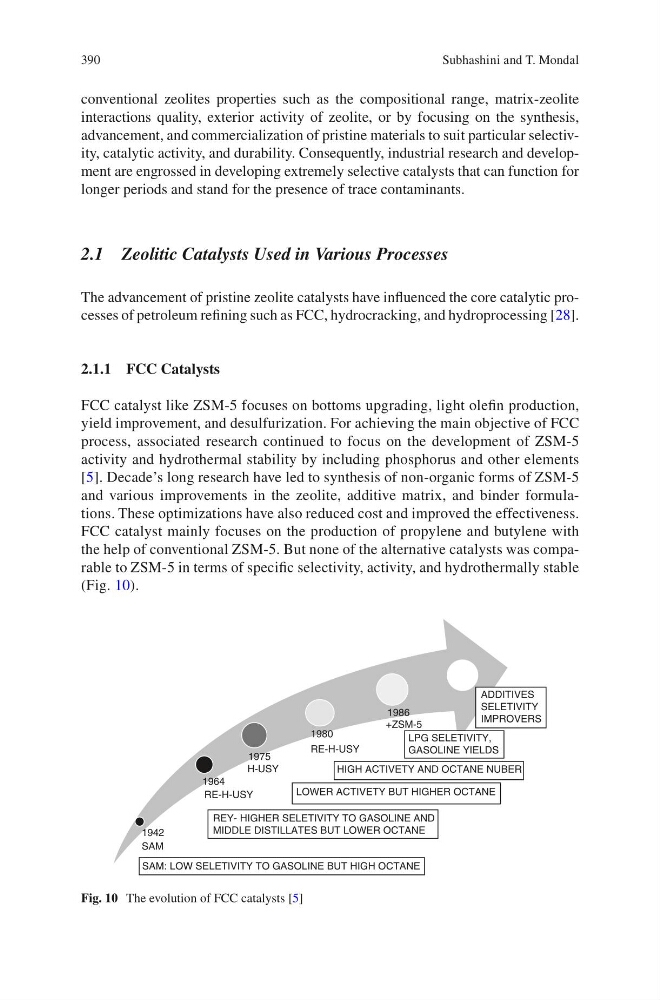
FCC catalyst mainly focuses on the production of propylene and butylene with
the help of conventional ZSM-5. But none of the alternative catalysts was comparable to ZSM-5 in terms of specific selectivity, activity, and hydrothermally stable
(Fig. 10).
1986
1980
+ZSM-5
RE-H-USY
1975
H-USY
1964
RE-H-USY
1942
SAM
ADDITIVES
SELETIVITY
IMPROVERS
LPG SELETIVITY,
GASOLINE YIELDS
REY- HIGHER SELETIVITY TO GASOLINE AND
MIDDLE DISTILLATES BUT LOWER OCTANE
SAM: LOW SELETIVITY TO GASOLINE BUT HIGH OCTANE
HIGH ACTIVETY AND OCTANE NUBER
LOWER ACTIVETY BUT HIGHER OCTANE
Fig. 10 The evolution of FCC catalysts [5]
Subhashini and T. Mondal
conventional zeolites properties such as the compositional range, matrix-zeolite
interactions quality, exterior activity of zeolite, or by focusing on the synthesis,
advancement, and commercialization of pristine materials to suit particular selectivity, catalytic activity, and durability. Consequently, industrial research and development are engrossed in developing extremely selective catalysts that can function for
longer periods and stand for the presence of trace contaminants.
2.1 Zeolitic Catalysts Used in Various Processes
The advancement of pristine zeolite catalysts have influenced the core catalytic processes of petroleum refining such as FCC, hydrocracking, and hydroprocessing [28].
2.1.1 FCC Catalysts
FCC catalyst like ZSM-5 focuses on bottoms upgrading, light olefin production,
yield improvement, and desulfurization. For achieving the main objective of FCC
process, associated research continued to focus on the development of ZSM-5
activity and hydrothermal stability by including phosphorus and other elements
[5]. Decade’s long research have led to synthesis of non-organic forms of ZSM-5
and various improvements in the zeolite, additive matrix, and binder formulations. These optimizations have also reduced cost and improved the effectiveness.
FCC catalyst mainly focuses on the production of propylene and butylene with
the help of conventional ZSM-5. But none of the alternative catalysts was comparable to ZSM-5 in terms of specific selectivity, activity, and hydrothermally stable
(Fig. 10).
1986
1980
+ZSM-5
RE-H-USY
1975
H-USY
1964
RE-H-USY
1942
SAM
ADDITIVES
SELETIVITY
IMPROVERS
LPG SELETIVITY,
GASOLINE YIELDS
REY- HIGHER SELETIVITY TO GASOLINE AND
MIDDLE DISTILLATES BUT LOWER OCTANE
SAM: LOW SELETIVITY TO GASOLINE BUT HIGH OCTANE
HIGH ACTIVETY AND OCTANE NUBER
LOWER ACTIVETY BUT HIGHER OCTANE
Fig. 10 The evolution of FCC catalysts [5]
Subhashini and T. Mondal