

391
2.1.2 Zeolitic Hydrocracking Catalysts
The conventional catalysts used in hydrocracking processes are bifunctional in
nature. Since the process demands simultaneous hydrogenation and dehydrogenation the refineries have focused on converting bifunctional catalysts from amorphous to zeolite-based catalysts. The various advantages of zeolite-based
hydrocracking catalysts are higher activity, specific selectivity, thermal stability,
resistance to poisons and impurities, and lower coking rate [23]. Recently the use of
supremely dealuminated USY zeolites and NiMo/MCM-41 has allowed the zeolites
to nudge the desired distillate selectivity along with better nitrogen tolerance and
cycle lengths as compared with that of the conventional amorphous hydrocracking
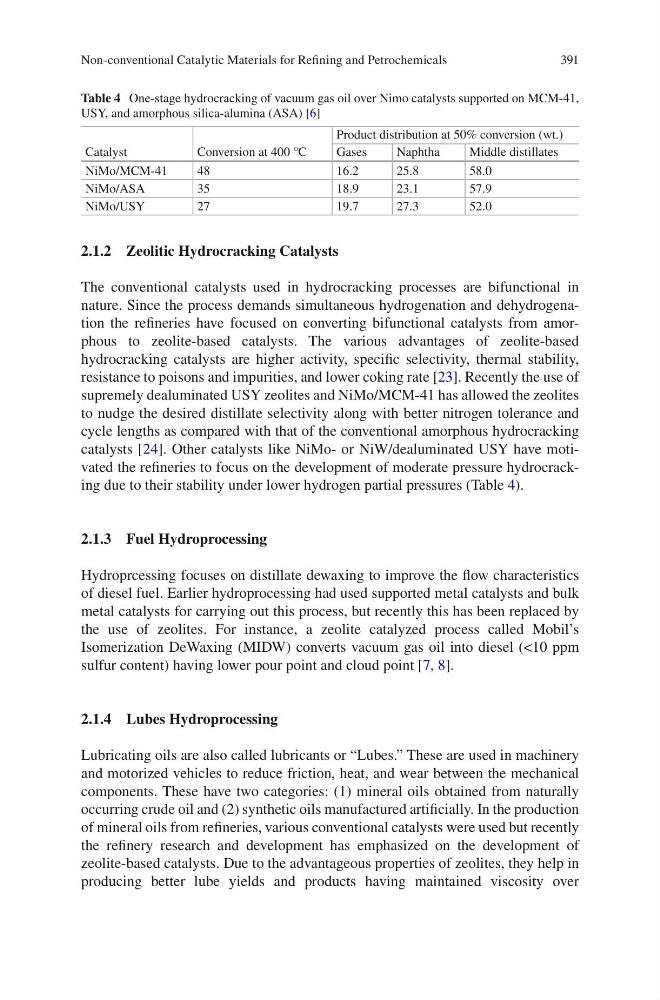
catalysts [24]. Other catalysts like NiMo- or NiW/dealuminated USY have motivated the refineries to focus on the development of moderate pressure hydrocracking due to their stability under lower hydrogen partial pressures (Table 4).
2.1.3 Fuel Hydroprocessing
Hydroprcessing focuses on distillate dewaxing to improve the flow characteristics
of diesel fuel. Earlier hydroprocessing had used supported metal catalysts and bulk
metal catalysts for carrying out this process, but recently this has been replaced by
the use of zeolites. For instance, a zeolite catalyzed process called Mobil’s
Isomerization DeWaxing (MIDW) converts vacuum gas oil into diesel (<10 ppm
sulfur content) having lower pour point and cloud point [7, 8].
2.1.4 Lubes Hydroprocessing
Lubricating oils are also called lubricants or “Lubes.” These are used in machinery
and motorized vehicles to reduce friction, heat, and wear between the mechanical
components. These have two categories: (1) mineral oils obtained from naturally
occurring crude oil and (2) synthetic oils manufactured artificially. In the production
of mineral oils from refineries, various conventional catalysts were used but recently
the refinery research and development has emphasized on the development of
zeolite- based catalysts. Due to the advantageous properties of zeolites, they help in
producing better lube yields and products having maintained viscosity over
Table 4 One-stage hydrocracking of vacuum gas oil over Nimo catalysts supported on MCM-41,
USY, and amorphous silica-alumina (ASA) [6]
Catalyst
Conversion at 400 °C
Product distribution at 50% conversion (wt.)
Gases
Naphtha
Middle distillates
NiMo/MCM-41
48
16.2
25.8
58.0
NiMo/ASA
35
18.9
23.1
57.9
NiMo/USY
27
19.7
27.3
52.0
Non-conventional Catalytic Materials for Refining and Petrochemicals
2.1.2 Zeolitic Hydrocracking Catalysts
The conventional catalysts used in hydrocracking processes are bifunctional in
nature. Since the process demands simultaneous hydrogenation and dehydrogenation the refineries have focused on converting bifunctional catalysts from amorphous to zeolite-based catalysts. The various advantages of zeolite-based
hydrocracking catalysts are higher activity, specific selectivity, thermal stability,
resistance to poisons and impurities, and lower coking rate [23]. Recently the use of
supremely dealuminated USY zeolites and NiMo/MCM-41 has allowed the zeolites
to nudge the desired distillate selectivity along with better nitrogen tolerance and
cycle lengths as compared with that of the conventional amorphous hydrocracking
catalysts [24]. Other catalysts like NiMo- or NiW/dealuminated USY have motivated the refineries to focus on the development of moderate pressure hydrocracking due to their stability under lower hydrogen partial pressures (Table 4).
2.1.3 Fuel Hydroprocessing
Hydroprcessing focuses on distillate dewaxing to improve the flow characteristics
of diesel fuel. Earlier hydroprocessing had used supported metal catalysts and bulk
metal catalysts for carrying out this process, but recently this has been replaced by
the use of zeolites. For instance, a zeolite catalyzed process called Mobil’s
Isomerization DeWaxing (MIDW) converts vacuum gas oil into diesel (<10 ppm
sulfur content) having lower pour point and cloud point [7, 8].
2.1.4 Lubes Hydroprocessing
Lubricating oils are also called lubricants or “Lubes.” These are used in machinery
and motorized vehicles to reduce friction, heat, and wear between the mechanical
components. These have two categories: (1) mineral oils obtained from naturally
occurring crude oil and (2) synthetic oils manufactured artificially. In the production
of mineral oils from refineries, various conventional catalysts were used but recently
the refinery research and development has emphasized on the development of
zeolite- based catalysts. Due to the advantageous properties of zeolites, they help in
producing better lube yields and products having maintained viscosity over
Table 4 One-stage hydrocracking of vacuum gas oil over Nimo catalysts supported on MCM-41,
USY, and amorphous silica-alumina (ASA) [6]
Catalyst
Conversion at 400 °C
Product distribution at 50% conversion (wt.)
Gases
Naphtha
Middle distillates
NiMo/MCM-41
48
16.2
25.8
58.0
NiMo/ASA
35
18.9
23.1
57.9
NiMo/USY
27
19.7
27.3
52.0
Non-conventional Catalytic Materials for Refining and Petrochemicals