

386
further conversion into transportation fuel blending stocks. The ARC undergoes
extended processing in catalytic cracking units and hydroprocessing units, whereas
the delayed coking and solvent extraction (or Flexicoking) are certain thermal
cracking processes used for converting VRC feedstocks into more simpler and
desired range products (Fig. 6).
1.6 Hydrotreating
The process of treating petroleum products with hydrogen to make them catalytically stable and/or removing the contaminant is known as hydrotreating. Petroleum
products are stabilized by converting the unstable double bonds (C=C) and triple
bonds (C≡C) into stable single (C–C) bonds, for example, converting alkenes and
gum-forming unstable diolefins to paraffin. Sulfur, nitrogen, oxygen, halides, and
certain trace metals are some of the impurities removed by hydrotreating [16].
A broad domain of feedstocks like from naphtha to reduced crude can be treated by
hydrotreating. Employing a hydrotreating process specifically for sulfur removal
from crude is known as hydrodesulphurization(HDS). Usually the aromatic content
present in crude causes environmental pollution; hence their concentration must be
controlled. These limitations make it necessary to hydrogenate aromatic rings present in crude oil and thereby reduce the aromatic content of crude oil by converting
aromatics to paraffin. Hydrotreating uses different catalysts for catalytically stabilizing the various feedstocks. A few examples of hydrotreating catalysts are oxides
of cobalt and molybdenum on alumina, oxide of nickel and vanadium, nickel
thiomolybdate, sulfides of tungsten and nickel, and vanadium oxide [4]. The cobalt
and molybdenum oxides on alumina catalysts are commonly used hydrotreating
H 2 MAKEUP
H 2 RECYCLE
FEED
H 2 MAKEUP
H 2 RECYCLE
GAS
C1 – C4, LSR
NAPHTHA
DIESEL
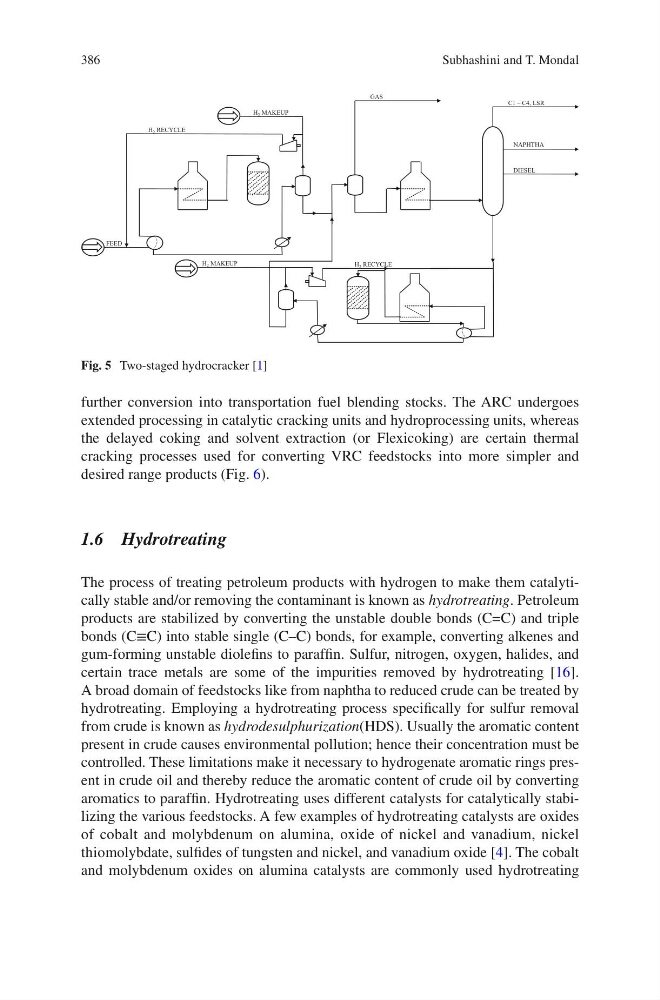
Fig. 5 Two-staged hydrocracker [1]
Subhashini and T. Mondal
further conversion into transportation fuel blending stocks. The ARC undergoes
extended processing in catalytic cracking units and hydroprocessing units, whereas
the delayed coking and solvent extraction (or Flexicoking) are certain thermal
cracking processes used for converting VRC feedstocks into more simpler and
desired range products (Fig. 6).
1.6 Hydrotreating
The process of treating petroleum products with hydrogen to make them catalytically stable and/or removing the contaminant is known as hydrotreating. Petroleum
products are stabilized by converting the unstable double bonds (C=C) and triple
bonds (C≡C) into stable single (C–C) bonds, for example, converting alkenes and
gum-forming unstable diolefins to paraffin. Sulfur, nitrogen, oxygen, halides, and
certain trace metals are some of the impurities removed by hydrotreating [16].
A broad domain of feedstocks like from naphtha to reduced crude can be treated by
hydrotreating. Employing a hydrotreating process specifically for sulfur removal
from crude is known as hydrodesulphurization(HDS). Usually the aromatic content
present in crude causes environmental pollution; hence their concentration must be
controlled. These limitations make it necessary to hydrogenate aromatic rings present in crude oil and thereby reduce the aromatic content of crude oil by converting
aromatics to paraffin. Hydrotreating uses different catalysts for catalytically stabilizing the various feedstocks. A few examples of hydrotreating catalysts are oxides
of cobalt and molybdenum on alumina, oxide of nickel and vanadium, nickel
thiomolybdate, sulfides of tungsten and nickel, and vanadium oxide [4]. The cobalt
and molybdenum oxides on alumina catalysts are commonly used hydrotreating
H 2 MAKEUP
H 2 RECYCLE
FEED
H 2 MAKEUP
H 2 RECYCLE
GAS
C1 – C4, LSR
NAPHTHA
DIESEL
Fig. 5 Two-staged hydrocracker [1]
Subhashini and T. Mondal