

385
• Higher demand for lighter petroleum products, i.e., gasoline and jet fuel instead
of diesel fuel and home heating oils
• Availability of cheaper hydrogen production in large amounts from catalytic
reforming
• New environmental regulations demanding lower limits of sulfur and aromatic
contents in motor fuels
Various process conditions such as operations at lower pressure, desired product
specifications, and catalysts are under continuous evolving stage to bring out the
required conversion of higher-boiling fractions.
A few advantages of hydrocracking process are:
• Improved gasoline yield
• Improved octane quality and sensitivity of gasoline pool
• Higher yield of isobutane in butane fraction
• Substitute to the fluid catalytic cracking for upgradation of heavy cracking cuts
into valuable gasoline and lighter fuel oils
Catalytic cracking and hydrocracking are considered to be the two sides of a coin
in modern refineries. The catalytic cracking uses atmospheric cracked paraffin and
vacuum gas oils for their feedstock. However, in case of hydrocracking, the feedstocks are aromatic cycle oils and coking unit distillates. The aromatic cycle oils
and coker distillates resist catalytic cracking. But these can be hydrocracked very
easily under higher pressures and hydrogen atmosphere (Fig. 5).
1.5 Hydroprocessing and Resid Processing
The atmospheric tower bottoms and vacuum tower bottoms with their initial boiling
points as 343 °C and 566 °C respectively are called “resids.” The resids contain
sulfur, nitrogen, and metals in greater concentrations as compared with that contained in the feedstock crude oil, and contain hydrocarbons in very much lower
ratios. The concentrations of sulfur, nitrogen, and metals are even higher in the
vacuum-reduced crude (VRC) as compared to atmospheric reduced crude (ARC).
Stern environmental regulations and emission norms have made the application of
heavy oils for fuels very tough and expensive. Therefore, the heavy oils must be
converted into feedstocks for several refining processes that will supplement their
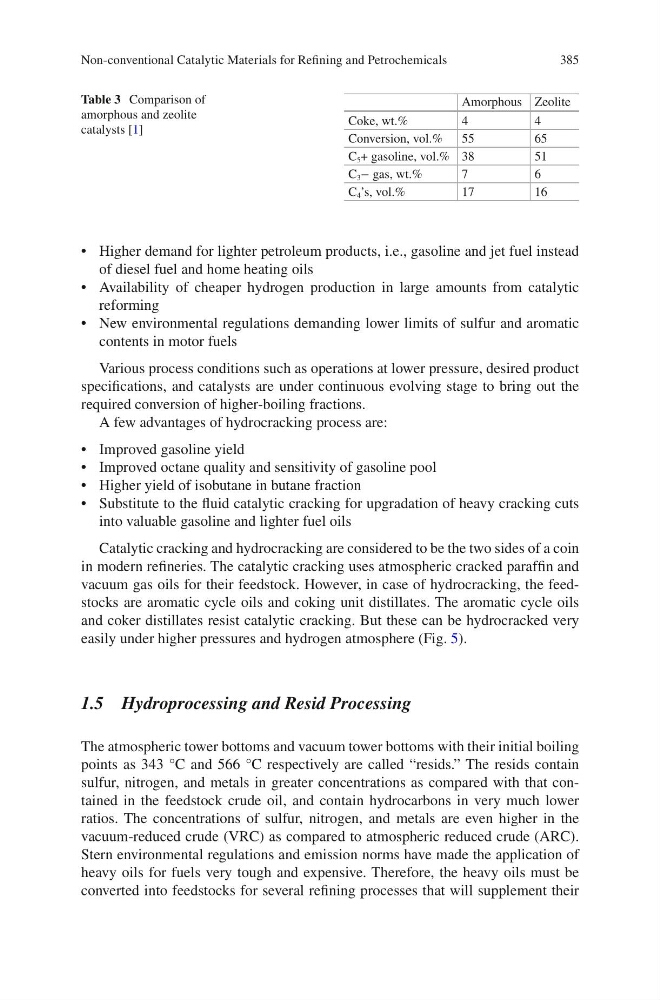
Table 3 Comparison of
amorphous and zeolite
catalysts [1]
Amorphous Zeolite
Coke, wt.%
4
4
Conversion, vol.% 55
65
C 5 + gasoline, vol.% 38
51
C 3 − gas, wt.%
7
6
C 4 ’s, vol.%
17
16
Non-conventional Catalytic Materials for Refining and Petrochemicals
• Higher demand for lighter petroleum products, i.e., gasoline and jet fuel instead
of diesel fuel and home heating oils
• Availability of cheaper hydrogen production in large amounts from catalytic
reforming
• New environmental regulations demanding lower limits of sulfur and aromatic
contents in motor fuels
Various process conditions such as operations at lower pressure, desired product
specifications, and catalysts are under continuous evolving stage to bring out the
required conversion of higher-boiling fractions.
A few advantages of hydrocracking process are:
• Improved gasoline yield
• Improved octane quality and sensitivity of gasoline pool
• Higher yield of isobutane in butane fraction
• Substitute to the fluid catalytic cracking for upgradation of heavy cracking cuts
into valuable gasoline and lighter fuel oils
Catalytic cracking and hydrocracking are considered to be the two sides of a coin
in modern refineries. The catalytic cracking uses atmospheric cracked paraffin and
vacuum gas oils for their feedstock. However, in case of hydrocracking, the feedstocks are aromatic cycle oils and coking unit distillates. The aromatic cycle oils
and coker distillates resist catalytic cracking. But these can be hydrocracked very
easily under higher pressures and hydrogen atmosphere (Fig. 5).
1.5 Hydroprocessing and Resid Processing
The atmospheric tower bottoms and vacuum tower bottoms with their initial boiling
points as 343 °C and 566 °C respectively are called “resids.” The resids contain
sulfur, nitrogen, and metals in greater concentrations as compared with that contained in the feedstock crude oil, and contain hydrocarbons in very much lower
ratios. The concentrations of sulfur, nitrogen, and metals are even higher in the
vacuum-reduced crude (VRC) as compared to atmospheric reduced crude (ARC).
Stern environmental regulations and emission norms have made the application of
heavy oils for fuels very tough and expensive. Therefore, the heavy oils must be
converted into feedstocks for several refining processes that will supplement their
Table 3 Comparison of
amorphous and zeolite
catalysts [1]
Amorphous Zeolite
Coke, wt.%
4
4
Conversion, vol.% 55
65
C 5 + gasoline, vol.% 38
51
C 3 − gas, wt.%
7
6
C 4 ’s, vol.%
17
16
Non-conventional Catalytic Materials for Refining and Petrochemicals