

384
1.3 Catalytic Cracking
The conversion of heavy oils into valuable and lighter products like gasoline is done
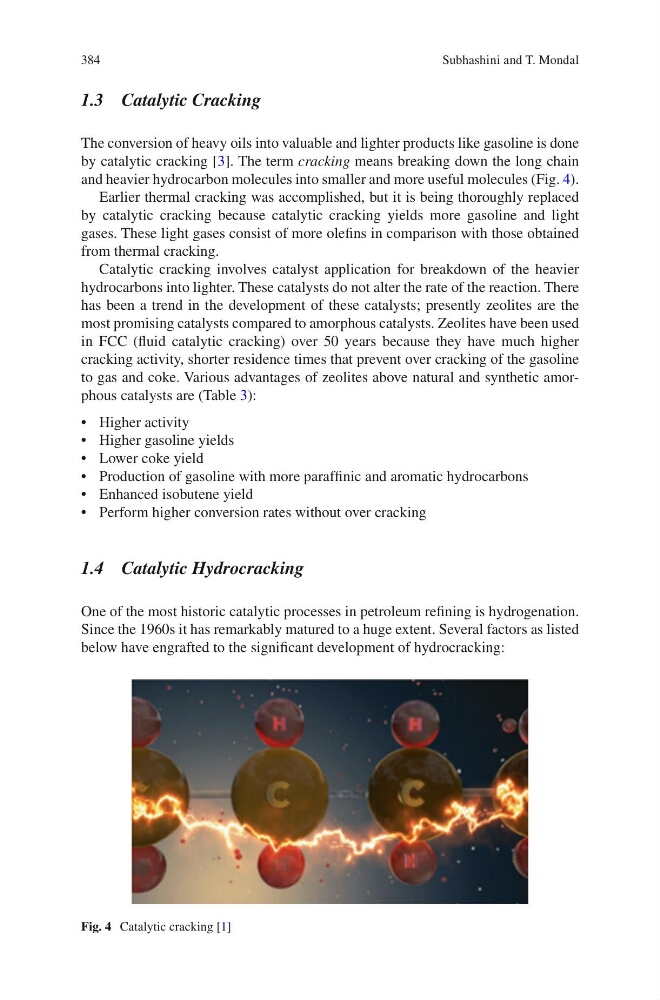
by catalytic cracking [3]. The term cracking means breaking down the long chain
and heavier hydrocarbon molecules into smaller and more useful molecules (Fig. 4).
Earlier thermal cracking was accomplished, but it is being thoroughly replaced
by catalytic cracking because catalytic cracking yields more gasoline and light
gases. These light gases consist of more olefins in comparison with those obtained
from thermal cracking.
Catalytic cracking involves catalyst application for breakdown of the heavier
hydrocarbons into lighter. These catalysts do not alter the rate of the reaction. There
has been a trend in the development of these catalysts; presently zeolites are the
most promising catalysts compared to amorphous catalysts. Zeolites have been used
in FCC (fluid catalytic cracking) over 50 years because they have much higher
cracking activity, shorter residence times that prevent over cracking of the gasoline
to gas and coke. Various advantages of zeolites above natural and synthetic amorphous catalysts are (Table 3):
• Higher activity
• Higher gasoline yields
• Lower coke yield
• Production of gasoline with more paraffinic and aromatic hydrocarbons
• Enhanced isobutene yield
• Perform higher conversion rates without over cracking
1.4 Catalytic Hydrocracking
One of the most historic catalytic processes in petroleum refining is hydrogenation.
Since the 1960s it has remarkably matured to a huge extent. Several factors as listed
below have engrafted to the significant development of hydrocracking:
Fig. 4 Catalytic cracking [1]
Subhashini and T. Mondal
1.3 Catalytic Cracking
The conversion of heavy oils into valuable and lighter products like gasoline is done
by catalytic cracking [3]. The term cracking means breaking down the long chain
and heavier hydrocarbon molecules into smaller and more useful molecules (Fig. 4).
Earlier thermal cracking was accomplished, but it is being thoroughly replaced
by catalytic cracking because catalytic cracking yields more gasoline and light
gases. These light gases consist of more olefins in comparison with those obtained
from thermal cracking.
Catalytic cracking involves catalyst application for breakdown of the heavier
hydrocarbons into lighter. These catalysts do not alter the rate of the reaction. There
has been a trend in the development of these catalysts; presently zeolites are the
most promising catalysts compared to amorphous catalysts. Zeolites have been used
in FCC (fluid catalytic cracking) over 50 years because they have much higher
cracking activity, shorter residence times that prevent over cracking of the gasoline
to gas and coke. Various advantages of zeolites above natural and synthetic amorphous catalysts are (Table 3):
• Higher activity
• Higher gasoline yields
• Lower coke yield
• Production of gasoline with more paraffinic and aromatic hydrocarbons
• Enhanced isobutene yield
• Perform higher conversion rates without over cracking
1.4 Catalytic Hydrocracking
One of the most historic catalytic processes in petroleum refining is hydrogenation.
Since the 1960s it has remarkably matured to a huge extent. Several factors as listed
below have engrafted to the significant development of hydrocracking:
Fig. 4 Catalytic cracking [1]
Subhashini and T. Mondal