

383
energy and electric supply for heavy industries. Due to the various limitations of
heavier fraction feedstocks, these industries have also initiated to shift towards
lighter fraction feedstock such as natural gas. Hence, heavier fractions obtained
from distillation are further processed to convert into lighter fractions. This conversion of heavier fractions into lighter fractions is aided by the cooking process. The
by-product of the coking process is coke formation that primarily contains carbon.
Coking is generally used to pre-treat vacuum residuals to prepare them a suitable
feedstock for catalytic crackers and hydrocrackers. There are different types of
cokes obtained during delayed coking process:
• Sponge coke—it is hard, porous, asymmetrical shaped lumps with particles size
ranging from 20 in. to fine dust. Since it looks like a black sponge, it is called
sponge coke.
• Needle coke—it is obtained from feedstocks with high aromatic content under
high pressure (100 psig) and high recycle ratios (1:1). Since it appears to be an
elongated crystalline structure, it is called needle coke. Needle coke shows lower
electrical resistivity and has a lower thermal expansion coefficient; therefore, it
is preferred over sponge coke by electrode manufacturing industries.
• Shot coke—it is produced while processing very heavy residuals or during operational upsets. It has a characteristic shape of clusters of shot sized pellets.
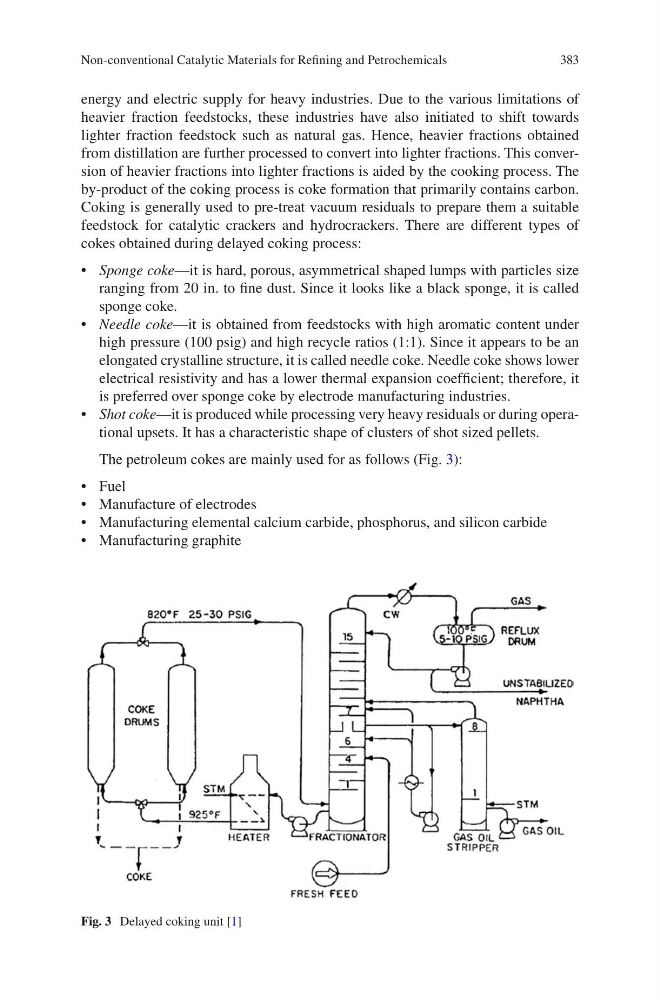
The petroleum cokes are mainly used for as follows (Fig. 3):
• Fuel
• Manufacture of electrodes
• Manufacturing elemental calcium carbide, phosphorus, and silicon carbide
• Manufacturing graphite
Fig. 3 Delayed coking unit [1]
Non-conventional Catalytic Materials for Refining and Petrochemicals
energy and electric supply for heavy industries. Due to the various limitations of
heavier fraction feedstocks, these industries have also initiated to shift towards
lighter fraction feedstock such as natural gas. Hence, heavier fractions obtained
from distillation are further processed to convert into lighter fractions. This conversion of heavier fractions into lighter fractions is aided by the cooking process. The
by-product of the coking process is coke formation that primarily contains carbon.
Coking is generally used to pre-treat vacuum residuals to prepare them a suitable
feedstock for catalytic crackers and hydrocrackers. There are different types of
cokes obtained during delayed coking process:
• Sponge coke—it is hard, porous, asymmetrical shaped lumps with particles size
ranging from 20 in. to fine dust. Since it looks like a black sponge, it is called
sponge coke.
• Needle coke—it is obtained from feedstocks with high aromatic content under
high pressure (100 psig) and high recycle ratios (1:1). Since it appears to be an
elongated crystalline structure, it is called needle coke. Needle coke shows lower
electrical resistivity and has a lower thermal expansion coefficient; therefore, it
is preferred over sponge coke by electrode manufacturing industries.
• Shot coke—it is produced while processing very heavy residuals or during operational upsets. It has a characteristic shape of clusters of shot sized pellets.
The petroleum cokes are mainly used for as follows (Fig. 3):
• Fuel
• Manufacture of electrodes
• Manufacturing elemental calcium carbide, phosphorus, and silicon carbide
• Manufacturing graphite
Fig. 3 Delayed coking unit [1]
Non-conventional Catalytic Materials for Refining and Petrochemicals