

382
• Gas oils—The gas oils are used to produce gasoline, diesel, and jet fuels in a
hydrocracker/catalytic cracker unit. In addition, the lubricating oils producing
processing units use heavier vacuum gas oils as their feedstocks.
• Residuum—The lube base stocks and heavy fuel oil are obtained from vacuum
still bottoms by further processing them in various units like visbreaker, deasphalting, or coker. The deasphalting unit’s product can be further processed to
obtain different grades of asphalt crudes. These asphalt crudes can be used in
roads and roofing.
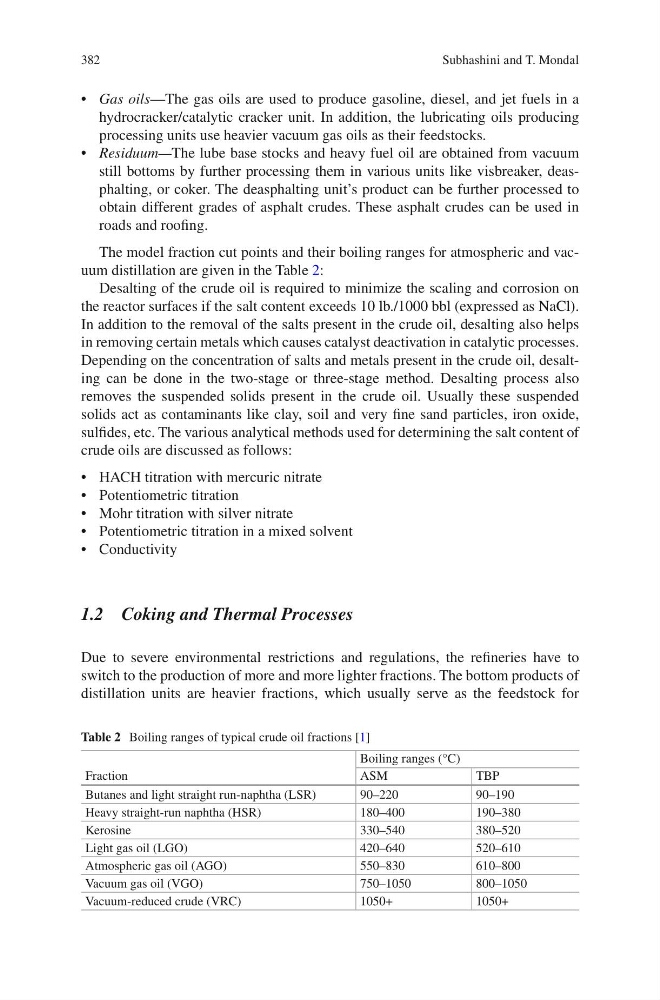
The model fraction cut points and their boiling ranges for atmospheric and vacuum distillation are given in the Table 2:
Desalting of the crude oil is required to minimize the scaling and corrosion on
the reactor surfaces if the salt content exceeds 10 lb./1000 bbl (expressed as NaCl).
In addition to the removal of the salts present in the crude oil, desalting also helps
in removing certain metals which causes catalyst deactivation in catalytic processes.
Depending on the concentration of salts and metals present in the crude oil, desalting can be done in the two-stage or three-stage method. Desalting process also
removes the suspended solids present in the crude oil. Usually these suspended
solids act as contaminants like clay, soil and very fine sand particles, iron oxide,
sulfides, etc. The various analytical methods used for determining the salt content of
crude oils are discussed as follows:
• HACH titration with mercuric nitrate
• Potentiometric titration
• Mohr titration with silver nitrate
• Potentiometric titration in a mixed solvent
• Conductivity
1.2 Coking and Thermal Processes
Due to severe environmental restrictions and regulations, the refineries have to
switch to the production of more and more lighter fractions. The bottom products of
distillation units are heavier fractions, which usually serve as the feedstock for
Table 2 Boiling ranges of typical crude oil fractions [1]
Fraction
Boiling ranges (°C)
ASM
TBP
Butanes and light straight run-naphtha (LSR)
90–220
90–190
Heavy straight-run naphtha (HSR)
180–400
190–380
Kerosine
330–540
380–520
Light gas oil (LGO)
420–640
520–610
Atmospheric gas oil (AGO)
550–830
610–800
Vacuum gas oil (VGO)
750–1050
800–1050
Vacuum-reduced crude (VRC)
1050+
1050+
Subhashini and T. Mondal
• Gas oils—The gas oils are used to produce gasoline, diesel, and jet fuels in a
hydrocracker/catalytic cracker unit. In addition, the lubricating oils producing
processing units use heavier vacuum gas oils as their feedstocks.
• Residuum—The lube base stocks and heavy fuel oil are obtained from vacuum
still bottoms by further processing them in various units like visbreaker, deasphalting, or coker. The deasphalting unit’s product can be further processed to
obtain different grades of asphalt crudes. These asphalt crudes can be used in
roads and roofing.
The model fraction cut points and their boiling ranges for atmospheric and vacuum distillation are given in the Table 2:
Desalting of the crude oil is required to minimize the scaling and corrosion on
the reactor surfaces if the salt content exceeds 10 lb./1000 bbl (expressed as NaCl).
In addition to the removal of the salts present in the crude oil, desalting also helps
in removing certain metals which causes catalyst deactivation in catalytic processes.
Depending on the concentration of salts and metals present in the crude oil, desalting can be done in the two-stage or three-stage method. Desalting process also
removes the suspended solids present in the crude oil. Usually these suspended
solids act as contaminants like clay, soil and very fine sand particles, iron oxide,
sulfides, etc. The various analytical methods used for determining the salt content of
crude oils are discussed as follows:
• HACH titration with mercuric nitrate
• Potentiometric titration
• Mohr titration with silver nitrate
• Potentiometric titration in a mixed solvent
• Conductivity
1.2 Coking and Thermal Processes
Due to severe environmental restrictions and regulations, the refineries have to
switch to the production of more and more lighter fractions. The bottom products of
distillation units are heavier fractions, which usually serve as the feedstock for
Table 2 Boiling ranges of typical crude oil fractions [1]
Fraction
Boiling ranges (°C)
ASM
TBP
Butanes and light straight run-naphtha (LSR)
90–220
90–190
Heavy straight-run naphtha (HSR)
180–400
190–380
Kerosine
330–540
380–520
Light gas oil (LGO)
420–640
520–610
Atmospheric gas oil (AGO)
550–830
610–800
Vacuum gas oil (VGO)
750–1050
800–1050
Vacuum-reduced crude (VRC)
1050+
1050+
Subhashini and T. Mondal