

381
1.1 Distillation
It is the foremost process in the refining industry. It fractionates the crude stills into
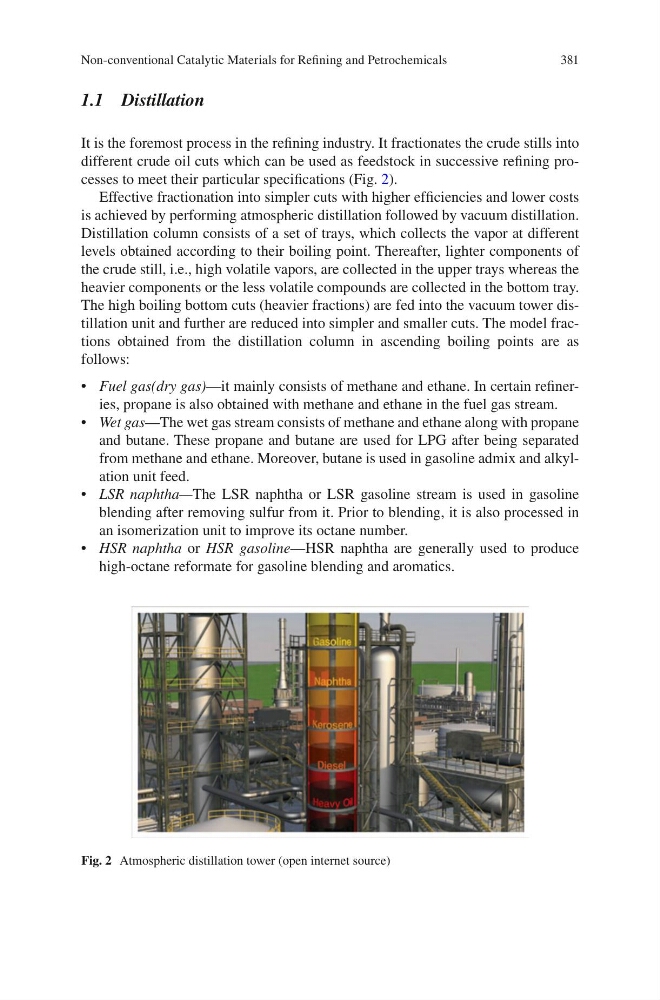
different crude oil cuts which can be used as feedstock in successive refining processes to meet their particular specifications (Fig. 2).
Effective fractionation into simpler cuts with higher efficiencies and lower costs
is achieved by performing atmospheric distillation followed by vacuum distillation.
Distillation column consists of a set of trays, which collects the vapor at different
levels obtained according to their boiling point. Thereafter, lighter components of
the crude still, i.e., high volatile vapors, are collected in the upper trays whereas the
heavier components or the less volatile compounds are collected in the bottom tray.
The high boiling bottom cuts (heavier fractions) are fed into the vacuum tower distillation unit and further are reduced into simpler and smaller cuts. The model fractions obtained from the distillation column in ascending boiling points are as
follows:
• Fuel gas(dry gas)—it mainly consists of methane and ethane. In certain refineries, propane is also obtained with methane and ethane in the fuel gas stream.
• Wet gas—The wet gas stream consists of methane and ethane along with propane
and butane. These propane and butane are used for LPG after being separated
from methane and ethane. Moreover, butane is used in gasoline admix and alkylation unit feed.
• LSR naphtha—The LSR naphtha or LSR gasoline stream is used in gasoline
blending after removing sulfur from it. Prior to blending, it is also processed in
an isomerization unit to improve its octane number.
• HSR naphtha or HSR gasoline—HSR naphtha are generally used to produce
high-octane reformate for gasoline blending and aromatics.
Fig. 2 Atmospheric distillation tower (open internet source)
Non-conventional Catalytic Materials for Refining and Petrochemicals
1.1 Distillation
It is the foremost process in the refining industry. It fractionates the crude stills into
different crude oil cuts which can be used as feedstock in successive refining processes to meet their particular specifications (Fig. 2).
Effective fractionation into simpler cuts with higher efficiencies and lower costs
is achieved by performing atmospheric distillation followed by vacuum distillation.
Distillation column consists of a set of trays, which collects the vapor at different
levels obtained according to their boiling point. Thereafter, lighter components of
the crude still, i.e., high volatile vapors, are collected in the upper trays whereas the
heavier components or the less volatile compounds are collected in the bottom tray.
The high boiling bottom cuts (heavier fractions) are fed into the vacuum tower distillation unit and further are reduced into simpler and smaller cuts. The model fractions obtained from the distillation column in ascending boiling points are as
follows:
• Fuel gas(dry gas)—it mainly consists of methane and ethane. In certain refineries, propane is also obtained with methane and ethane in the fuel gas stream.
• Wet gas—The wet gas stream consists of methane and ethane along with propane
and butane. These propane and butane are used for LPG after being separated
from methane and ethane. Moreover, butane is used in gasoline admix and alkylation unit feed.
• LSR naphtha—The LSR naphtha or LSR gasoline stream is used in gasoline
blending after removing sulfur from it. Prior to blending, it is also processed in
an isomerization unit to improve its octane number.
• HSR naphtha or HSR gasoline—HSR naphtha are generally used to produce
high-octane reformate for gasoline blending and aromatics.
Fig. 2 Atmospheric distillation tower (open internet source)
Non-conventional Catalytic Materials for Refining and Petrochemicals