

346
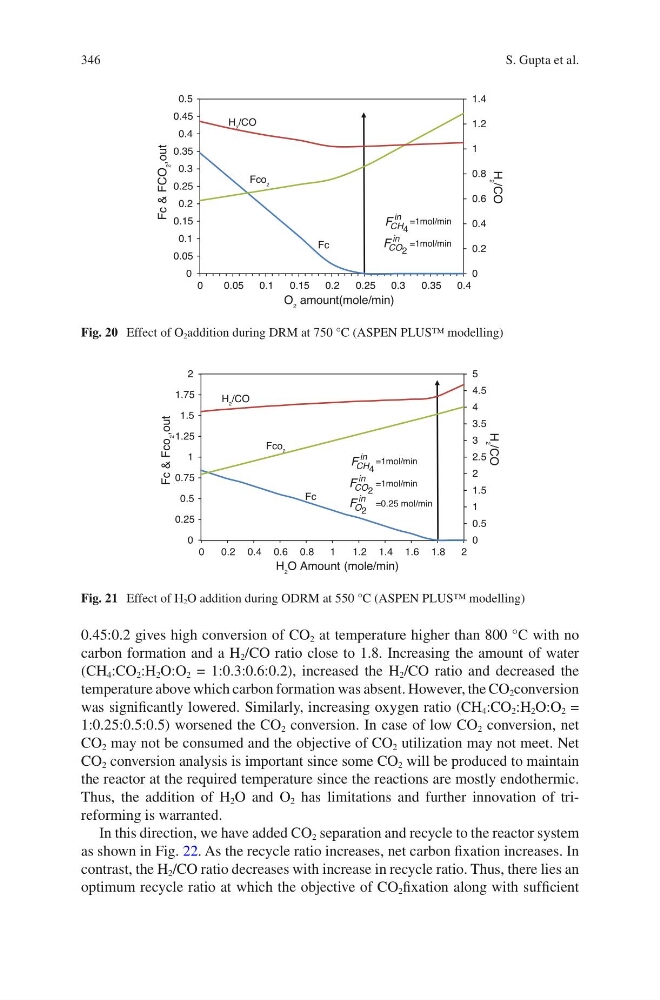
0.45:0.2 gives high conversion of CO 2 at temperature higher than 800 °C with no
carbon formation and a H 2 /CO ratio close to 1.8. Increasing the amount of water
(CH 4 :CO 2 :H 2 O:O 2 = 1:0.3:0.6:0.2), increased the H 2 /CO ratio and decreased the
temperature above which carbon formation was absent. However, the CO 2 conversion
was significantly lowered. Similarly, increasing oxygen ratio (CH 4 :CO 2 :H 2 O:O 2 =
1:0.25:0.5:0.5) worsened the CO 2 conversion. In case of low CO 2 conversion, net
CO 2 may not be consumed and the objective of CO 2 utilization may not meet. Net
CO 2 conversion analysis is important since some CO 2 will be produced to maintain
the reactor at the required temperature since the reactions are mostly endothermic.
Thus, the addition of H 2 O and O 2 has limitations and further innovation of trireforming is warranted.
In this direction, we have added CO 2 separation and recycle to the reactor system
as shown in Fig. 22. As the recycle ratio increases, net carbon fixation increases. In
contrast, the H 2 /CO ratio decreases with increase in recycle ratio. Thus, there lies an
optimum recycle ratio at which the objective of CO 2 fixation along with sufficient
0
0.2
0.4
0.6
0.8
1
1.2
1.4
0
0.05
0.1
0.15
0.2
0.25
0.3
0.35
0.4
0.45
0.5
0
0 .05
0.1
0.15
0.2
0.25
0.3
0.35
0.4
H₂/CO
Fc & FCO₂,out
O₂ amount(mole/min)
H₂/CO
Fco₂
Fc
F CH 4
in
F CO 2
=1mol/min
=1mol/min
in
Fig. 20 Effect of O 2 addition during DRM at 750 °C (ASPEN PLUS™ modelling)
0
0.5
1
1.5
2
2.5
3
3.5
4
4.5
5
0
0.25
0.5
0.75
1
1.25
1.5
1.75
2
0
0.2 0.4 0.6 0.8
1
1.2 1.4 1.6 1.8
2
H₂/CO
Fc & Fco₂,out
H₂O Amount (mole/min)
H₂/CO
Fc
Fco₂
F CH 4
in
F CO 2
=1mol/min
=1mol/min
in
F O 2
=0.25 mol/min
in
Fig. 21 Effect of H 2 O addition during ODRM at 550 °C (ASPEN PLUS™ modelling)
S. Gupta et al.
0.45:0.2 gives high conversion of CO 2 at temperature higher than 800 °C with no
carbon formation and a H 2 /CO ratio close to 1.8. Increasing the amount of water
(CH 4 :CO 2 :H 2 O:O 2 = 1:0.3:0.6:0.2), increased the H 2 /CO ratio and decreased the
temperature above which carbon formation was absent. However, the CO 2 conversion
was significantly lowered. Similarly, increasing oxygen ratio (CH 4 :CO 2 :H 2 O:O 2 =
1:0.25:0.5:0.5) worsened the CO 2 conversion. In case of low CO 2 conversion, net
CO 2 may not be consumed and the objective of CO 2 utilization may not meet. Net
CO 2 conversion analysis is important since some CO 2 will be produced to maintain
the reactor at the required temperature since the reactions are mostly endothermic.
Thus, the addition of H 2 O and O 2 has limitations and further innovation of trireforming is warranted.
In this direction, we have added CO 2 separation and recycle to the reactor system
as shown in Fig. 22. As the recycle ratio increases, net carbon fixation increases. In
contrast, the H 2 /CO ratio decreases with increase in recycle ratio. Thus, there lies an
optimum recycle ratio at which the objective of CO 2 fixation along with sufficient
0
0.2
0.4
0.6
0.8
1
1.2
1.4
0
0.05
0.1
0.15
0.2
0.25
0.3
0.35
0.4
0.45
0.5
0
0 .05
0.1
0.15
0.2
0.25
0.3
0.35
0.4
H₂/CO
Fc & FCO₂,out
O₂ amount(mole/min)
H₂/CO
Fco₂
Fc
F CH 4
in
F CO 2
=1mol/min
=1mol/min
in
Fig. 20 Effect of O 2 addition during DRM at 750 °C (ASPEN PLUS™ modelling)
0
0.5
1
1.5
2
2.5
3
3.5
4
4.5
5
0
0.25
0.5
0.75
1
1.25
1.5
1.75
2
0
0.2 0.4 0.6 0.8
1
1.2 1.4 1.6 1.8
2
H₂/CO
Fc & Fco₂,out
H₂O Amount (mole/min)
H₂/CO
Fc
Fco₂
F CH 4
in
F CO 2
=1mol/min
=1mol/min
in
F O 2
=0.25 mol/min
in
Fig. 21 Effect of H 2 O addition during ODRM at 550 °C (ASPEN PLUS™ modelling)
S. Gupta et al.