

347
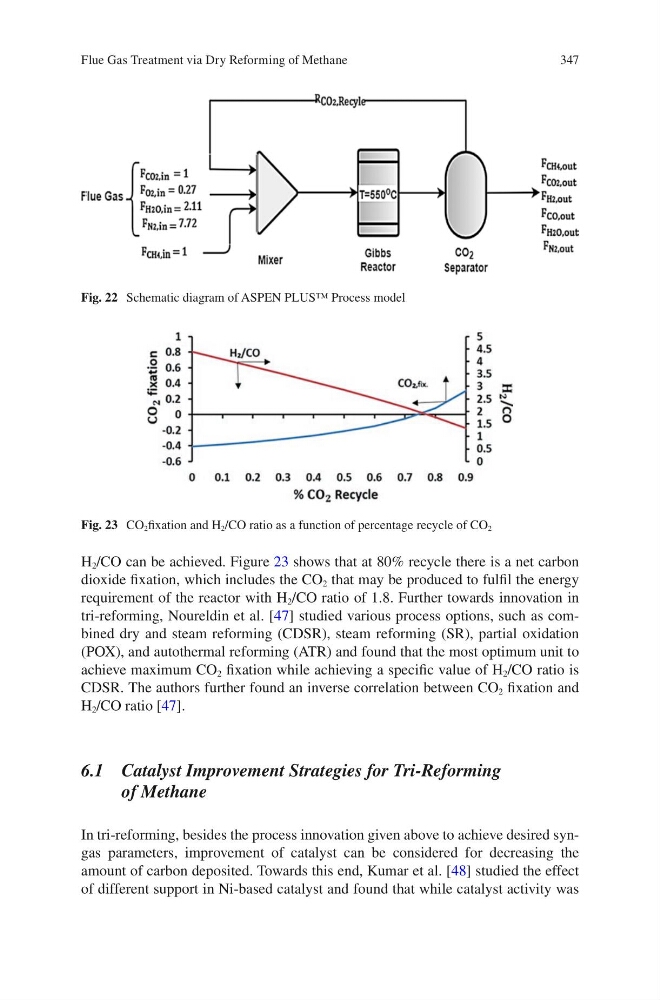
H 2 /CO can be achieved. Figure 23 shows that at 80% recycle there is a net carbon
dioxide fixation, which includes the CO 2 that may be produced to fulfil the energy
requirement of the reactor with H 2 /CO ratio of 1.8. Further towards innovation in
tri-reforming, Noureldin et al. [47] studied various process options, such as combined dry and steam reforming (CDSR), steam reforming (SR), partial oxidation
(POX), and autothermal reforming (ATR) and found that the most optimum unit to
achieve maximum CO 2 fixation while achieving a specific value of H 2 /CO ratio is
CDSR. The authors further found an inverse correlation between CO 2 fixation and
H 2 /CO ratio [47].
6.1 Catalyst Improvement Strategies for Tri-Reforming
of Methane
In tri-reforming, besides the process innovation given above to achieve desired syngas parameters, improvement of catalyst can be considered for decreasing the
amount of carbon deposited. Towards this end, Kumar et al. [48] studied the effect
of different support in Ni-based catalyst and found that while catalyst activity was
Fig. 22 Schematic diagram of ASPEN PLUS™ Process model
Fig. 23 CO 2 fixation and H 2 /CO ratio as a function of percentage recycle of CO 2
Flue Gas Treatment via Dry Reforming of Methane
H 2 /CO can be achieved. Figure 23 shows that at 80% recycle there is a net carbon
dioxide fixation, which includes the CO 2 that may be produced to fulfil the energy
requirement of the reactor with H 2 /CO ratio of 1.8. Further towards innovation in
tri-reforming, Noureldin et al. [47] studied various process options, such as combined dry and steam reforming (CDSR), steam reforming (SR), partial oxidation
(POX), and autothermal reforming (ATR) and found that the most optimum unit to
achieve maximum CO 2 fixation while achieving a specific value of H 2 /CO ratio is
CDSR. The authors further found an inverse correlation between CO 2 fixation and
H 2 /CO ratio [47].
6.1 Catalyst Improvement Strategies for Tri-Reforming
of Methane
In tri-reforming, besides the process innovation given above to achieve desired syngas parameters, improvement of catalyst can be considered for decreasing the
amount of carbon deposited. Towards this end, Kumar et al. [48] studied the effect
of different support in Ni-based catalyst and found that while catalyst activity was
Fig. 22 Schematic diagram of ASPEN PLUS™ Process model
Fig. 23 CO 2 fixation and H 2 /CO ratio as a function of percentage recycle of CO 2
Flue Gas Treatment via Dry Reforming of Methane