

344
OH H
H O
∗ + ∗ ↔
+ ∗
2
2
CO
CO
∗ ↔
+ ∗
6. Reverse water gas shift reaction also takes places as described by the following steps:
CO
CO
2
2
∗ ↔
∗
CO
H
CO OH
slow
2 ∗ + ∗ ↔
∗ +
∗ ( )
OH H
H O
∗ + ∗ ↔
+ ∗
2
2
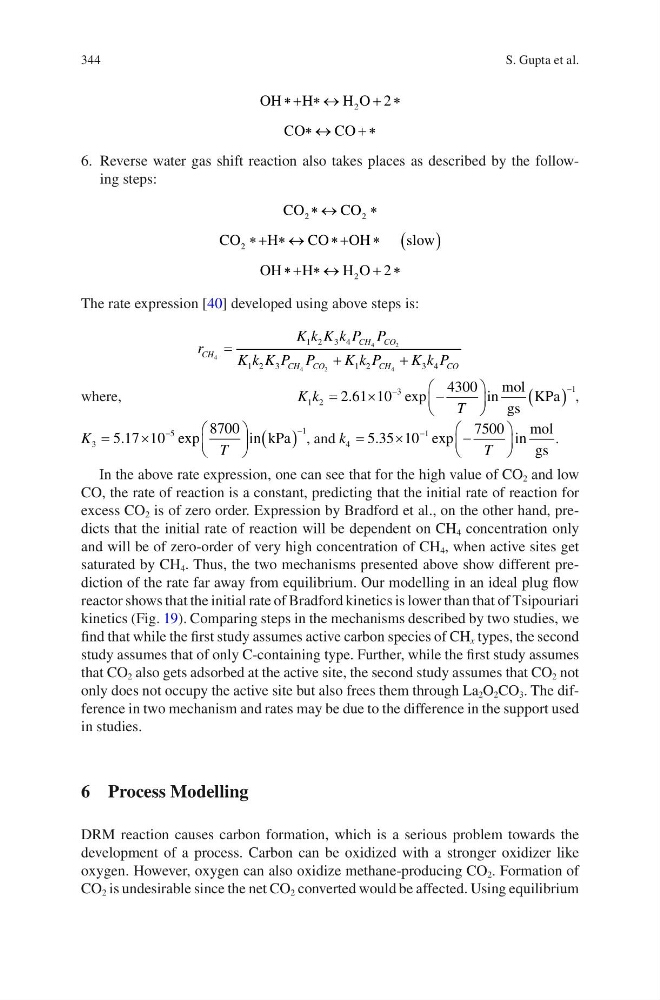
The rate expression [40] developed using above steps is:
r
K k K k P P
K k K P P
K k P
K k P
CH
CH CO
CH CO
CH
CO
4
4
2
4
2
4
1 2 3 4
1 2 3
1 2
34
=
+
+
where,
K k
T
1 2
3
1
2 61 10
4300
=
×
−
( )
−
−
.
e xp
in
mol
gs
KPa ,
K
T
3
5
1
5 17 10
8700
=
×
( )
−
−
.
e xp
in kPa , and k
T
4
1
5 35 10
7500
=
×
−
−
.
e xp
in
mol
gs
.
In the above rate expression, one can see that for the high value of CO 2 and low
CO, the rate of reaction is a constant, predicting that the initial rate of reaction for
excess CO 2 is of zero order. Expression by Bradford et al., on the other hand, predicts that the initial rate of reaction will be dependent on CH 4 concentration only
and will be of zero-order of very high concentration of CH 4 , when active sites get
saturated by CH 4 . Thus, the two mechanisms presented above show different prediction of the rate far away from equilibrium. Our modelling in an ideal plug flow
reactor shows that the initial rate of Bradford kinetics is lower than that of Tsipouriari
kinetics (Fig. 19). Comparing steps in the mechanisms described by two studies, we
find that while the first study assumes active carbon species of CH x types, the second
study assumes that of only C-containing type. Further, while the first study assumes
that CO 2 also gets adsorbed at the active site, the second study assumes that CO 2 not
only does not occupy the active site but also frees them through La 2 O 2 CO 3 . The difference in two mechanism and rates may be due to the difference in the support used
in studies.
6 Process Modelling
DRM reaction causes carbon formation, which is a serious problem towards the
development of a process. Carbon can be oxidized with a stronger oxidizer like
oxygen. However, oxygen can also oxidize methane-producing CO 2 . Formation of
CO 2 is undesirable since the net CO 2 converted would be affected. Using equilibrium
S. Gupta et al.
OH H
H O
∗ + ∗ ↔
+ ∗
2
2
CO
CO
∗ ↔
+ ∗
6. Reverse water gas shift reaction also takes places as described by the following steps:
CO
CO
2
2
∗ ↔
∗
CO
H
CO OH
slow
2 ∗ + ∗ ↔
∗ +
∗ ( )
OH H
H O
∗ + ∗ ↔
+ ∗
2
2
The rate expression [40] developed using above steps is:
r
K k K k P P
K k K P P
K k P
K k P
CH
CH CO
CH CO
CH
CO
4
4
2
4
2
4
1 2 3 4
1 2 3
1 2
34
=
+
+
where,
K k
T
1 2
3
1
2 61 10
4300
=
×
−
( )
−
−
.
e xp
in
mol
gs
KPa ,
K
T
3
5
1
5 17 10
8700
=
×
( )
−
−
.
e xp
in kPa , and k
T
4
1
5 35 10
7500
=
×
−
−
.
e xp
in
mol
gs
.
In the above rate expression, one can see that for the high value of CO 2 and low
CO, the rate of reaction is a constant, predicting that the initial rate of reaction for
excess CO 2 is of zero order. Expression by Bradford et al., on the other hand, predicts that the initial rate of reaction will be dependent on CH 4 concentration only
and will be of zero-order of very high concentration of CH 4 , when active sites get
saturated by CH 4 . Thus, the two mechanisms presented above show different prediction of the rate far away from equilibrium. Our modelling in an ideal plug flow
reactor shows that the initial rate of Bradford kinetics is lower than that of Tsipouriari
kinetics (Fig. 19). Comparing steps in the mechanisms described by two studies, we
find that while the first study assumes active carbon species of CH x types, the second
study assumes that of only C-containing type. Further, while the first study assumes
that CO 2 also gets adsorbed at the active site, the second study assumes that CO 2 not
only does not occupy the active site but also frees them through La 2 O 2 CO 3 . The difference in two mechanism and rates may be due to the difference in the support used
in studies.
6 Process Modelling
DRM reaction causes carbon formation, which is a serious problem towards the
development of a process. Carbon can be oxidized with a stronger oxidizer like
oxygen. However, oxygen can also oxidize methane-producing CO 2 . Formation of
CO 2 is undesirable since the net CO 2 converted would be affected. Using equilibrium
S. Gupta et al.