

343
The proposed kinetic model fits the experimental data very well. It can be seen
from the rate expression that for low P CO and P H 2 values or high values of P CO 2 , the
rate is independent of CO 2 concentration.
5.2.2 Tsipouriari Mechanism
On the other hand, Tsipouriari et al. [40] propose a different mechanism for Ni/
La 2 O 3 catalyst based on the observation that while the rate of reaction decreases
with time for reactions over many supports (Al 2 O 3 , YSZ, SiO 2 and CaO), it shows a
reverse trend for La 2 O 3 , suggesting that La 2 O 3 somehow stabilizes the Ni catalyst. It
was proposed that LaO x forms at the catalyst surface which reacts with CO 2 to form
carbonates and oxycarbonates. The carbonates and oxycarbonates react with
deposited carbon, freeing the active sites [40]. This hypothesis was supported by the
observation of La 2 O 2 CO 3 species by Zhang et al. [41]. Further, it was observed that
the rate of dissociation of CH 4 is much higher than that of CO 2 and active carbon
species consist of carbon only [40]. Furthermore, oxygen for the formation of CO
comes from La 2 O 2 CO 3 [42] and methane cracking on Ni/La 2 O 3 is a slow step [43].
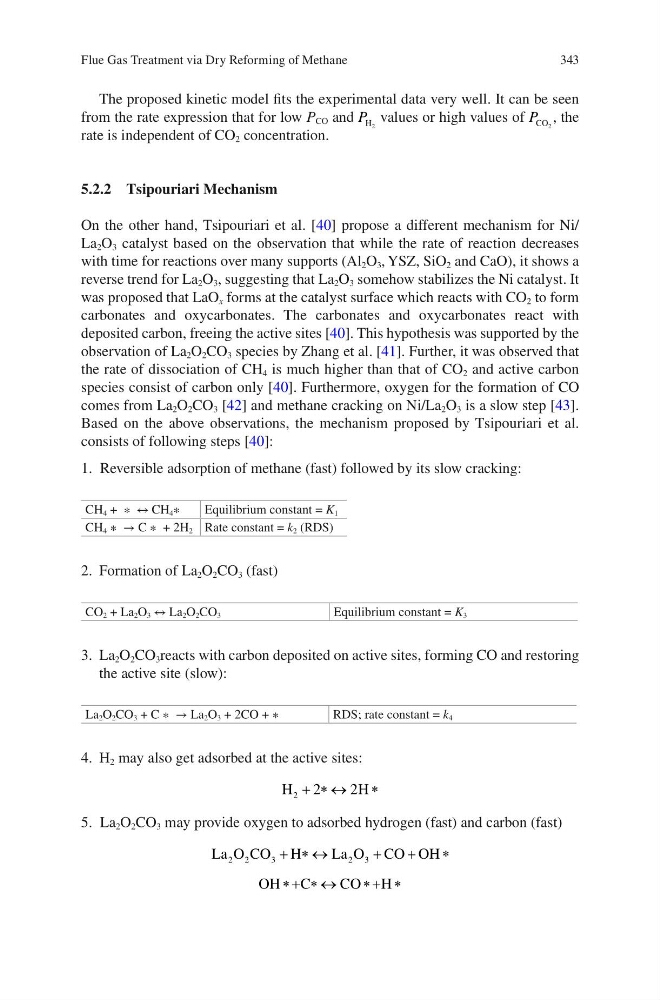
Based on the above observations, the mechanism proposed by Tsipouriari et al.
consists of following steps [40]:
1. Reversible adsorption of methane (fast) followed by its slow cracking:
CH 4 + ∗ ↔ CH 4 ∗
Equilibrium constant = K 1
CH 4 ∗ → C ∗ + 2H 2 Rate constant = k 2 (RDS)
2. Formation of La 2 O 2 CO 3 (fast)
CO 2 + La 2 O 3 ↔ La 2 O 2 CO 3
Equilibrium constant = K 3
3. La 2 O 2 CO 3 reacts with carbon deposited on active sites, forming CO and restoring
the active site (slow):
La 2 O 2 CO 3 + C ∗ → La 2 O 3 + 2CO + ∗
RDS; rate constant = k 4
4. H 2 may also get adsorbed at the active sites:
H
H
2
2
2
+ ∗ ↔
∗
5. La 2 O 2 CO 3 may provide oxygen to adsorbed hydrogen (fast) and carbon (fast)
La O CO H
La O CO OH
2 2
3
23
+ ∗ ↔
+
+
∗
OH C
CO H
∗ + ∗ ↔
∗ + ∗
Flue Gas Treatment via Dry Reforming of Methane
The proposed kinetic model fits the experimental data very well. It can be seen
from the rate expression that for low P CO and P H 2 values or high values of P CO 2 , the
rate is independent of CO 2 concentration.
5.2.2 Tsipouriari Mechanism
On the other hand, Tsipouriari et al. [40] propose a different mechanism for Ni/
La 2 O 3 catalyst based on the observation that while the rate of reaction decreases
with time for reactions over many supports (Al 2 O 3 , YSZ, SiO 2 and CaO), it shows a
reverse trend for La 2 O 3 , suggesting that La 2 O 3 somehow stabilizes the Ni catalyst. It
was proposed that LaO x forms at the catalyst surface which reacts with CO 2 to form
carbonates and oxycarbonates. The carbonates and oxycarbonates react with
deposited carbon, freeing the active sites [40]. This hypothesis was supported by the
observation of La 2 O 2 CO 3 species by Zhang et al. [41]. Further, it was observed that
the rate of dissociation of CH 4 is much higher than that of CO 2 and active carbon
species consist of carbon only [40]. Furthermore, oxygen for the formation of CO
comes from La 2 O 2 CO 3 [42] and methane cracking on Ni/La 2 O 3 is a slow step [43].
Based on the above observations, the mechanism proposed by Tsipouriari et al.
consists of following steps [40]:
1. Reversible adsorption of methane (fast) followed by its slow cracking:
CH 4 + ∗ ↔ CH 4 ∗
Equilibrium constant = K 1
CH 4 ∗ → C ∗ + 2H 2 Rate constant = k 2 (RDS)
2. Formation of La 2 O 2 CO 3 (fast)
CO 2 + La 2 O 3 ↔ La 2 O 2 CO 3
Equilibrium constant = K 3
3. La 2 O 2 CO 3 reacts with carbon deposited on active sites, forming CO and restoring
the active site (slow):
La 2 O 2 CO 3 + C ∗ → La 2 O 3 + 2CO + ∗
RDS; rate constant = k 4
4. H 2 may also get adsorbed at the active sites:
H
H
2
2
2
+ ∗ ↔
∗
5. La 2 O 2 CO 3 may provide oxygen to adsorbed hydrogen (fast) and carbon (fast)
La O CO H
La O CO OH
2 2
3
23
+ ∗ ↔
+
+
∗
OH C
CO H
∗ + ∗ ↔
∗ + ∗
Flue Gas Treatment via Dry Reforming of Methane