

342
5.2.1 Bradford Mechanism
After analysing available data on DRM reaction, Bradford et al. [39] propose the
following mechanism of this reaction for Ni/MgO and Ni/TiO 2 catalysts:
(i)
CH
C H
H
4
2
4
2
+ ∗ ↔
∗+
−
x
x
Rate constants = k 1 and k −1
(ii)
2[CO 2 + ∗ ↔ CO 2 ∗]
Equilibrium constant = K 2
(iii)
H 2 + 2 ∗ ↔ 2H∗
Equilibrium constant = K 3
(iv)
2[CO 2 ∗ + H ∗ ↔ CO ∗ + OH∗]
Equilibrium constant = K 4
(v)
OH ∗ + H ∗ ↔ H 2 O + 2∗
Equilibrium constant = K 5
(vi)
CH x ∗ + OH ∗ ↔ CH x O ∗ + H∗
Equilibrium constant = K 6
(vii)
CH O
CO
H
x
x
∗ →
∗ +
2
2
Rate constant = k 7
(viii)
3[CO ∗ ↔ CO + ∗]
Equilibrium constant = 1/K 8
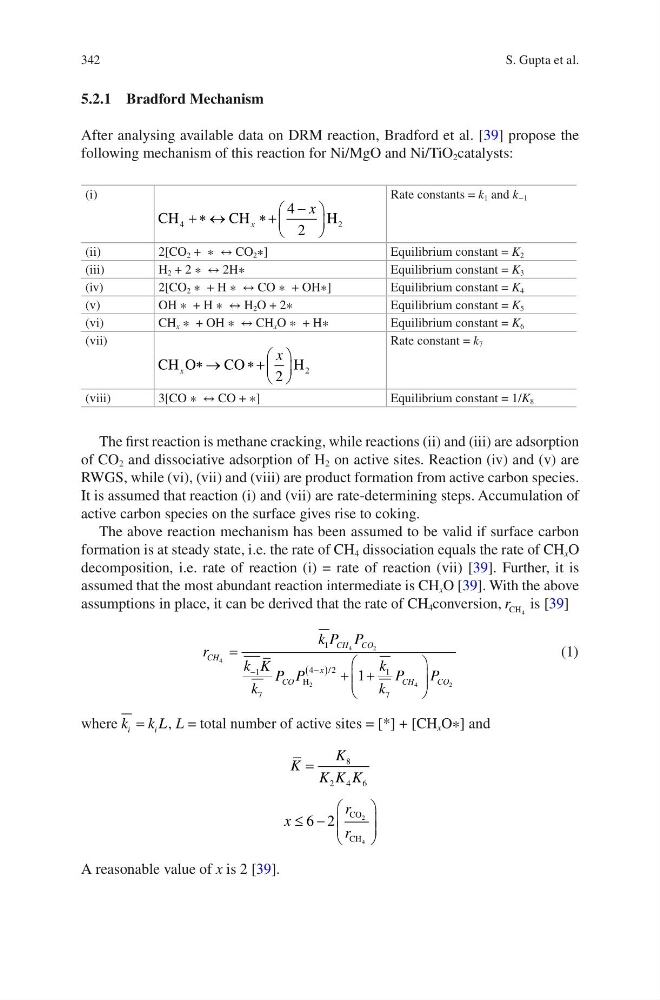
The first reaction is methane cracking, while reactions (ii) and (iii) are adsorption
of CO 2 and dissociative adsorption of H 2 on active sites. Reaction (iv) and (v) are
RWGS, while (vi), (vii) and (viii) are product formation from active carbon species.
It is assumed that reaction (i) and (vii) are rate-determining steps. Accumulation of
active carbon species on the surface gives rise to coking.
The above reaction mechanism has been assumed to be valid if surface carbon
formation is at steady state, i.e. the rate of CH 4 dissociation equals the rate of CH x O
decomposition, i.e. rate of reaction (i) = rate of reaction (vii) [39]. Further, it is
assumed that the most abundant reaction intermediate is CH x O [39]. With the above
assumptions in place, it can be derived that the rate of CH 4 conversion, r CH 4 is [39]
r
k P P
k K
k
P P
k
k
P
P
CH
CH CO
CO
x
CH
CO
4
4
2
2
4
2
1
1
7
4
2
1
7
1
=
+ +
−
−
( )
H
/
(1)
where k k L
i
i
=
, L = total number of active sites = [*] + [CH x O∗] and
K
K
K K K
=
8
2 4 6
x
r
r
≤ −
6 2
2
4
CO
CH
A reasonable value of x is 2 [39].
S. Gupta et al.
5.2.1 Bradford Mechanism
After analysing available data on DRM reaction, Bradford et al. [39] propose the
following mechanism of this reaction for Ni/MgO and Ni/TiO 2 catalysts:
(i)
CH
C H
H
4
2
4
2
+ ∗ ↔
∗+
−
x
x
Rate constants = k 1 and k −1
(ii)
2[CO 2 + ∗ ↔ CO 2 ∗]
Equilibrium constant = K 2
(iii)
H 2 + 2 ∗ ↔ 2H∗
Equilibrium constant = K 3
(iv)
2[CO 2 ∗ + H ∗ ↔ CO ∗ + OH∗]
Equilibrium constant = K 4
(v)
OH ∗ + H ∗ ↔ H 2 O + 2∗
Equilibrium constant = K 5
(vi)
CH x ∗ + OH ∗ ↔ CH x O ∗ + H∗
Equilibrium constant = K 6
(vii)
CH O
CO
H
x
x
∗ →
∗ +
2
2
Rate constant = k 7
(viii)
3[CO ∗ ↔ CO + ∗]
Equilibrium constant = 1/K 8
The first reaction is methane cracking, while reactions (ii) and (iii) are adsorption
of CO 2 and dissociative adsorption of H 2 on active sites. Reaction (iv) and (v) are
RWGS, while (vi), (vii) and (viii) are product formation from active carbon species.
It is assumed that reaction (i) and (vii) are rate-determining steps. Accumulation of
active carbon species on the surface gives rise to coking.
The above reaction mechanism has been assumed to be valid if surface carbon
formation is at steady state, i.e. the rate of CH 4 dissociation equals the rate of CH x O
decomposition, i.e. rate of reaction (i) = rate of reaction (vii) [39]. Further, it is
assumed that the most abundant reaction intermediate is CH x O [39]. With the above
assumptions in place, it can be derived that the rate of CH 4 conversion, r CH 4 is [39]
r
k P P
k K
k
P P
k
k
P
P
CH
CH CO
CO
x
CH
CO
4
4
2
2
4
2
1
1
7
4
2
1
7
1
=
+ +
−
−
( )
H
/
(1)
where k k L
i
i
=
, L = total number of active sites = [*] + [CH x O∗] and
K
K
K K K
=
8
2 4 6
x
r
r
≤ −
6 2
2
4
CO
CH
A reasonable value of x is 2 [39].
S. Gupta et al.