

341
r
k
E
RT
N N
N
N N
N N
K
CH
CH
CO
CO
CO
CH
CO
4
4
2
2
4
2
04
4
2
2
2
1
1
1
=
−
−
exp
H
eq
+
+
1
2
1 2
4
2
2
K
N
N
K N
CO
CO
A
B H
/
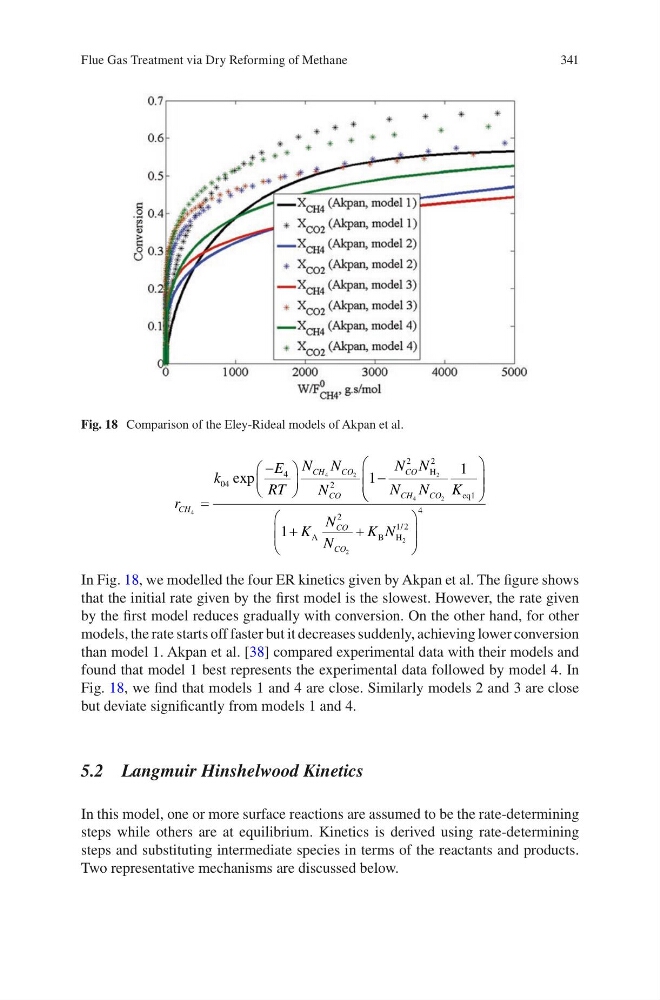
In Fig. 18, we modelled the four ER kinetics given by Akpan et al. The figure shows
that the initial rate given by the first model is the slowest. However, the rate given
by the first model reduces gradually with conversion. On the other hand, for other
models, the rate starts off faster but it decreases suddenly, achieving lower conversion
than model 1. Akpan et al. [38] compared experimental data with their models and
found that model 1 best represents the experimental data followed by model 4. In
Fig. 18, we find that models 1 and 4 are close. Similarly models 2 and 3 are close
but deviate significantly from models 1 and 4.
5.2 Langmuir Hinshelwood Kinetics
In this model, one or more surface reactions are assumed to be the rate-determining
steps while others are at equilibrium. Kinetics is derived using rate-determining
steps and substituting intermediate species in terms of the reactants and products.
Two representative mechanisms are discussed below.
Fig. 18 Comparison of the Eley-Rideal models of Akpan et al.
Flue Gas Treatment via Dry Reforming of Methane
r
k
E
RT
N N
N
N N
N N
K
CH
CH
CO
CO
CO
CH
CO
4
4
2
2
4
2
04
4
2
2
2
1
1
1
=
−
−
exp
H
eq
+
+
1
2
1 2
4
2
2
K
N
N
K N
CO
CO
A
B H
/
In Fig. 18, we modelled the four ER kinetics given by Akpan et al. The figure shows
that the initial rate given by the first model is the slowest. However, the rate given
by the first model reduces gradually with conversion. On the other hand, for other
models, the rate starts off faster but it decreases suddenly, achieving lower conversion
than model 1. Akpan et al. [38] compared experimental data with their models and
found that model 1 best represents the experimental data followed by model 4. In
Fig. 18, we find that models 1 and 4 are close. Similarly models 2 and 3 are close
but deviate significantly from models 1 and 4.
5.2 Langmuir Hinshelwood Kinetics
In this model, one or more surface reactions are assumed to be the rate-determining
steps while others are at equilibrium. Kinetics is derived using rate-determining
steps and substituting intermediate species in terms of the reactants and products.
Two representative mechanisms are discussed below.
Fig. 18 Comparison of the Eley-Rideal models of Akpan et al.
Flue Gas Treatment via Dry Reforming of Methane