

335
on several of these properties simultaneously, resulting in changes in both conversion
and coke deposition. For example, we have seen that alumina-supported nickel
catalysts possessing strong metal support interactions showed better carbon
resistance compared to MgAl 2 O 4 -supported nickel at comparable conversions [11].
Thus, more carefully controlled experiments are required to quantify the effect of
base addition and to clearly delineate the mechanism of carbon deposition on
catalyst.
4.2 Potassium Aluminate Shown to Enhance Coke Resistance
Property of NiAl 2 O 4
Formation of nickel aluminate has been shown to increase coke resistance characteristics of Ni/Al 2 O 3 catalyst [19]. Nickel aluminate, NiAl 2 O 4 , is usually formed by
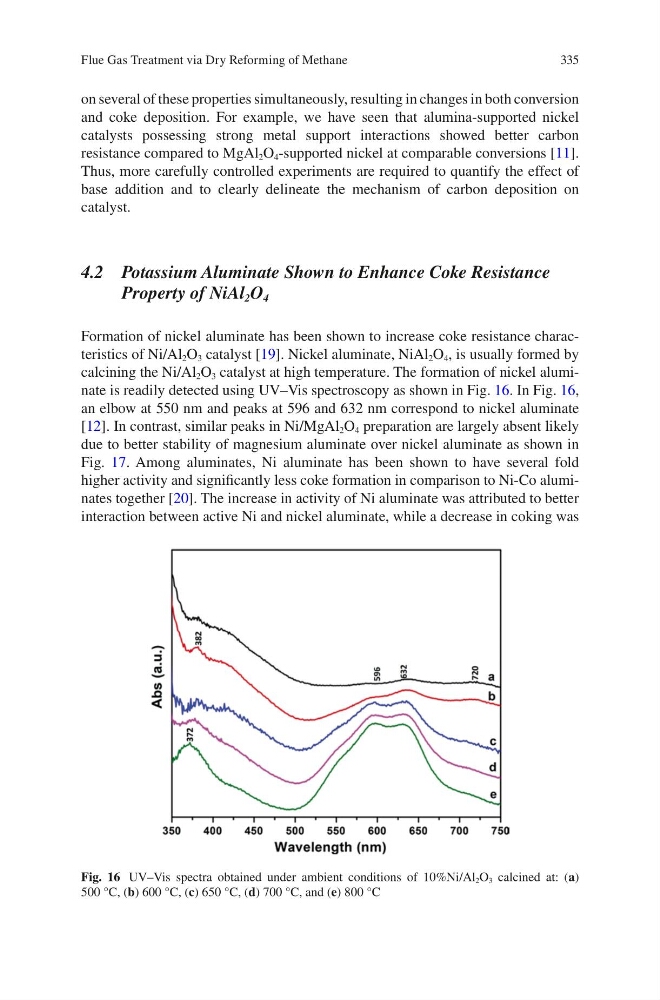
calcining the Ni/Al 2 O 3 catalyst at high temperature. The formation of nickel aluminate is readily detected using UV–Vis spectroscopy as shown in Fig. 16. In Fig. 16,
an elbow at 550 nm and peaks at 596 and 632 nm correspond to nickel aluminate
[12]. In contrast, similar peaks in Ni/MgAl 2 O 4 preparation are largely absent likely
due to better stability of magnesium aluminate over nickel aluminate as shown in
Fig. 17. Among aluminates, Ni aluminate has been shown to have several fold
higher activity and significantly less coke formation in comparison to Ni-Co aluminates together [20]. The increase in activity of Ni aluminate was attributed to better
interaction between active Ni and nickel aluminate, while a decrease in coking was
Fig. 16 UV–Vis spectra obtained under ambient conditions of 10%Ni/Al 2 O 3 calcined at: (a)
500 °C, (b) 600 °C, (c) 650 °C, (d) 700 °C, and (e) 800 °C
Flue Gas Treatment via Dry Reforming of Methane
on several of these properties simultaneously, resulting in changes in both conversion
and coke deposition. For example, we have seen that alumina-supported nickel
catalysts possessing strong metal support interactions showed better carbon
resistance compared to MgAl 2 O 4 -supported nickel at comparable conversions [11].
Thus, more carefully controlled experiments are required to quantify the effect of
base addition and to clearly delineate the mechanism of carbon deposition on
catalyst.
4.2 Potassium Aluminate Shown to Enhance Coke Resistance
Property of NiAl 2 O 4
Formation of nickel aluminate has been shown to increase coke resistance characteristics of Ni/Al 2 O 3 catalyst [19]. Nickel aluminate, NiAl 2 O 4 , is usually formed by
calcining the Ni/Al 2 O 3 catalyst at high temperature. The formation of nickel aluminate is readily detected using UV–Vis spectroscopy as shown in Fig. 16. In Fig. 16,
an elbow at 550 nm and peaks at 596 and 632 nm correspond to nickel aluminate
[12]. In contrast, similar peaks in Ni/MgAl 2 O 4 preparation are largely absent likely
due to better stability of magnesium aluminate over nickel aluminate as shown in
Fig. 17. Among aluminates, Ni aluminate has been shown to have several fold
higher activity and significantly less coke formation in comparison to Ni-Co aluminates together [20]. The increase in activity of Ni aluminate was attributed to better
interaction between active Ni and nickel aluminate, while a decrease in coking was
Fig. 16 UV–Vis spectra obtained under ambient conditions of 10%Ni/Al 2 O 3 calcined at: (a)
500 °C, (b) 600 °C, (c) 650 °C, (d) 700 °C, and (e) 800 °C
Flue Gas Treatment via Dry Reforming of Methane