

334
the mesoporous structure increases catalytic activity and carbon deposition [15].
While Ni loading increases carbon deposition, the addition of hydroxyapatite and
fluoroapatite stabilized the catalyst. This is likely due to their basic property and
ability to chemisorb CO 2 [16]. Adding Mg and Co to over alumina-supported Ni
catalyst increased both the activity and coke resistance in comparison to supported
Ni alone or Ni/Co [17]. In addition, variation in support has also shown an effect on
carbon deposition. For example, MgO-γ-Al 2 O 3 and MgAl 2 O 4 supports compared to
alumina alone have shown better coke resistance and sintering resistance due to
better interaction between Ni and Mg, which gave rise to highly dispersed Ni active
metal [18]. Since hydroxyapatite, fluoroapatite, and magnesium oxide are bases, it
can be concluded that adding a basic component to the catalyst may enhance its
coke resistance property. However, several properties of catalyst are coupled. For
example, a base may have an effect on the: (i) the electronic property of Ni, (ii)
interaction of the catalyst with CO 2 , (iii) the dispersion of Ni, or (iv) interaction of
carbon with Ni and the support. It is also possible that the base may have an effect
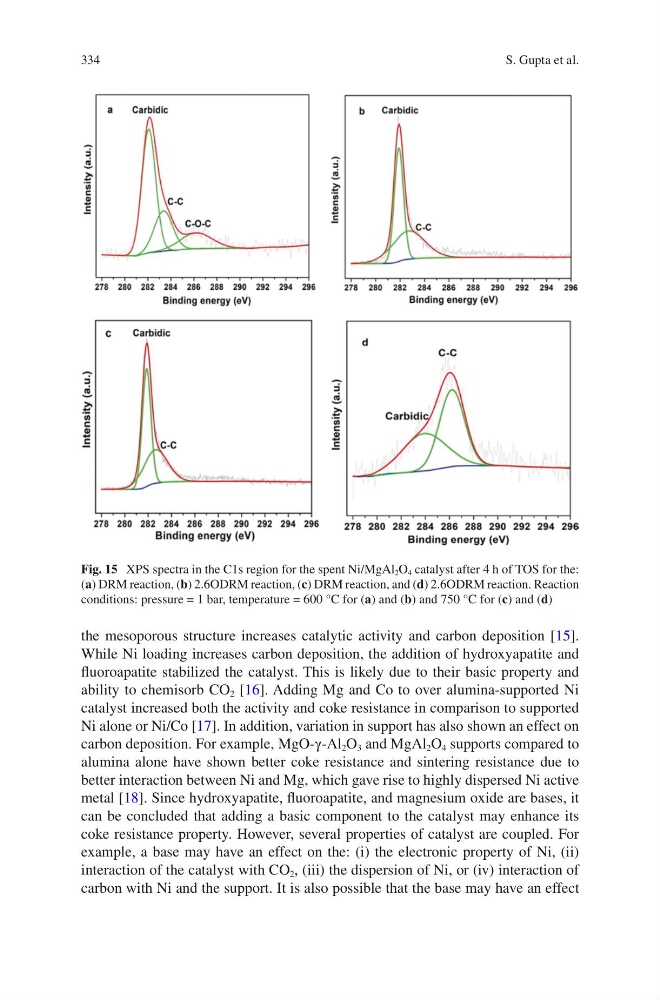
Fig. 15 XPS spectra in the C1s region for the spent Ni/MgAl 2 O 4 catalyst after 4 h of TOS for the:
(a) DRM reaction, (b) 2.6ODRM reaction, (c) DRM reaction, and (d) 2.6ODRM reaction. Reaction
conditions: pressure = 1 bar, temperature = 600 °C for (a) and (b) and 750 °C for (c) and (d)
S. Gupta et al.
the mesoporous structure increases catalytic activity and carbon deposition [15].
While Ni loading increases carbon deposition, the addition of hydroxyapatite and
fluoroapatite stabilized the catalyst. This is likely due to their basic property and
ability to chemisorb CO 2 [16]. Adding Mg and Co to over alumina-supported Ni
catalyst increased both the activity and coke resistance in comparison to supported
Ni alone or Ni/Co [17]. In addition, variation in support has also shown an effect on
carbon deposition. For example, MgO-γ-Al 2 O 3 and MgAl 2 O 4 supports compared to
alumina alone have shown better coke resistance and sintering resistance due to
better interaction between Ni and Mg, which gave rise to highly dispersed Ni active
metal [18]. Since hydroxyapatite, fluoroapatite, and magnesium oxide are bases, it
can be concluded that adding a basic component to the catalyst may enhance its
coke resistance property. However, several properties of catalyst are coupled. For
example, a base may have an effect on the: (i) the electronic property of Ni, (ii)
interaction of the catalyst with CO 2 , (iii) the dispersion of Ni, or (iv) interaction of
carbon with Ni and the support. It is also possible that the base may have an effect
Fig. 15 XPS spectra in the C1s region for the spent Ni/MgAl 2 O 4 catalyst after 4 h of TOS for the:
(a) DRM reaction, (b) 2.6ODRM reaction, (c) DRM reaction, and (d) 2.6ODRM reaction. Reaction
conditions: pressure = 1 bar, temperature = 600 °C for (a) and (b) and 750 °C for (c) and (d)
S. Gupta et al.