

320
1 Introduction
Flue gases are produced from the exhaust of combustion units, which include those
from coal-fired and natural gas-fired burners. The main constituents of flue gas are
N 2 , CO 2 , H 2 O and O 2 , with a trace amount of SO 2 and NO x . Typical compositions of
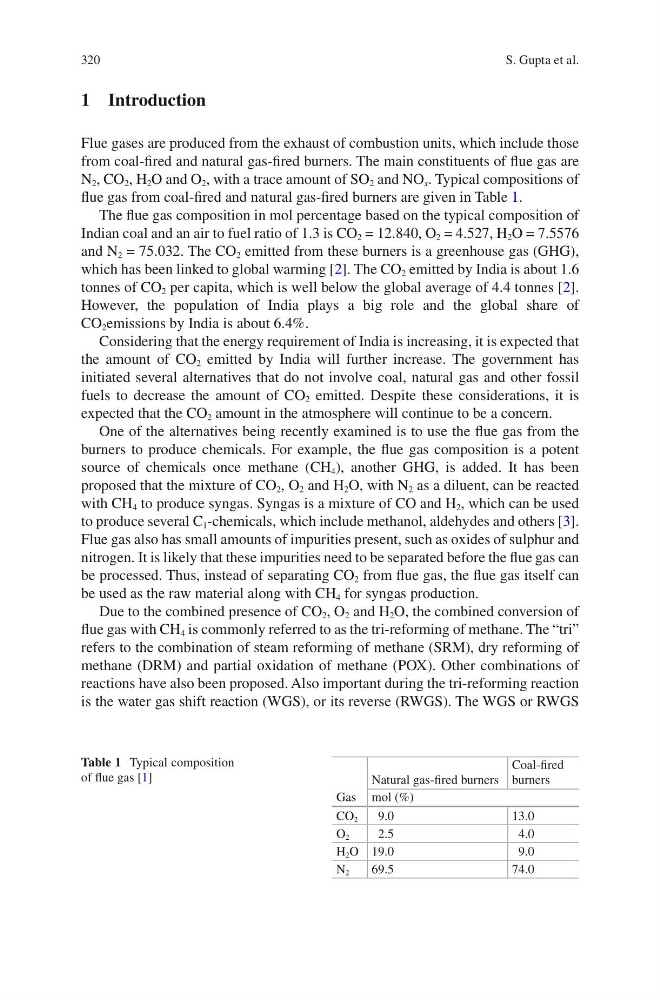
flue gas from coal-fired and natural gas-fired burners are given in Table 1.
The flue gas composition in mol percentage based on the typical composition of
Indian coal and an air to fuel ratio of 1.3 is CO 2 = 12.840, O 2 = 4.527, H 2 O = 7.5576
and N 2 = 75.032. The CO 2 emitted from these burners is a greenhouse gas (GHG),
which has been linked to global warming [2]. The CO 2 emitted by India is about 1.6
tonnes of CO 2 per capita, which is well below the global average of 4.4 tonnes [2].
However, the population of India plays a big role and the global share of
CO 2 emissions by India is about 6.4%.
Considering that the energy requirement of India is increasing, it is expected that
the amount of CO 2 emitted by India will further increase. The government has
initiated several alternatives that do not involve coal, natural gas and other fossil
fuels to decrease the amount of CO 2 emitted. Despite these considerations, it is
expected that the CO 2 amount in the atmosphere will continue to be a concern.
One of the alternatives being recently examined is to use the flue gas from the
burners to produce chemicals. For example, the flue gas composition is a potent
source of chemicals once methane (CH 4 ), another GHG, is added. It has been
proposed that the mixture of CO 2 , O 2 and H 2 O, with N 2 as a diluent, can be reacted
with CH 4 to produce syngas. Syngas is a mixture of CO and H 2 , which can be used
to produce several C 1 -chemicals, which include methanol, aldehydes and others [3].
Flue gas also has small amounts of impurities present, such as oxides of sulphur and
nitrogen. It is likely that these impurities need to be separated before the flue gas can
be processed. Thus, instead of separating CO 2 from flue gas, the flue gas itself can
be used as the raw material along with CH 4 for syngas production.
Due to the combined presence of CO 2 , O 2 and H 2 O, the combined conversion of
flue gas with CH 4 is commonly referred to as the tri-reforming of methane. The “tri”
refers to the combination of steam reforming of methane (SRM), dry reforming of
methane (DRM) and partial oxidation of methane (POX). Other combinations of
reactions have also been proposed. Also important during the tri-reforming reaction
is the water gas shift reaction (WGS), or its reverse (RWGS). The WGS or RWGS
Table 1 Typical composition
of flue gas [1]
Gas
Natural gas-fired burners
Coal-fired
burners
mol (%)
CO 2
9.0
13.0
O 2
2.5
4.0
H 2 O 19.0
9.0
N 2
69.5
74.0
S. Gupta et al.
1 Introduction
Flue gases are produced from the exhaust of combustion units, which include those
from coal-fired and natural gas-fired burners. The main constituents of flue gas are
N 2 , CO 2 , H 2 O and O 2 , with a trace amount of SO 2 and NO x . Typical compositions of
flue gas from coal-fired and natural gas-fired burners are given in Table 1.
The flue gas composition in mol percentage based on the typical composition of
Indian coal and an air to fuel ratio of 1.3 is CO 2 = 12.840, O 2 = 4.527, H 2 O = 7.5576
and N 2 = 75.032. The CO 2 emitted from these burners is a greenhouse gas (GHG),
which has been linked to global warming [2]. The CO 2 emitted by India is about 1.6
tonnes of CO 2 per capita, which is well below the global average of 4.4 tonnes [2].
However, the population of India plays a big role and the global share of
CO 2 emissions by India is about 6.4%.
Considering that the energy requirement of India is increasing, it is expected that
the amount of CO 2 emitted by India will further increase. The government has
initiated several alternatives that do not involve coal, natural gas and other fossil
fuels to decrease the amount of CO 2 emitted. Despite these considerations, it is
expected that the CO 2 amount in the atmosphere will continue to be a concern.
One of the alternatives being recently examined is to use the flue gas from the
burners to produce chemicals. For example, the flue gas composition is a potent
source of chemicals once methane (CH 4 ), another GHG, is added. It has been
proposed that the mixture of CO 2 , O 2 and H 2 O, with N 2 as a diluent, can be reacted
with CH 4 to produce syngas. Syngas is a mixture of CO and H 2 , which can be used
to produce several C 1 -chemicals, which include methanol, aldehydes and others [3].
Flue gas also has small amounts of impurities present, such as oxides of sulphur and
nitrogen. It is likely that these impurities need to be separated before the flue gas can
be processed. Thus, instead of separating CO 2 from flue gas, the flue gas itself can
be used as the raw material along with CH 4 for syngas production.
Due to the combined presence of CO 2 , O 2 and H 2 O, the combined conversion of
flue gas with CH 4 is commonly referred to as the tri-reforming of methane. The “tri”
refers to the combination of steam reforming of methane (SRM), dry reforming of
methane (DRM) and partial oxidation of methane (POX). Other combinations of
reactions have also been proposed. Also important during the tri-reforming reaction
is the water gas shift reaction (WGS), or its reverse (RWGS). The WGS or RWGS
Table 1 Typical composition
of flue gas [1]
Gas
Natural gas-fired burners
Coal-fired
burners
mol (%)
CO 2
9.0
13.0
O 2
2.5
4.0
H 2 O 19.0
9.0
N 2
69.5
74.0
S. Gupta et al.