

321
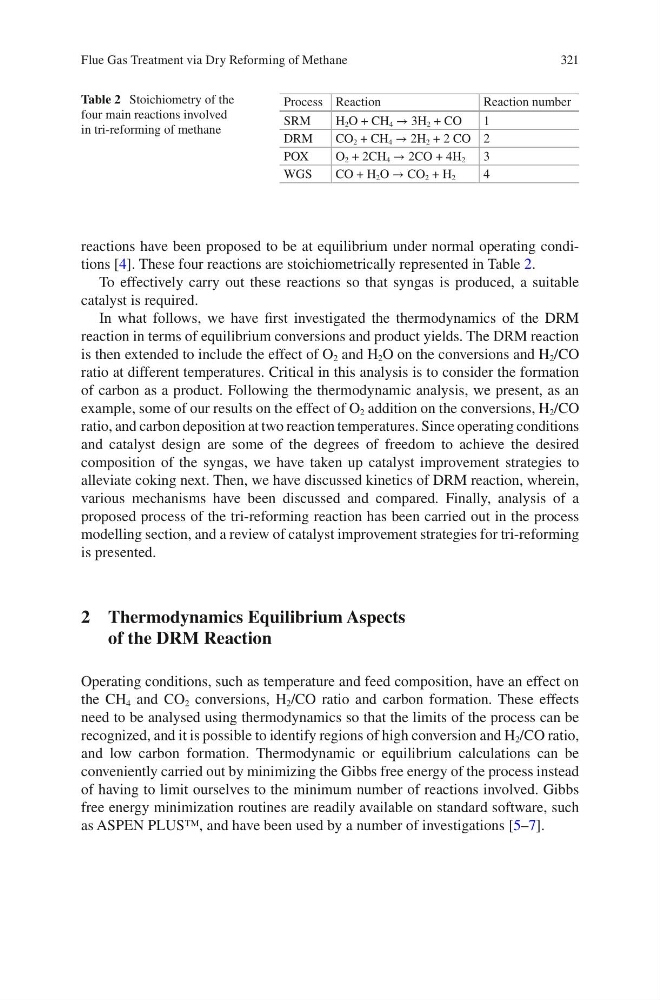
reactions have been proposed to be at equilibrium under normal operating conditions [4]. These four reactions are stoichiometrically represented in Table 2.
To effectively carry out these reactions so that syngas is produced, a suitable
catalyst is required.
In what follows, we have first investigated the thermodynamics of the DRM
reaction in terms of equilibrium conversions and product yields. The DRM reaction
is then extended to include the effect of O 2 and H 2 O on the conversions and H 2 /CO
ratio at different temperatures. Critical in this analysis is to consider the formation
of carbon as a product. Following the thermodynamic analysis, we present, as an
example, some of our results on the effect of O 2 addition on the conversions, H 2 /CO
ratio, and carbon deposition at two reaction temperatures. Since operating conditions
and catalyst design are some of the degrees of freedom to achieve the desired
composition of the syngas, we have taken up catalyst improvement strategies to
alleviate coking next. Then, we have discussed kinetics of DRM reaction, wherein,
various mechanisms have been discussed and compared. Finally, analysis of a
proposed process of the tri-reforming reaction has been carried out in the process
modelling section, and a review of catalyst improvement strategies for tri-reforming
is presented.
2 Thermodynamics Equilibrium Aspects
of the DRM Reaction
Operating conditions, such as temperature and feed composition, have an effect on
the CH 4 and CO 2 conversions, H 2 /CO ratio and carbon formation. These effects
need to be analysed using thermodynamics so that the limits of the process can be
recognized, and it is possible to identify regions of high conversion and H 2 /CO ratio,
and low carbon formation. Thermodynamic or equilibrium calculations can be
conveniently carried out by minimizing the Gibbs free energy of the process instead
of having to limit ourselves to the minimum number of reactions involved. Gibbs
free energy minimization routines are readily available on standard software, such
as ASPEN PLUS™, and have been used by a number of investigations [5–7].
Table 2 Stoichiometry of the
four main reactions involved
in tri-reforming of methane
Process Reaction
Reaction number
SRM
H 2 O + CH 4 → 3H 2 + CO
1
DRM
CO 2 + CH 4 → 2H 2 + 2 CO 2
POX
O 2 + 2CH 4 → 2CO + 4H 2 3
WGS
CO + H 2 O → CO 2 + H 2
4
Flue Gas Treatment via Dry Reforming of Methane
reactions have been proposed to be at equilibrium under normal operating conditions [4]. These four reactions are stoichiometrically represented in Table 2.
To effectively carry out these reactions so that syngas is produced, a suitable
catalyst is required.
In what follows, we have first investigated the thermodynamics of the DRM
reaction in terms of equilibrium conversions and product yields. The DRM reaction
is then extended to include the effect of O 2 and H 2 O on the conversions and H 2 /CO
ratio at different temperatures. Critical in this analysis is to consider the formation
of carbon as a product. Following the thermodynamic analysis, we present, as an
example, some of our results on the effect of O 2 addition on the conversions, H 2 /CO
ratio, and carbon deposition at two reaction temperatures. Since operating conditions
and catalyst design are some of the degrees of freedom to achieve the desired
composition of the syngas, we have taken up catalyst improvement strategies to
alleviate coking next. Then, we have discussed kinetics of DRM reaction, wherein,
various mechanisms have been discussed and compared. Finally, analysis of a
proposed process of the tri-reforming reaction has been carried out in the process
modelling section, and a review of catalyst improvement strategies for tri-reforming
is presented.
2 Thermodynamics Equilibrium Aspects
of the DRM Reaction
Operating conditions, such as temperature and feed composition, have an effect on
the CH 4 and CO 2 conversions, H 2 /CO ratio and carbon formation. These effects
need to be analysed using thermodynamics so that the limits of the process can be
recognized, and it is possible to identify regions of high conversion and H 2 /CO ratio,
and low carbon formation. Thermodynamic or equilibrium calculations can be
conveniently carried out by minimizing the Gibbs free energy of the process instead
of having to limit ourselves to the minimum number of reactions involved. Gibbs
free energy minimization routines are readily available on standard software, such
as ASPEN PLUS™, and have been used by a number of investigations [5–7].
Table 2 Stoichiometry of the
four main reactions involved
in tri-reforming of methane
Process Reaction
Reaction number
SRM
H 2 O + CH 4 → 3H 2 + CO
1
DRM
CO 2 + CH 4 → 2H 2 + 2 CO 2
POX
O 2 + 2CH 4 → 2CO + 4H 2 3
WGS
CO + H 2 O → CO 2 + H 2
4
Flue Gas Treatment via Dry Reforming of Methane