

298
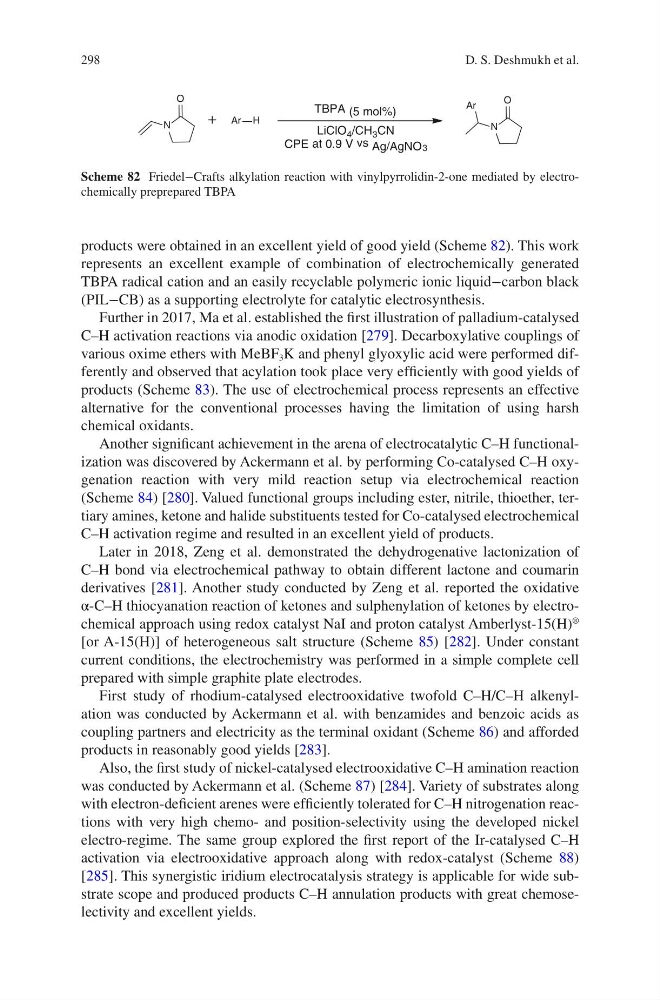
products were obtained in an excellent yield of good yield (Scheme 82). This work
represents an excellent example of combination of electrochemically generated
TBPA radical cation and an easily recyclable polymeric ionic liquid−carbon black
(PIL−CB) as a supporting electrolyte for catalytic electrosynthesis.
Further in 2017, Ma et al. established the first illustration of palladium-catalysed
C–H activation reactions via anodic oxidation [279]. Decarboxylative couplings of
various oxime ethers with MeBF 3 K and phenyl glyoxylic acid were performed differently and observed that acylation took place very efficiently with good yields of
products (Scheme 83). The use of electrochemical process represents an effective
alternative for the conventional processes having the limitation of using harsh
chemical oxidants.
Another significant achievement in the arena of electrocatalytic C–H functionalization was discovered by Ackermann et al. by performing Co-catalysed C–H oxygenation reaction with very mild reaction setup via electrochemical reaction
(Scheme 84) [280]. Valued functional groups including ester, nitrile, thioether, tertiary amines, ketone and halide substituents tested for Co-catalysed electrochemical
C–H activation regime and resulted in an excellent yield of products.
Later in 2018, Zeng et al. demonstrated the dehydrogenative lactonization of
C–H bond via electrochemical pathway to obtain different lactone and coumarin
derivatives [281]. Another study conducted by Zeng et al. reported the oxidative
α-C–H thiocyanation reaction of ketones and sulphenylation of ketones by electrochemical approach using redox catalyst NaI and proton catalyst Amberlyst-15(H)
®
[or A-15(H)] of heterogeneous salt structure (Scheme 85) [282]. Under constant
current conditions, the electrochemistry was performed in a simple complete cell
prepared with simple graphite plate electrodes.
First study of rhodium-catalysed electrooxidative twofold C–H/C–H alkenylation was conducted by Ackermann et al. with benzamides and benzoic acids as
coupling partners and electricity as the terminal oxidant (Scheme 86) and afforded
products in reasonably good yields [283].
Also, the first study of nickel-catalysed electrooxidative C–H amination reaction
was conducted by Ackermann et al. (Scheme 87) [284]. Variety of substrates along
with electron-deficient arenes were efficiently tolerated for C–H nitrogenation reactions with very high chemo- and position-selectivity using the developed nickel
electro-regime. The same group explored the first report of the Ir-catalysed C–H
activation via electrooxidative approach along with redox-catalyst (Scheme 88)
[285]. This synergistic iridium electrocatalysis strategy is applicable for wide substrate scope and produced products C–H annulation products with great chemoselectivity and excellent yields.
TBPA (5 mol%)
LiClO 4 /CH 3 CN
CPE at 0.9 V vs Ag/AgNO3
N
O
Ar H
N
O
Ar
Scheme 82 Friedel−Crafts alkylation reaction with vinylpyrrolidin-2-one mediated by electrochemically preprepared TBPA
D. S. Deshmukh et al.
products were obtained in an excellent yield of good yield (Scheme 82). This work
represents an excellent example of combination of electrochemically generated
TBPA radical cation and an easily recyclable polymeric ionic liquid−carbon black
(PIL−CB) as a supporting electrolyte for catalytic electrosynthesis.
Further in 2017, Ma et al. established the first illustration of palladium-catalysed
C–H activation reactions via anodic oxidation [279]. Decarboxylative couplings of
various oxime ethers with MeBF 3 K and phenyl glyoxylic acid were performed differently and observed that acylation took place very efficiently with good yields of
products (Scheme 83). The use of electrochemical process represents an effective
alternative for the conventional processes having the limitation of using harsh
chemical oxidants.
Another significant achievement in the arena of electrocatalytic C–H functionalization was discovered by Ackermann et al. by performing Co-catalysed C–H oxygenation reaction with very mild reaction setup via electrochemical reaction
(Scheme 84) [280]. Valued functional groups including ester, nitrile, thioether, tertiary amines, ketone and halide substituents tested for Co-catalysed electrochemical
C–H activation regime and resulted in an excellent yield of products.
Later in 2018, Zeng et al. demonstrated the dehydrogenative lactonization of
C–H bond via electrochemical pathway to obtain different lactone and coumarin
derivatives [281]. Another study conducted by Zeng et al. reported the oxidative
α-C–H thiocyanation reaction of ketones and sulphenylation of ketones by electrochemical approach using redox catalyst NaI and proton catalyst Amberlyst-15(H)
®
[or A-15(H)] of heterogeneous salt structure (Scheme 85) [282]. Under constant
current conditions, the electrochemistry was performed in a simple complete cell
prepared with simple graphite plate electrodes.
First study of rhodium-catalysed electrooxidative twofold C–H/C–H alkenylation was conducted by Ackermann et al. with benzamides and benzoic acids as
coupling partners and electricity as the terminal oxidant (Scheme 86) and afforded
products in reasonably good yields [283].
Also, the first study of nickel-catalysed electrooxidative C–H amination reaction
was conducted by Ackermann et al. (Scheme 87) [284]. Variety of substrates along
with electron-deficient arenes were efficiently tolerated for C–H nitrogenation reactions with very high chemo- and position-selectivity using the developed nickel
electro-regime. The same group explored the first report of the Ir-catalysed C–H
activation via electrooxidative approach along with redox-catalyst (Scheme 88)
[285]. This synergistic iridium electrocatalysis strategy is applicable for wide substrate scope and produced products C–H annulation products with great chemoselectivity and excellent yields.
TBPA (5 mol%)
LiClO 4 /CH 3 CN
CPE at 0.9 V vs Ag/AgNO3
N
O
Ar H
N
O
Ar
Scheme 82 Friedel−Crafts alkylation reaction with vinylpyrrolidin-2-one mediated by electrochemically preprepared TBPA
D. S. Deshmukh et al.