

296
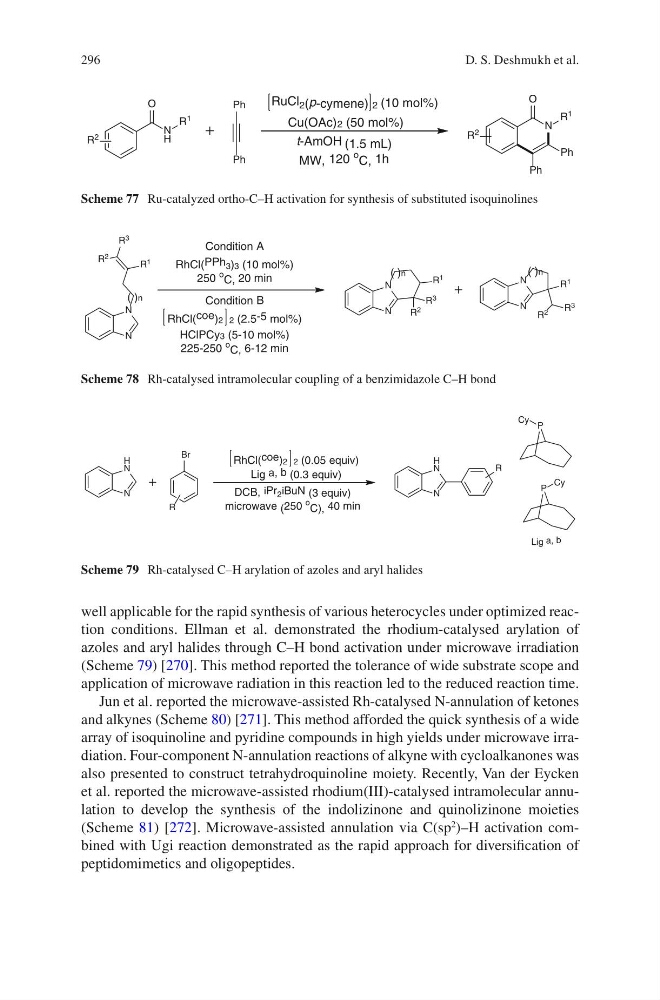
well applicable for the rapid synthesis of various heterocycles under optimized reaction conditions. Ellman et al. demonstrated the rhodium-catalysed arylation of
azoles and aryl halides through C–H bond activation under microwave irradiation
(Scheme 79) [270]. This method reported the tolerance of wide substrate scope and
application of microwave radiation in this reaction led to the reduced reaction time.
Jun et al. reported the microwave-assisted Rh-catalysed N-annulation of ketones
and alkynes (Scheme 80) [271]. This method afforded the quick synthesis of a wide
array of isoquinoline and pyridine compounds in high yields under microwave irradiation. Four-component N-annulation reactions of alkyne with cycloalkanones was
also presented to construct tetrahydroquinoline moiety. Recently, Van der Eycken
et al. reported the microwave-assisted rhodium(III)-catalysed intramolecular annulation to develop the synthesis of the indolizinone and quinolizinone moieties
(Scheme 81) [272]. Microwave-assisted annulation via C(sp
2
)–H activation combined with Ugi reaction demonstrated as the rapid approach for diversification of
peptidomimetics and oligopeptides.
O
N
H
R 2
RuCl 2( p-cymene) 2 (10 mol%)
Cu(OAc)2 (50 mol%)
t-AmOH (1.5 mL)
MW, 120
o C, 1h
R 2
Ph
Ph
N
O
Ph
Ph
R 1
R 1
Scheme 77 Ru-catalyzed ortho-C–H activation for synthesis of substituted isoquinolines
Condition A
RhCl( PPh 3)3 (10 mol%)
250
o C, 20 min
Condition B
RhCl( coe )2 2 (2.5 -5 mol%)
HClPCy3 (5-10 mol%)
225-250
o C, 6-12 min
N
N
R 1
R 3
R 2
N
N
N
N
R 1
R 2
R 3
R 1
R 2
R 3
( )n
( )n
( )n
Scheme 78 Rh-catalysed intramolecular coupling of a benzimidazole C–H bond
RhCl( coe )2 2 (0.05 equiv)
Lig a, b (0.3 equiv)
N
H
N
Br
R
N
H
N
R
P
Cy
P
Cy
Lig a, b
DCB, iPr 2 iBuN (3 equiv)
microwave ( 250
o C), 40 min
Scheme 79 Rh-catalysed C–H arylation of azoles and aryl halides
D. S. Deshmukh et al.
well applicable for the rapid synthesis of various heterocycles under optimized reaction conditions. Ellman et al. demonstrated the rhodium-catalysed arylation of
azoles and aryl halides through C–H bond activation under microwave irradiation
(Scheme 79) [270]. This method reported the tolerance of wide substrate scope and
application of microwave radiation in this reaction led to the reduced reaction time.
Jun et al. reported the microwave-assisted Rh-catalysed N-annulation of ketones
and alkynes (Scheme 80) [271]. This method afforded the quick synthesis of a wide
array of isoquinoline and pyridine compounds in high yields under microwave irradiation. Four-component N-annulation reactions of alkyne with cycloalkanones was
also presented to construct tetrahydroquinoline moiety. Recently, Van der Eycken
et al. reported the microwave-assisted rhodium(III)-catalysed intramolecular annulation to develop the synthesis of the indolizinone and quinolizinone moieties
(Scheme 81) [272]. Microwave-assisted annulation via C(sp
2
)–H activation combined with Ugi reaction demonstrated as the rapid approach for diversification of
peptidomimetics and oligopeptides.
O
N
H
R 2
RuCl 2( p-cymene) 2 (10 mol%)
Cu(OAc)2 (50 mol%)
t-AmOH (1.5 mL)
MW, 120
o C, 1h
R 2
Ph
Ph
N
O
Ph
Ph
R 1
R 1
Scheme 77 Ru-catalyzed ortho-C–H activation for synthesis of substituted isoquinolines
Condition A
RhCl( PPh 3)3 (10 mol%)
250
o C, 20 min
Condition B
RhCl( coe )2 2 (2.5 -5 mol%)
HClPCy3 (5-10 mol%)
225-250
o C, 6-12 min
N
N
R 1
R 3
R 2
N
N
N
N
R 1
R 2
R 3
R 1
R 2
R 3
( )n
( )n
( )n
Scheme 78 Rh-catalysed intramolecular coupling of a benzimidazole C–H bond
RhCl( coe )2 2 (0.05 equiv)
Lig a, b (0.3 equiv)
N
H
N
Br
R
N
H
N
R
P
Cy
P
Cy
Lig a, b
DCB, iPr 2 iBuN (3 equiv)
microwave ( 250
o C), 40 min
Scheme 79 Rh-catalysed C–H arylation of azoles and aryl halides
D. S. Deshmukh et al.