

295
Pd(OAc)2 (5 mol%)
Ag 3 PO 4 (50 mol%)
4-CF 3 C 6 H 4 I (3 equiv)
AcOH (30 equiv)
H 2 O (40 equiv)
MW, 180
o C, 50 min
N
O
N
O
CO 2 H
CF 3
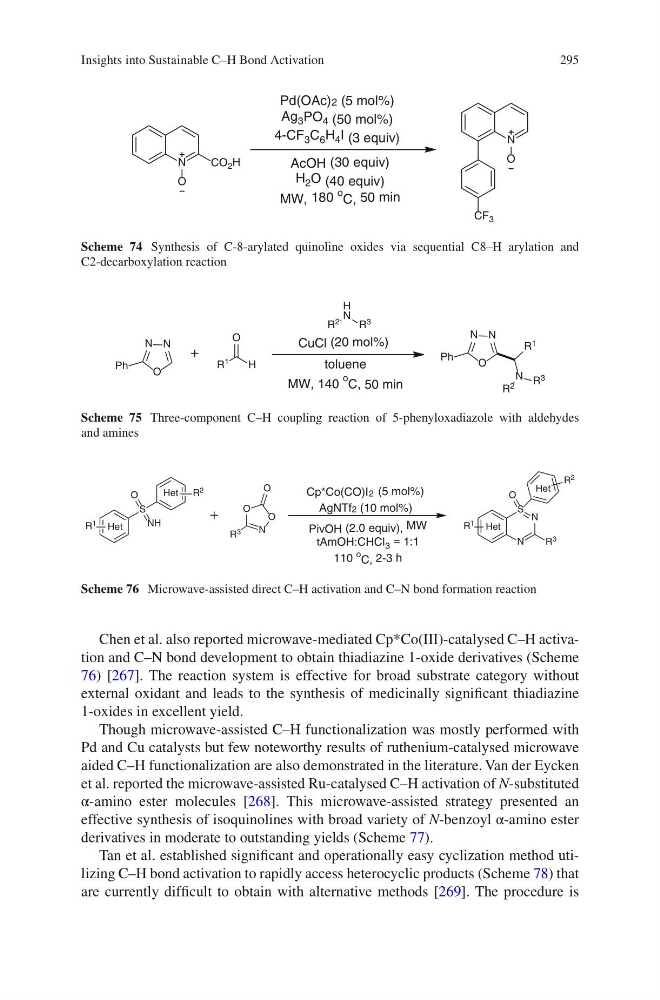
Scheme 74 Synthesis of C-8-arylated quinoline oxides via sequential C8–H arylation and
C2-decarboxylation reaction
CuCl (20 mol%)
toluene
MW, 140
o C, 50 min
R 1
H
O
N
O
N
Ph
R 2
H
N R 3
N
O
N
Ph
N
R 2
R 3
R 1
Scheme 75 Three-component C–H coupling reaction of 5-phenyloxadiazole with aldehydes
and amines
S
R 1
Cp*Co(CO)I2 (5 mol%)
AgNTf2 (10 mol%)
PivOH (2.0 equiv), MW
tAmOH:CHCl 3 = 1:1
110
o C, 2-3 h
O
NH
R 2
O
N
O
O
R 3
S
R 1
O
R 2
N
N
R 3
Het
Het
Het
Het
Scheme 76 Microwave-assisted direct C–H activation and C–N bond formation reaction
Chen et al. also reported microwave-mediated Cp*Co(III)-catalysed C–H activation and C–N bond development to obtain thiadiazine 1-oxide derivatives (Scheme
76) [267]. The reaction system is effective for broad substrate category without
external oxidant and leads to the synthesis of medicinally significant thiadiazine
1-oxides in excellent yield.
Though microwave-assisted C–H functionalization was mostly performed with
Pd and Cu catalysts but few noteworthy results of ruthenium-catalysed microwave
aided C–H functionalization are also demonstrated in the literature. Van der Eycken
et al. reported the microwave-assisted Ru-catalysed C–H activation of N-substituted
α-amino ester molecules [268]. This microwave-assisted strategy presented an
effective synthesis of isoquinolines with broad variety of N-benzoyl α-amino ester
derivatives in moderate to outstanding yields (Scheme 77).
Tan et al. established significant and operationally easy cyclization method utilizing C–H bond activation to rapidly access heterocyclic products (Scheme 78) that
are currently difficult to obtain with alternative methods [269]. The procedure is
Insights into Sustainable C–H Bond Activation
Pd(OAc)2 (5 mol%)
Ag 3 PO 4 (50 mol%)
4-CF 3 C 6 H 4 I (3 equiv)
AcOH (30 equiv)
H 2 O (40 equiv)
MW, 180
o C, 50 min
N
O
N
O
CO 2 H
CF 3
Scheme 74 Synthesis of C-8-arylated quinoline oxides via sequential C8–H arylation and
C2-decarboxylation reaction
CuCl (20 mol%)
toluene
MW, 140
o C, 50 min
R 1
H
O
N
O
N
Ph
R 2
H
N R 3
N
O
N
Ph
N
R 2
R 3
R 1
Scheme 75 Three-component C–H coupling reaction of 5-phenyloxadiazole with aldehydes
and amines
S
R 1
Cp*Co(CO)I2 (5 mol%)
AgNTf2 (10 mol%)
PivOH (2.0 equiv), MW
tAmOH:CHCl 3 = 1:1
110
o C, 2-3 h
O
NH
R 2
O
N
O
O
R 3
S
R 1
O
R 2
N
N
R 3
Het
Het
Het
Het
Scheme 76 Microwave-assisted direct C–H activation and C–N bond formation reaction
Chen et al. also reported microwave-mediated Cp*Co(III)-catalysed C–H activation and C–N bond development to obtain thiadiazine 1-oxide derivatives (Scheme
76) [267]. The reaction system is effective for broad substrate category without
external oxidant and leads to the synthesis of medicinally significant thiadiazine
1-oxides in excellent yield.
Though microwave-assisted C–H functionalization was mostly performed with
Pd and Cu catalysts but few noteworthy results of ruthenium-catalysed microwave
aided C–H functionalization are also demonstrated in the literature. Van der Eycken
et al. reported the microwave-assisted Ru-catalysed C–H activation of N-substituted
α-amino ester molecules [268]. This microwave-assisted strategy presented an
effective synthesis of isoquinolines with broad variety of N-benzoyl α-amino ester
derivatives in moderate to outstanding yields (Scheme 77).
Tan et al. established significant and operationally easy cyclization method utilizing C–H bond activation to rapidly access heterocyclic products (Scheme 78) that
are currently difficult to obtain with alternative methods [269]. The procedure is
Insights into Sustainable C–H Bond Activation