

285
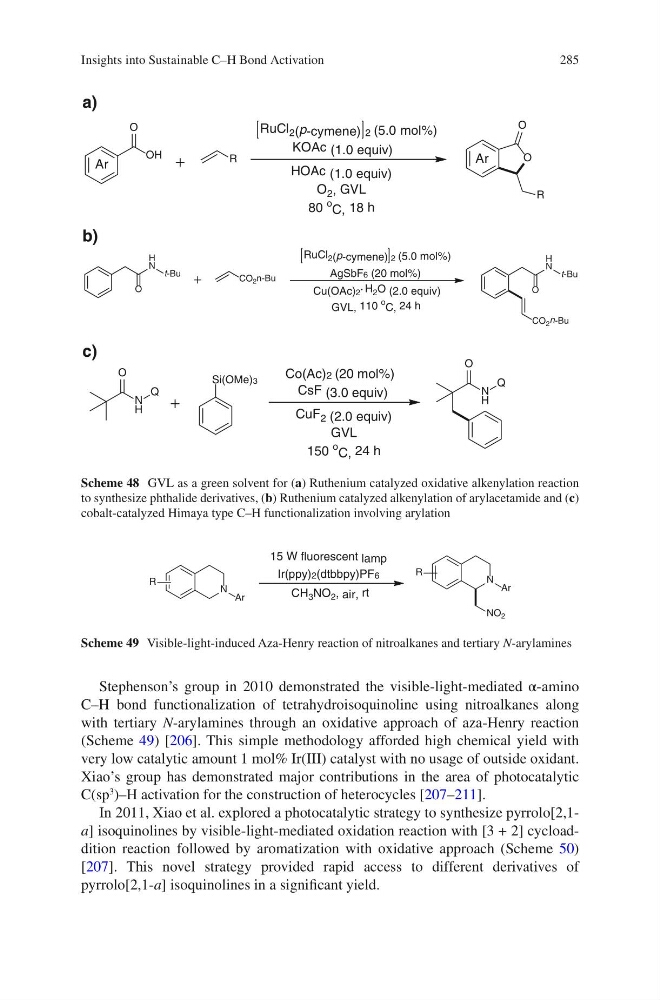
Stephenson’s group in 2010 demonstrated the visible-light-mediated α-amino
C–H bond functionalization of tetrahydroisoquinoline using nitroalkanes along
with tertiary N-arylamines through an oxidative approach of aza-Henry reaction
(Scheme 49) [206]. This simple methodology afforded high chemical yield with
very low catalytic amount 1 mol% Ir(III) catalyst with no usage of outside oxidant.
Xiao’s group has demonstrated major contributions in the area of photocatalytic
C(sp
3
)–H activation for the construction of heterocycles [207–211].
In 2011, Xiao et al. explored a photocatalytic strategy to synthesize pyrrolo[2,1a] isoquinolines by visible-light-mediated oxidation reaction with [3 + 2] cycloaddition reaction followed by aromatization with oxidative approach (Scheme 50)
[207]. This novel strategy provided rapid access to different derivatives of
pyrrolo[2,1-a] isoquinolines in a significant yield.
a)
O
RuCl 2( p-cymene) 2 (5.0 mol%)
KOAc (1.0 equiv)
HOAc (1.0 equiv)
O 2 , GVL
80
o C, 18 h
R
OH
O
O
R
Ar
Ar
b)
CO 2 n-Bu
H
N
O
t-Bu
H
N
O
t-Bu
RuCl 2( p-cymene) 2 (5.0 mol%)
AgSbF6 (20 mol%)
GVL, 110
o C, 24 h
Cu(OAc)2 H 2 O (2.0 equiv)
CO 2 n-Bu
c)
CsF (3.0 equiv)
CuF 2 (2.0 equiv)
GVL
150
o C, 24 h
N
H
O
Q
Si(OMe)3
N
H
O
Q
Co(Ac)2 (20 mol%)
Scheme 48 GVL as a green solvent for (a) Ruthenium catalyzed oxidative alkenylation reaction
to synthesize phthalide derivatives, (b) Ruthenium catalyzed alkenylation of arylacetamide and (c)
cobalt-catalyzed Himaya type C–H functionalization involving arylation
15 W fluorescent lamp
Ir(ppy)2(dtbbpy)PF6
CH 3 NO 2 , air, rt
R
N Ar
NO 2
R
N Ar
Scheme 49 Visible-light-induced Aza-Henry reaction of nitroalkanes and tertiary N-arylamines
Insights into Sustainable C–H Bond Activation
Stephenson’s group in 2010 demonstrated the visible-light-mediated α-amino
C–H bond functionalization of tetrahydroisoquinoline using nitroalkanes along
with tertiary N-arylamines through an oxidative approach of aza-Henry reaction
(Scheme 49) [206]. This simple methodology afforded high chemical yield with
very low catalytic amount 1 mol% Ir(III) catalyst with no usage of outside oxidant.
Xiao’s group has demonstrated major contributions in the area of photocatalytic
C(sp
3
)–H activation for the construction of heterocycles [207–211].
In 2011, Xiao et al. explored a photocatalytic strategy to synthesize pyrrolo[2,1a] isoquinolines by visible-light-mediated oxidation reaction with [3 + 2] cycloaddition reaction followed by aromatization with oxidative approach (Scheme 50)
[207]. This novel strategy provided rapid access to different derivatives of
pyrrolo[2,1-a] isoquinolines in a significant yield.
a)
O
RuCl 2( p-cymene) 2 (5.0 mol%)
KOAc (1.0 equiv)
HOAc (1.0 equiv)
O 2 , GVL
80
o C, 18 h
R
OH
O
O
R
Ar
Ar
b)
CO 2 n-Bu
H
N
O
t-Bu
H
N
O
t-Bu
RuCl 2( p-cymene) 2 (5.0 mol%)
AgSbF6 (20 mol%)
GVL, 110
o C, 24 h
Cu(OAc)2 H 2 O (2.0 equiv)
CO 2 n-Bu
c)
CsF (3.0 equiv)
CuF 2 (2.0 equiv)
GVL
150
o C, 24 h
N
H
O
Q
Si(OMe)3
N
H
O
Q
Co(Ac)2 (20 mol%)
Scheme 48 GVL as a green solvent for (a) Ruthenium catalyzed oxidative alkenylation reaction
to synthesize phthalide derivatives, (b) Ruthenium catalyzed alkenylation of arylacetamide and (c)
cobalt-catalyzed Himaya type C–H functionalization involving arylation
15 W fluorescent lamp
Ir(ppy)2(dtbbpy)PF6
CH 3 NO 2 , air, rt
R
N Ar
NO 2
R
N Ar
Scheme 49 Visible-light-induced Aza-Henry reaction of nitroalkanes and tertiary N-arylamines
Insights into Sustainable C–H Bond Activation