

286
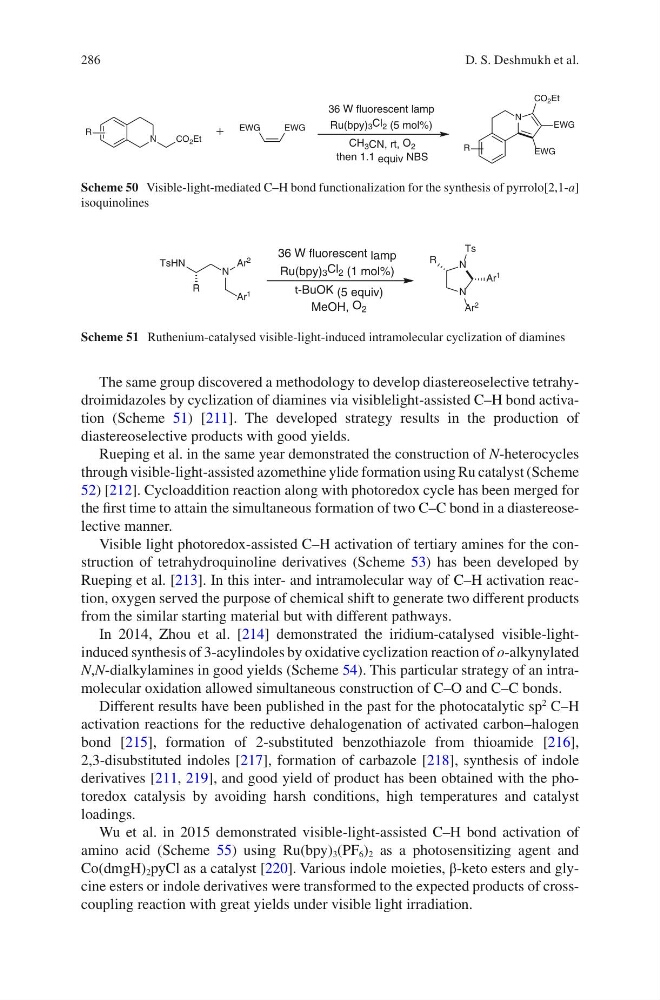
The same group discovered a methodology to develop diastereoselective tetrahydroimidazoles by cyclization of diamines via visiblelight-assisted C–H bond activation (Scheme 51) [211]. The developed strategy results in the production of
diastereoselective products with good yields.
Rueping et al. in the same year demonstrated the construction of N-heterocycles
through visible-light-assisted azomethine ylide formation using Ru catalyst (Scheme
52) [212]. Cycloaddition reaction along with photoredox cycle has been merged for
the first time to attain the simultaneous formation of two C–C bond in a diastereoselective manner.
Visible light photoredox-assisted C–H activation of tertiary amines for the construction of tetrahydroquinoline derivatives (Scheme 53) has been developed by
Rueping et al. [213]. In this inter- and intramolecular way of C–H activation reaction, oxygen served the purpose of chemical shift to generate two different products
from the similar starting material but with different pathways.
In 2014, Zhou et al. [214] demonstrated the iridium-catalysed visible-lightinduced synthesis of 3-acylindoles by oxidative cyclization reaction of o- alkynylated
N,N-dialkylamines in good yields (Scheme 54). This particular strategy of an intramolecular oxidation allowed simultaneous construction of C–O and C–C bonds.
Different results have been published in the past for the photocatalytic sp
2
C–H
activation reactions for the reductive dehalogenation of activated carbon–halogen
bond [215], formation of 2-substituted benzothiazole from thioamide [216],
2,3-disubstituted indoles [217], formation of carbazole [218], synthesis of indole
derivatives [211, 219], and good yield of product has been obtained with the photoredox catalysis by avoiding harsh conditions, high temperatures and catalyst
loadings.
Wu et al. in 2015 demonstrated visible-light-assisted C–H bond activation of
amino acid (Scheme 55) using Ru(bpy) 3 (PF 6 ) 2 as a photosensitizing agent and
Co(dmgH) 2 pyCl as a catalyst [220]. Various indole moieties, β-keto esters and glycine esters or indole derivatives were transformed to the expected products of crosscoupling reaction with great yields under visible light irradiation.
36 W fluorescent lamp
Ru(bpy)3 Cl 2 (5 mol%)
CH 3CN, rt, O 2
then 1.1 equiv NBS
R
R
N
CO 2 Et
EWG
EWG
N
CO 2 Et
EWG
EWG
Scheme 50 Visible-light-mediated C–H bond functionalization for the synthesis of pyrrolo[2,1-a]
isoquinolines
36 W fluorescent lamp
Ru(bpy)3 Cl 2 (1 mol%)
t-BuOK (5 equiv)
MeOH, O 2
N
Ar 2
Ar 1
TsHN
R
N
N
Ts
Ar 2
R
Ar 1
Scheme 51 Ruthenium-catalysed visible-light-induced intramolecular cyclization of diamines
D. S. Deshmukh et al.
The same group discovered a methodology to develop diastereoselective tetrahydroimidazoles by cyclization of diamines via visiblelight-assisted C–H bond activation (Scheme 51) [211]. The developed strategy results in the production of
diastereoselective products with good yields.
Rueping et al. in the same year demonstrated the construction of N-heterocycles
through visible-light-assisted azomethine ylide formation using Ru catalyst (Scheme
52) [212]. Cycloaddition reaction along with photoredox cycle has been merged for
the first time to attain the simultaneous formation of two C–C bond in a diastereoselective manner.
Visible light photoredox-assisted C–H activation of tertiary amines for the construction of tetrahydroquinoline derivatives (Scheme 53) has been developed by
Rueping et al. [213]. In this inter- and intramolecular way of C–H activation reaction, oxygen served the purpose of chemical shift to generate two different products
from the similar starting material but with different pathways.
In 2014, Zhou et al. [214] demonstrated the iridium-catalysed visible-lightinduced synthesis of 3-acylindoles by oxidative cyclization reaction of o- alkynylated
N,N-dialkylamines in good yields (Scheme 54). This particular strategy of an intramolecular oxidation allowed simultaneous construction of C–O and C–C bonds.
Different results have been published in the past for the photocatalytic sp
2
C–H
activation reactions for the reductive dehalogenation of activated carbon–halogen
bond [215], formation of 2-substituted benzothiazole from thioamide [216],
2,3-disubstituted indoles [217], formation of carbazole [218], synthesis of indole
derivatives [211, 219], and good yield of product has been obtained with the photoredox catalysis by avoiding harsh conditions, high temperatures and catalyst
loadings.
Wu et al. in 2015 demonstrated visible-light-assisted C–H bond activation of
amino acid (Scheme 55) using Ru(bpy) 3 (PF 6 ) 2 as a photosensitizing agent and
Co(dmgH) 2 pyCl as a catalyst [220]. Various indole moieties, β-keto esters and glycine esters or indole derivatives were transformed to the expected products of crosscoupling reaction with great yields under visible light irradiation.
36 W fluorescent lamp
Ru(bpy)3 Cl 2 (5 mol%)
CH 3CN, rt, O 2
then 1.1 equiv NBS
R
R
N
CO 2 Et
EWG
EWG
N
CO 2 Et
EWG
EWG
Scheme 50 Visible-light-mediated C–H bond functionalization for the synthesis of pyrrolo[2,1-a]
isoquinolines
36 W fluorescent lamp
Ru(bpy)3 Cl 2 (1 mol%)
t-BuOK (5 equiv)
MeOH, O 2
N
Ar 2
Ar 1
TsHN
R
N
N
Ts
Ar 2
R
Ar 1
Scheme 51 Ruthenium-catalysed visible-light-induced intramolecular cyclization of diamines
D. S. Deshmukh et al.