

284
6 Photocatalytic C–H Bond Activations
Heterocyclic compounds involving a variety of natural compounds and synthesized
pharmaceutical moieties occur in a broad scope of biologically active molecules. In
the course of the past decade, synthesis of heterocyclic compounds through C–H
activation reaction has attracted increasing attention from organic chemists [23,
153, 195–198]. Due to its eco-friendly and energy-conversant features, visiblelight- mediated photoredoxcatalysis has experienced quick improvement over the
previous decade. As of late, the utilization C–H functionalization by visible lightmediated photocatalysis [199–201] for the development of heterocyclic frameworks
has risen as developing area in the organic synthesis [195–202]. Functionalization
of different classes of organic compounds comprising ethers, alcohols, aldehydes,
ketones, amides, esters, nitriles, alkyl aromatics, and alkanes could be performed by
photocatalysed C–H functionalization [203–205]. This section of the book chapter
gives an overview of the representative examples of C–H activations with the aid of
photocatalysis.
a)
norbornene (65 mol%)
K 2 CO 3 (1.7 equiv)
GVL
105
o C, 24 h
Pd EnCat TM 30 (5.0 mol%)
CO 2 Me
I
R
CO 2 Me
R
MeO 2 C
b)
MesCO 2 H (30 mol%)
KTFA (3.0 equiv)
GVL
150
o C, 16 h
Pd/C (5.0 mol%)
N
N
N
R 2
R 1
Br
Ar
N
N
N
R 2
R 1
Ar
c)
MesCO 2 H (20 mol%)
TBAAc (2.0 equiv)
GVL
120
o C, 80 min
Pd/C
Br
O
N
N
N
Bn
O
N
N
N
Bn
Pd/C: packed in a coil flow reactor
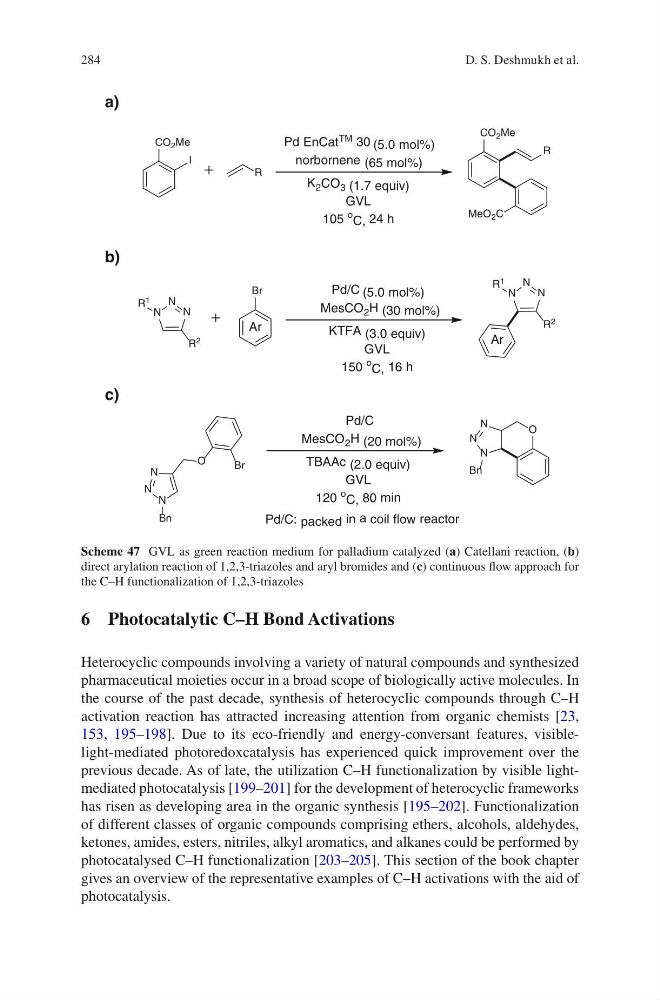
Scheme 47 GVL as green reaction medium for palladium catalyzed (a) Catellani reaction, (b)
direct arylation reaction of 1,2,3-triazoles and aryl bromides and (c) continuous flow approach for
the C–H functionalization of 1,2,3-triazoles
D. S. Deshmukh et al.
6 Photocatalytic C–H Bond Activations
Heterocyclic compounds involving a variety of natural compounds and synthesized
pharmaceutical moieties occur in a broad scope of biologically active molecules. In
the course of the past decade, synthesis of heterocyclic compounds through C–H
activation reaction has attracted increasing attention from organic chemists [23,
153, 195–198]. Due to its eco-friendly and energy-conversant features, visiblelight- mediated photoredoxcatalysis has experienced quick improvement over the
previous decade. As of late, the utilization C–H functionalization by visible lightmediated photocatalysis [199–201] for the development of heterocyclic frameworks
has risen as developing area in the organic synthesis [195–202]. Functionalization
of different classes of organic compounds comprising ethers, alcohols, aldehydes,
ketones, amides, esters, nitriles, alkyl aromatics, and alkanes could be performed by
photocatalysed C–H functionalization [203–205]. This section of the book chapter
gives an overview of the representative examples of C–H activations with the aid of
photocatalysis.
a)
norbornene (65 mol%)
K 2 CO 3 (1.7 equiv)
GVL
105
o C, 24 h
Pd EnCat TM 30 (5.0 mol%)
CO 2 Me
I
R
CO 2 Me
R
MeO 2 C
b)
MesCO 2 H (30 mol%)
KTFA (3.0 equiv)
GVL
150
o C, 16 h
Pd/C (5.0 mol%)
N
N
N
R 2
R 1
Br
Ar
N
N
N
R 2
R 1
Ar
c)
MesCO 2 H (20 mol%)
TBAAc (2.0 equiv)
GVL
120
o C, 80 min
Pd/C
Br
O
N
N
N
Bn
O
N
N
N
Bn
Pd/C: packed in a coil flow reactor
Scheme 47 GVL as green reaction medium for palladium catalyzed (a) Catellani reaction, (b)
direct arylation reaction of 1,2,3-triazoles and aryl bromides and (c) continuous flow approach for
the C–H functionalization of 1,2,3-triazoles
D. S. Deshmukh et al.