

283
Various palladium-catalysed C–H activation reactions using GVL as a green solvent has been reported in the literature [185]. Few representative examples are mentioned here. In 2016, Ackermann and Vaccaro demonstrated the utilization of GVL
as a green solvent for palladium-catalysed Catellani reaction and effectiveness of
GVL was observed over other classical solvents like DMF, NMP and MeCN [189].
Use of two palladium sources viz. Pd EnCat 30 and Pd/Al 2 O 3 was demonstrated for
reaction (Scheme 47a) and the later found to be very robust in nature due to low
leaching (~2 ppm) and recyclability of the catalyst. Direct arylation reaction of
1,2,3-triazoles and aryl bromides was represented by the same groups using Pd/C
catalyst and GVL as solvent (Scheme 47b) [190] and found to be effective for wide
functional group tolerance and excellent position selectivity with high yields.
Moreover, Ackermann and Vaccaro et al. explored the continuous flow C−H functionalization of 1,2,3-triazoles with the use of Pd/C catalyst and organic base and
GVL as a solvent (Scheme 47c) [191]. This demonstrated continuous flow strategy
led to the great durability, efficient recovery and recyclability of the catalyst.
Very few examples of the Ruthenium-catalysed C–H functionalization methods
using GVL as a reaction medium has been developed by Ackerman group (Scheme
48) [183–188]. Ruthenium-catalysed oxidative alkenylation reaction to synthesize
phthalide derivatives from alkenes and aryl carboxylic acids is reported using
molecular oxygen playing a role of an oxidant and GVL as a reaction media (Scheme
48a) [192]. Alkenylation of arylacetamide was performed in the GVL solvent by
Ackerman’s group (Scheme 48b) [193].
GVL solvent found to be beneficial for cobalt-catalysed Himaya type C–H functionalization involving arylation of interesting C(sp
3
)–H bond (Scheme 48c) [194].
dppe (15 mol%)
PhMgBr (3.45 equiv)
2-MeTHF
65
o C, 9 min
Fe(acac)3 (10 mol%)
Ar
Ar
N
H
O
N
Br
R
Ar
Ar
N
H
O
N
N
H
O
Q
R
a) primary alkylation
b) secondary alkylation
dppe (11 mol%)
PhMgBr (4.1 equiv)
BHT (1.0 equiv)
2-MeTHF
65
o C, 5 min
Fe(acac)3 (10 mol%)
Br
O
N
H
Q
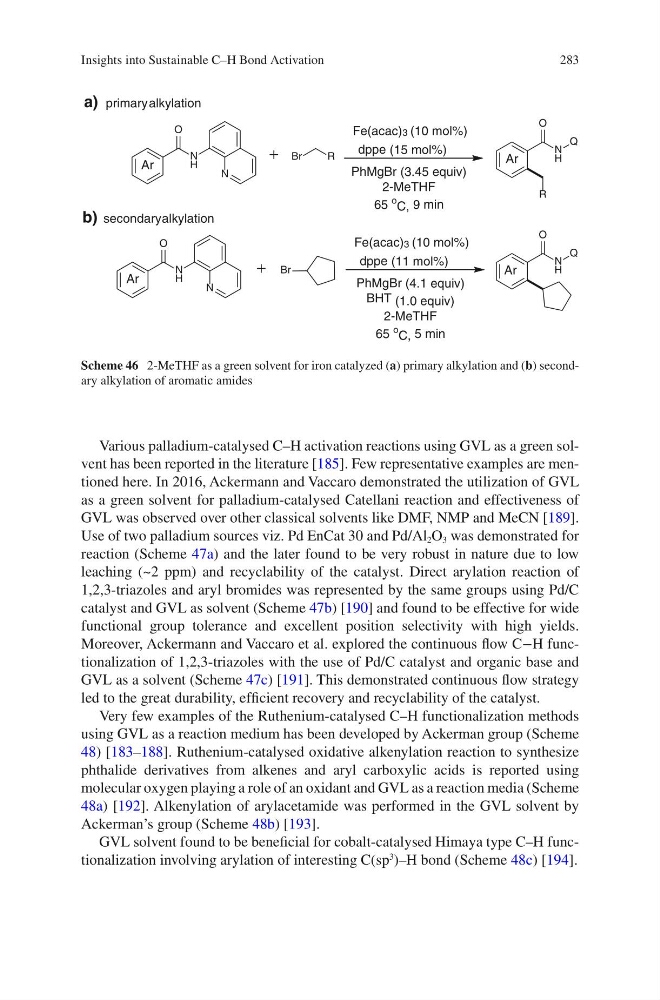
Scheme 46 2-MeTHF as a green solvent for iron catalyzed (a) primary alkylation and (b) secondary alkylation of aromatic amides
Insights into Sustainable C–H Bond Activation
Various palladium-catalysed C–H activation reactions using GVL as a green solvent has been reported in the literature [185]. Few representative examples are mentioned here. In 2016, Ackermann and Vaccaro demonstrated the utilization of GVL
as a green solvent for palladium-catalysed Catellani reaction and effectiveness of
GVL was observed over other classical solvents like DMF, NMP and MeCN [189].
Use of two palladium sources viz. Pd EnCat 30 and Pd/Al 2 O 3 was demonstrated for
reaction (Scheme 47a) and the later found to be very robust in nature due to low
leaching (~2 ppm) and recyclability of the catalyst. Direct arylation reaction of
1,2,3-triazoles and aryl bromides was represented by the same groups using Pd/C
catalyst and GVL as solvent (Scheme 47b) [190] and found to be effective for wide
functional group tolerance and excellent position selectivity with high yields.
Moreover, Ackermann and Vaccaro et al. explored the continuous flow C−H functionalization of 1,2,3-triazoles with the use of Pd/C catalyst and organic base and
GVL as a solvent (Scheme 47c) [191]. This demonstrated continuous flow strategy
led to the great durability, efficient recovery and recyclability of the catalyst.
Very few examples of the Ruthenium-catalysed C–H functionalization methods
using GVL as a reaction medium has been developed by Ackerman group (Scheme
48) [183–188]. Ruthenium-catalysed oxidative alkenylation reaction to synthesize
phthalide derivatives from alkenes and aryl carboxylic acids is reported using
molecular oxygen playing a role of an oxidant and GVL as a reaction media (Scheme
48a) [192]. Alkenylation of arylacetamide was performed in the GVL solvent by
Ackerman’s group (Scheme 48b) [193].
GVL solvent found to be beneficial for cobalt-catalysed Himaya type C–H functionalization involving arylation of interesting C(sp
3
)–H bond (Scheme 48c) [194].
dppe (15 mol%)
PhMgBr (3.45 equiv)
2-MeTHF
65
o C, 9 min
Fe(acac)3 (10 mol%)
Ar
Ar
N
H
O
N
Br
R
Ar
Ar
N
H
O
N
N
H
O
Q
R
a) primary alkylation
b) secondary alkylation
dppe (11 mol%)
PhMgBr (4.1 equiv)
BHT (1.0 equiv)
2-MeTHF
65
o C, 5 min
Fe(acac)3 (10 mol%)
Br
O
N
H
Q
Scheme 46 2-MeTHF as a green solvent for iron catalyzed (a) primary alkylation and (b) secondary alkylation of aromatic amides
Insights into Sustainable C–H Bond Activation