

282
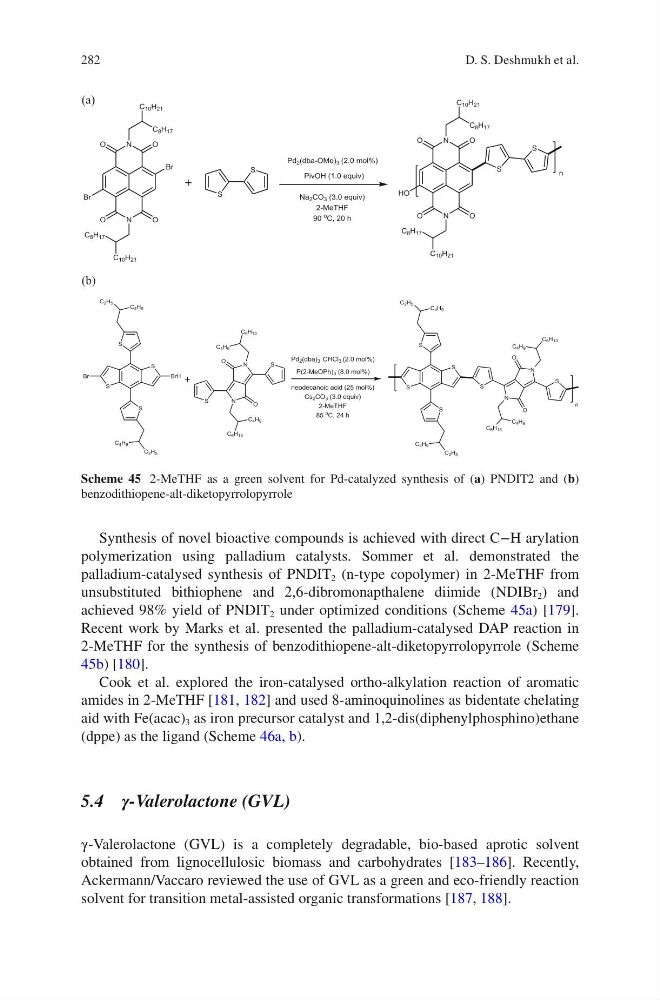
Synthesis of novel bioactive compounds is achieved with direct C−H arylation
polymerization using palladium catalysts. Sommer et al. demonstrated the
palladium- catalysed synthesis of PNDIT 2 (n-type copolymer) in 2-MeTHF from
unsubstituted bithiophene and 2,6-dibromonapthalene diimide (NDIBr 2 ) and
achieved 98% yield of PNDIT 2 under optimized conditions (Scheme 45a) [179].
Recent work by Marks et al. presented the palladium-catalysed DAP reaction in
2-MeTHF for the synthesis of benzodithiopene-alt-diketopyrrolopyrrole (Scheme
45b) [180].
Cook et al. explored the iron-catalysed ortho-alkylation reaction of aromatic
amides in 2-MeTHF [181, 182] and used 8-aminoquinolines as bidentate chelating
aid with Fe(acac) 3 as iron precursor catalyst and 1,2-dis(diphenylphosphino)ethane
(dppe) as the ligand (Scheme 46a, b).
5.4 γ-Valerolactone (GVL)
γ-Valerolactone (GVL) is a completely degradable, bio-based aprotic solvent
obtained from lignocellulosic biomass and carbohydrates [183–186]. Recently,
Ackermann/Vaccaro reviewed the use of GVL as a green and eco-friendly reaction
solvent for transition metal-assisted organic transformations [187, 188].
(a)
(b)
Scheme 45 2-MeTHF as a green solvent for Pd-catalyzed synthesis of (a) PNDIT2 and (b)
benzodithiopene-alt-diketopyrrolopyrrole
D. S. Deshmukh et al.
Synthesis of novel bioactive compounds is achieved with direct C−H arylation
polymerization using palladium catalysts. Sommer et al. demonstrated the
palladium- catalysed synthesis of PNDIT 2 (n-type copolymer) in 2-MeTHF from
unsubstituted bithiophene and 2,6-dibromonapthalene diimide (NDIBr 2 ) and
achieved 98% yield of PNDIT 2 under optimized conditions (Scheme 45a) [179].
Recent work by Marks et al. presented the palladium-catalysed DAP reaction in
2-MeTHF for the synthesis of benzodithiopene-alt-diketopyrrolopyrrole (Scheme
45b) [180].
Cook et al. explored the iron-catalysed ortho-alkylation reaction of aromatic
amides in 2-MeTHF [181, 182] and used 8-aminoquinolines as bidentate chelating
aid with Fe(acac) 3 as iron precursor catalyst and 1,2-dis(diphenylphosphino)ethane
(dppe) as the ligand (Scheme 46a, b).
5.4 γ-Valerolactone (GVL)
γ-Valerolactone (GVL) is a completely degradable, bio-based aprotic solvent
obtained from lignocellulosic biomass and carbohydrates [183–186]. Recently,
Ackermann/Vaccaro reviewed the use of GVL as a green and eco-friendly reaction
solvent for transition metal-assisted organic transformations [187, 188].
(a)
(b)
Scheme 45 2-MeTHF as a green solvent for Pd-catalyzed synthesis of (a) PNDIT2 and (b)
benzodithiopene-alt-diketopyrrolopyrrole
D. S. Deshmukh et al.