

276
4.8 Other Internal Oxidizing Directing Groups
In addition to the above-mentioned bonds, some other functional groups are also
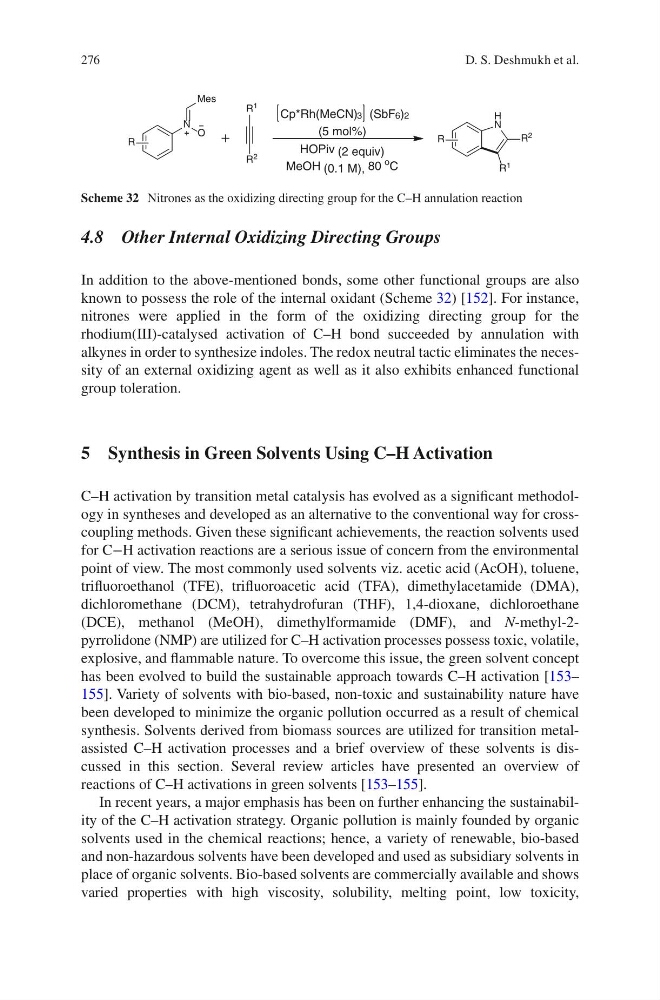
known to possess the role of the internal oxidant (Scheme 32) [152]. For instance,
nitrones were applied in the form of the oxidizing directing group for the
rhodium(III)-catalysed activation of C–H bond succeeded by annulation with
alkynes in order to synthesize indoles. The redox neutral tactic eliminates the necessity of an external oxidizing agent as well as it also exhibits enhanced functional
group toleration.
5 Synthesis in Green Solvents Using C–H Activation
C–H activation by transition metal catalysis has evolved as a significant methodology in syntheses and developed as an alternative to the conventional way for crosscoupling methods. Given these significant achievements, the reaction solvents used
for C−H activation reactions are a serious issue of concern from the environmental
point of view. The most commonly used solvents viz. acetic acid (AcOH), toluene,
trifluoroethanol (TFE), trifluoroacetic acid (TFA), dimethylacetamide (DMA),
dichloromethane (DCM), tetrahydrofuran (THF), 1,4-dioxane, dichloroethane
(DCE), methanol (MeOH), dimethylformamide (DMF), and N-methyl-2pyrrolidone (NMP) are utilized for C–H activation processes possess toxic, volatile,
explosive, and flammable nature. To overcome this issue, the green solvent concept
has been evolved to build the sustainable approach towards C–H activation [153–
155]. Variety of solvents with bio-based, non-toxic and sustainability nature have
been developed to minimize the organic pollution occurred as a result of chemical
synthesis. Solvents derived from biomass sources are utilized for transition metalassisted C–H activation processes and a brief overview of these solvents is discussed in this section. Several review articles have presented an overview of
reactions of C–H activations in green solvents [153–155].
In recent years, a major emphasis has been on further enhancing the sustainability of the C–H activation strategy. Organic pollution is mainly founded by organic
solvents used in the chemical reactions; hence, a variety of renewable, bio-based
and non-hazardous solvents have been developed and used as subsidiary solvents in
place of organic solvents. Bio-based solvents are commercially available and shows
varied properties with high viscosity, solubility, melting point, low toxicity,
N
R
Cp*Rh(MeCN)3 (SbF6)2
(5 mol%)
HOPiv (2 equiv)
MeOH (0.1 M), 80
o
C
R
R 1
R 2
O
Mes
H
N
R 2
R 1
Scheme 32 Nitrones as the oxidizing directing group for the C–H annulation reaction
D. S. Deshmukh et al.
4.8 Other Internal Oxidizing Directing Groups
In addition to the above-mentioned bonds, some other functional groups are also
known to possess the role of the internal oxidant (Scheme 32) [152]. For instance,
nitrones were applied in the form of the oxidizing directing group for the
rhodium(III)-catalysed activation of C–H bond succeeded by annulation with
alkynes in order to synthesize indoles. The redox neutral tactic eliminates the necessity of an external oxidizing agent as well as it also exhibits enhanced functional
group toleration.
5 Synthesis in Green Solvents Using C–H Activation
C–H activation by transition metal catalysis has evolved as a significant methodology in syntheses and developed as an alternative to the conventional way for crosscoupling methods. Given these significant achievements, the reaction solvents used
for C−H activation reactions are a serious issue of concern from the environmental
point of view. The most commonly used solvents viz. acetic acid (AcOH), toluene,
trifluoroethanol (TFE), trifluoroacetic acid (TFA), dimethylacetamide (DMA),
dichloromethane (DCM), tetrahydrofuran (THF), 1,4-dioxane, dichloroethane
(DCE), methanol (MeOH), dimethylformamide (DMF), and N-methyl-2pyrrolidone (NMP) are utilized for C–H activation processes possess toxic, volatile,
explosive, and flammable nature. To overcome this issue, the green solvent concept
has been evolved to build the sustainable approach towards C–H activation [153–
155]. Variety of solvents with bio-based, non-toxic and sustainability nature have
been developed to minimize the organic pollution occurred as a result of chemical
synthesis. Solvents derived from biomass sources are utilized for transition metalassisted C–H activation processes and a brief overview of these solvents is discussed in this section. Several review articles have presented an overview of
reactions of C–H activations in green solvents [153–155].
In recent years, a major emphasis has been on further enhancing the sustainability of the C–H activation strategy. Organic pollution is mainly founded by organic
solvents used in the chemical reactions; hence, a variety of renewable, bio-based
and non-hazardous solvents have been developed and used as subsidiary solvents in
place of organic solvents. Bio-based solvents are commercially available and shows
varied properties with high viscosity, solubility, melting point, low toxicity,
N
R
Cp*Rh(MeCN)3 (SbF6)2
(5 mol%)
HOPiv (2 equiv)
MeOH (0.1 M), 80
o
C
R
R 1
R 2
O
Mes
H
N
R 2
R 1
Scheme 32 Nitrones as the oxidizing directing group for the C–H annulation reaction
D. S. Deshmukh et al.