

275
O
O
R 2
R 1
Ru(p-cymene)Cl2 2 (2.5 mol%)
DCE/H 2 O (9:1),
80
o C, 36 h
R 1
R 2
R
R
CsOAc (20 mol%)
R 3 COOH
N
H
O
OH
NH
O
R 3
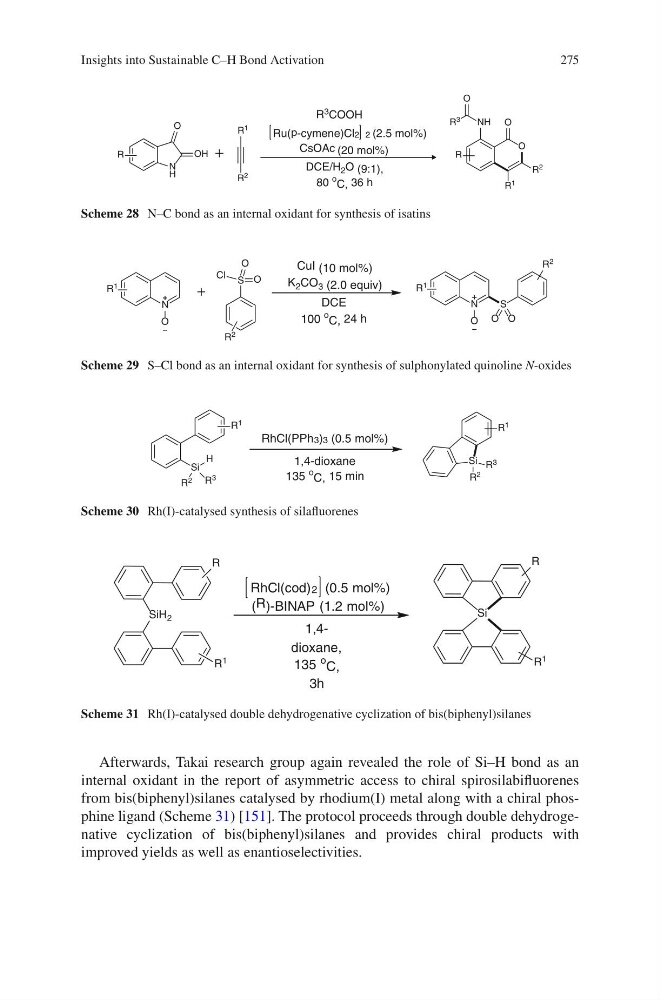
Scheme 28 N–C bond as an internal oxidant for synthesis of isatins
R 1
CuI (10 mol%)
K 2 CO 3 (2.0 equiv)
DCE
100
o
C, 24 h
N
O
S
Cl
O
O
R 2
R 1
N
O
S
O O
R 2
Scheme 29 S–Cl bond as an internal oxidant for synthesis of sulphonylated quinoline N-oxides
RhCl(PPh3)3 (0.5 mol%)
1,4-dioxane
135
o C, 15 min
R 1
Si
R 2 R 3
H
R 1
Si
R 2
R 3
Scheme 30 Rh(I)-catalysed synthesis of silafluorenes
RhCl(cod)2 (0.5 mol%)
( R )-BINAP (1.2 mol%)
1,4dioxane,
135
o C,
3h
SiH 2
R
R 1
Si
R
R 1
Scheme 31 Rh(I)-catalysed double dehydrogenative cyclization of bis(biphenyl)silanes
Afterwards, Takai research group again revealed the role of Si–H bond as an
internal oxidant in the report of asymmetric access to chiral spirosilabifluorenes
from bis(biphenyl)silanes catalysed by rhodium(I) metal along with a chiral phosphine ligand (Scheme 31) [151]. The protocol proceeds through double dehydrogenative cyclization of bis(biphenyl)silanes and provides chiral products with
improved yields as well as enantioselectivities.
Insights into Sustainable C–H Bond Activation
O
O
R 2
R 1
Ru(p-cymene)Cl2 2 (2.5 mol%)
DCE/H 2 O (9:1),
80
o C, 36 h
R 1
R 2
R
R
CsOAc (20 mol%)
R 3 COOH
N
H
O
OH
NH
O
R 3
Scheme 28 N–C bond as an internal oxidant for synthesis of isatins
R 1
CuI (10 mol%)
K 2 CO 3 (2.0 equiv)
DCE
100
o
C, 24 h
N
O
S
Cl
O
O
R 2
R 1
N
O
S
O O
R 2
Scheme 29 S–Cl bond as an internal oxidant for synthesis of sulphonylated quinoline N-oxides
RhCl(PPh3)3 (0.5 mol%)
1,4-dioxane
135
o C, 15 min
R 1
Si
R 2 R 3
H
R 1
Si
R 2
R 3
Scheme 30 Rh(I)-catalysed synthesis of silafluorenes
RhCl(cod)2 (0.5 mol%)
( R )-BINAP (1.2 mol%)
1,4dioxane,
135
o C,
3h
SiH 2
R
R 1
Si
R
R 1
Scheme 31 Rh(I)-catalysed double dehydrogenative cyclization of bis(biphenyl)silanes
Afterwards, Takai research group again revealed the role of Si–H bond as an
internal oxidant in the report of asymmetric access to chiral spirosilabifluorenes
from bis(biphenyl)silanes catalysed by rhodium(I) metal along with a chiral phosphine ligand (Scheme 31) [151]. The protocol proceeds through double dehydrogenative cyclization of bis(biphenyl)silanes and provides chiral products with
improved yields as well as enantioselectivities.
Insights into Sustainable C–H Bond Activation