

274
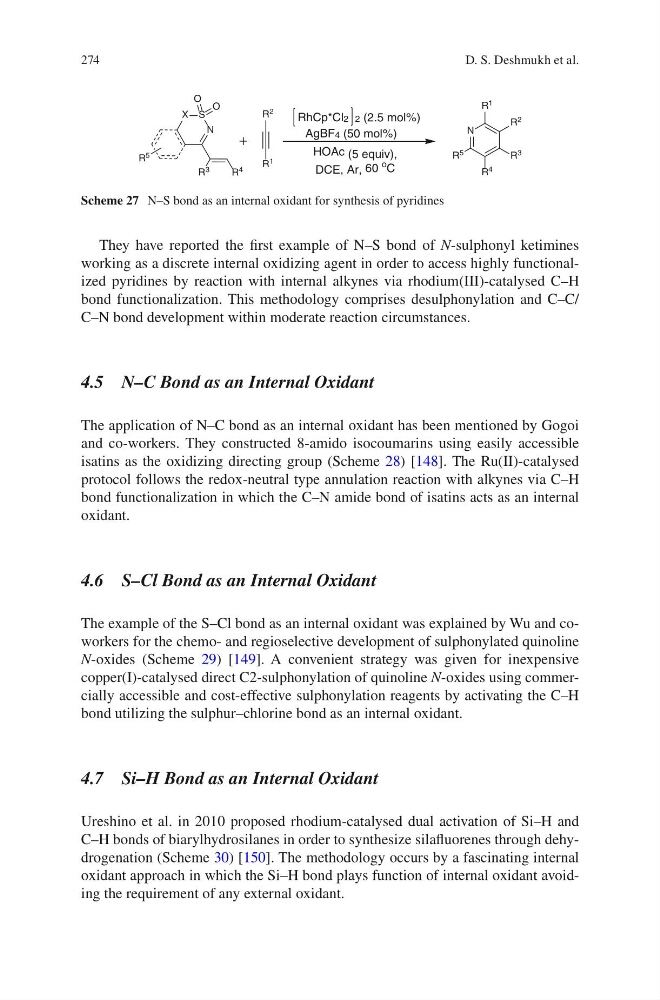
They have reported the first example of N–S bond of N-sulphonyl ketimines
working as a discrete internal oxidizing agent in order to access highly functionalized pyridines by reaction with internal alkynes via rhodium(III)-catalysed C–H
bond functionalization. This methodology comprises desulphonylation and C–C/
C–N bond development within moderate reaction circumstances.
4.5 N–C Bond as an Internal Oxidant
The application of N–C bond as an internal oxidant has been mentioned by Gogoi
and co-workers. They constructed 8-amido isocoumarins using easily accessible
isatins as the oxidizing directing group (Scheme 28) [148]. The Ru(II)-catalysed
protocol follows the redox-neutral type annulation reaction with alkynes via C–H
bond functionalization in which the C–N amide bond of isatins acts as an internal
oxidant.
4.6 S–Cl Bond as an Internal Oxidant
The example of the S–Cl bond as an internal oxidant was explained by Wu and coworkers for the chemo- and regioselective development of sulphonylated quinoline
N-oxides (Scheme 29) [149]. A convenient strategy was given for inexpensive
copper(I)-catalysed direct C2-sulphonylation of quinoline N-oxides using commercially accessible and cost-effective sulphonylation reagents by activating the C–H
bond utilizing the sulphur–chlorine bond as an internal oxidant.
4.7 Si–H Bond as an Internal Oxidant
Ureshino et al. in 2010 proposed rhodium-catalysed dual activation of Si–H and
C–H bonds of biarylhydrosilanes in order to synthesize silafluorenes through dehydrogenation (Scheme 30) [150]. The methodology occurs by a fascinating internal
oxidant approach in which the Si–H bond plays function of internal oxidant avoiding the requirement of any external oxidant.
RhCp*Cl2 2 (2.5 mol%)
AgBF4 (50 mol%)
HOAc (5 equiv),
DCE, Ar, 60
o C
R 2
R 1
N
S
X
R 5
R 3
R 4
O O
N
R 1
R 2
R 3
R 4
R 5
Scheme 27 N–S bond as an internal oxidant for synthesis of pyridines
D. S. Deshmukh et al.
They have reported the first example of N–S bond of N-sulphonyl ketimines
working as a discrete internal oxidizing agent in order to access highly functionalized pyridines by reaction with internal alkynes via rhodium(III)-catalysed C–H
bond functionalization. This methodology comprises desulphonylation and C–C/
C–N bond development within moderate reaction circumstances.
4.5 N–C Bond as an Internal Oxidant
The application of N–C bond as an internal oxidant has been mentioned by Gogoi
and co-workers. They constructed 8-amido isocoumarins using easily accessible
isatins as the oxidizing directing group (Scheme 28) [148]. The Ru(II)-catalysed
protocol follows the redox-neutral type annulation reaction with alkynes via C–H
bond functionalization in which the C–N amide bond of isatins acts as an internal
oxidant.
4.6 S–Cl Bond as an Internal Oxidant
The example of the S–Cl bond as an internal oxidant was explained by Wu and coworkers for the chemo- and regioselective development of sulphonylated quinoline
N-oxides (Scheme 29) [149]. A convenient strategy was given for inexpensive
copper(I)-catalysed direct C2-sulphonylation of quinoline N-oxides using commercially accessible and cost-effective sulphonylation reagents by activating the C–H
bond utilizing the sulphur–chlorine bond as an internal oxidant.
4.7 Si–H Bond as an Internal Oxidant
Ureshino et al. in 2010 proposed rhodium-catalysed dual activation of Si–H and
C–H bonds of biarylhydrosilanes in order to synthesize silafluorenes through dehydrogenation (Scheme 30) [150]. The methodology occurs by a fascinating internal
oxidant approach in which the Si–H bond plays function of internal oxidant avoiding the requirement of any external oxidant.
RhCp*Cl2 2 (2.5 mol%)
AgBF4 (50 mol%)
HOAc (5 equiv),
DCE, Ar, 60
o C
R 2
R 1
N
S
X
R 5
R 3
R 4
O O
N
R 1
R 2
R 3
R 4
R 5
Scheme 27 N–S bond as an internal oxidant for synthesis of pyridines
D. S. Deshmukh et al.