

273
[144]. The novel nitroso directing group acts as an internal oxidant for the redox-neutral
type C–H functionalization reactions by cleaving N–N bond. The protocol highlighted
a facilitating catalytic system and operational process with improved regioselectivity.
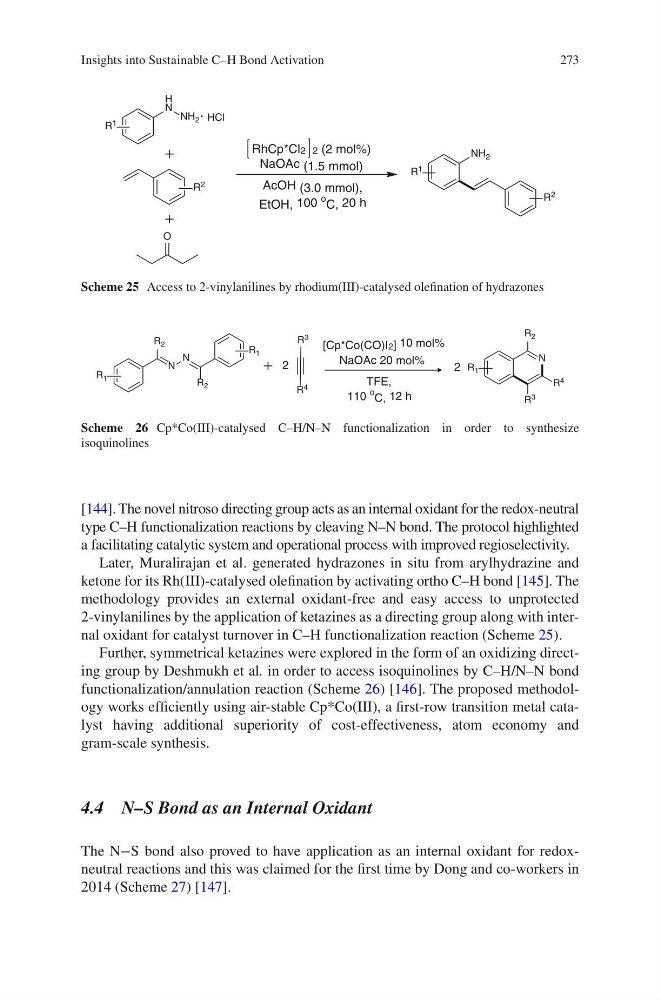
Later, Muralirajan et al. generated hydrazones in situ from arylhydrazine and
ketone for its Rh(III)-catalysed olefination by activating ortho C–H bond [145]. The
methodology provides an external oxidant-free and easy access to unprotected
2-vinylanilines by the application of ketazines as a directing group along with internal oxidant for catalyst turnover in C–H functionalization reaction (Scheme 25).
Further, symmetrical ketazines were explored in the form of an oxidizing directing group by Deshmukh et al. in order to access isoquinolines by C–H/N–N bond
functionalization/annulation reaction (Scheme 26) [146]. The proposed methodology works efficiently using air-stable Cp*Co(III), a first-row transition metal catalyst having additional superiority of cost-effectiveness, atom economy and
gram-scale synthesis.
4.4 N–S Bond as an Internal Oxidant
The N−S bond also proved to have application as an internal oxidant for redoxneutral reactions and this was claimed for the first time by Dong and co-workers in
2014 (Scheme 27) [147].
NaOAc 20 mol%
N
R 2
N
N
R 2
R 4
R 3
[Cp*Co(CO)I2] 10 mol%
TFE,
110
o C, 12 h
R 4
R 3
R 2
2
R 1
R 1
R 1
2
Scheme 26 Cp*Co(III)-catalysed C–H/N–N functionalization in order to synthesize
isoquinolines
H
N
RhCp*Cl2 2 (2 mol%)
NaOAc (1.5 mmol)
AcOH (3.0 mmol),
EtOH, 100
o C, 20 h
NH 2
R 1
NH 2
R 1
HCl
R 2
O
R 2
Scheme 25 Access to 2-vinylanilines by rhodium(III)-catalysed olefination of hydrazones
Insights into Sustainable C–H Bond Activation
[144]. The novel nitroso directing group acts as an internal oxidant for the redox-neutral
type C–H functionalization reactions by cleaving N–N bond. The protocol highlighted
a facilitating catalytic system and operational process with improved regioselectivity.
Later, Muralirajan et al. generated hydrazones in situ from arylhydrazine and
ketone for its Rh(III)-catalysed olefination by activating ortho C–H bond [145]. The
methodology provides an external oxidant-free and easy access to unprotected
2-vinylanilines by the application of ketazines as a directing group along with internal oxidant for catalyst turnover in C–H functionalization reaction (Scheme 25).
Further, symmetrical ketazines were explored in the form of an oxidizing directing group by Deshmukh et al. in order to access isoquinolines by C–H/N–N bond
functionalization/annulation reaction (Scheme 26) [146]. The proposed methodology works efficiently using air-stable Cp*Co(III), a first-row transition metal catalyst having additional superiority of cost-effectiveness, atom economy and
gram-scale synthesis.
4.4 N–S Bond as an Internal Oxidant
The N−S bond also proved to have application as an internal oxidant for redoxneutral reactions and this was claimed for the first time by Dong and co-workers in
2014 (Scheme 27) [147].
NaOAc 20 mol%
N
R 2
N
N
R 2
R 4
R 3
[Cp*Co(CO)I2] 10 mol%
TFE,
110
o C, 12 h
R 4
R 3
R 2
2
R 1
R 1
R 1
2
Scheme 26 Cp*Co(III)-catalysed C–H/N–N functionalization in order to synthesize
isoquinolines
H
N
RhCp*Cl2 2 (2 mol%)
NaOAc (1.5 mmol)
AcOH (3.0 mmol),
EtOH, 100
o C, 20 h
NH 2
R 1
NH 2
R 1
HCl
R 2
O
R 2
Scheme 25 Access to 2-vinylanilines by rhodium(III)-catalysed olefination of hydrazones
Insights into Sustainable C–H Bond Activation