

277
non- volatility and good biodegradability. The safe, readily available, cost-effective
and non-flammable nature of bio-based solvent makes them as eco-friendly solvents
in organic reactions. Herein, in this section, we have summarized representative
illustrations of C–H activation of the well-known green solvents like water and biobased solvents such as polyethylene glycols (PEG), gamma-valerolactone (GVL) or
2-methyltetrahydrofuran (2-MeTHF).
5.1 Water
Many of the alternative solvents [156, 157] have demonstrated the purpose of green
solvents for various organic transformations and to meet the green chemistry principle of limiting the use of organic solvents to reduce chemical waste, but none of
them are as green as water. Water acts as green solvent due to its various properties
such as abundance, cost-efficiency, environment compatibility, non-toxicity and
non-flammability.
Variety of examples of C–H activation using water as solvent have been reviewed
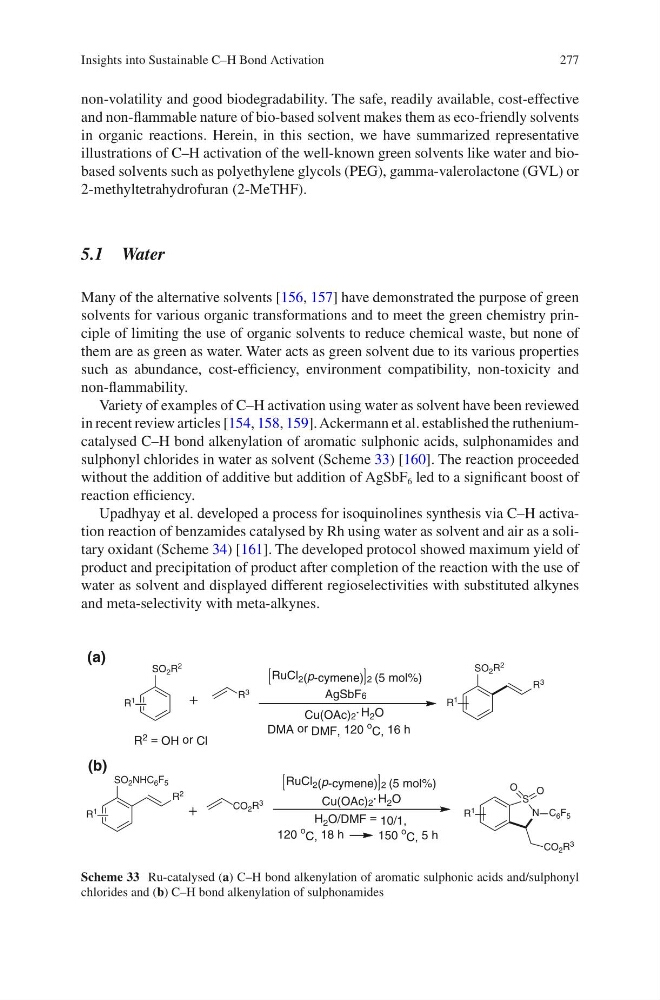
in recent review articles [154, 158, 159]. Ackermann et al. established the rutheniumcatalysed C–H bond alkenylation of aromatic sulphonic acids, sulphonamides and
sulphonyl chlorides in water as solvent (Scheme 33) [160]. The reaction proceeded
without the addition of additive but addition of AgSbF 6 led to a significant boost of
reaction efficiency.
Upadhyay et al. developed a process for isoquinolines synthesis via C–H activation reaction of benzamides catalysed by Rh using water as solvent and air as a solitary oxidant (Scheme 34) [161]. The developed protocol showed maximum yield of
product and precipitation of product after completion of the reaction with the use of
water as solvent and displayed different regioselectivities with substituted alkynes
and meta-selectivity with meta-alkynes.
R 1
RuCl 2( p-cymene) 2 (5 mol%)
Cu(OAc)2 H 2 O
H 2 O/DMF = 10/1,
R 3
SO 2 R 2
R 1
SO 2 R 2
R 3
R 2 = OH or Cl
R 1
RuCl 2( p-cymene) 2 (5 mol%)
Cu(OAc)2 H 2 O
DMA or DMF, 120
o C, 16 h
CO 2 R 3
SO 2 NHC 6 F 5
R 1
R 2
AgSbF6
150
o C, 5 h
120
o C, 18 h
N
S
O
O
C 6 F 5
CO 2 R 3
(a)
(b)
Scheme 33 Ru-catalysed (a) C–H bond alkenylation of aromatic sulphonic acids and/sulphonyl
chlorides and (b) C–H bond alkenylation of sulphonamides
Insights into Sustainable C–H Bond Activation
non- volatility and good biodegradability. The safe, readily available, cost-effective
and non-flammable nature of bio-based solvent makes them as eco-friendly solvents
in organic reactions. Herein, in this section, we have summarized representative
illustrations of C–H activation of the well-known green solvents like water and biobased solvents such as polyethylene glycols (PEG), gamma-valerolactone (GVL) or
2-methyltetrahydrofuran (2-MeTHF).
5.1 Water
Many of the alternative solvents [156, 157] have demonstrated the purpose of green
solvents for various organic transformations and to meet the green chemistry principle of limiting the use of organic solvents to reduce chemical waste, but none of
them are as green as water. Water acts as green solvent due to its various properties
such as abundance, cost-efficiency, environment compatibility, non-toxicity and
non-flammability.
Variety of examples of C–H activation using water as solvent have been reviewed
in recent review articles [154, 158, 159]. Ackermann et al. established the rutheniumcatalysed C–H bond alkenylation of aromatic sulphonic acids, sulphonamides and
sulphonyl chlorides in water as solvent (Scheme 33) [160]. The reaction proceeded
without the addition of additive but addition of AgSbF 6 led to a significant boost of
reaction efficiency.
Upadhyay et al. developed a process for isoquinolines synthesis via C–H activation reaction of benzamides catalysed by Rh using water as solvent and air as a solitary oxidant (Scheme 34) [161]. The developed protocol showed maximum yield of
product and precipitation of product after completion of the reaction with the use of
water as solvent and displayed different regioselectivities with substituted alkynes
and meta-selectivity with meta-alkynes.
R 1
RuCl 2( p-cymene) 2 (5 mol%)
Cu(OAc)2 H 2 O
H 2 O/DMF = 10/1,
R 3
SO 2 R 2
R 1
SO 2 R 2
R 3
R 2 = OH or Cl
R 1
RuCl 2( p-cymene) 2 (5 mol%)
Cu(OAc)2 H 2 O
DMA or DMF, 120
o C, 16 h
CO 2 R 3
SO 2 NHC 6 F 5
R 1
R 2
AgSbF6
150
o C, 5 h
120
o C, 18 h
N
S
O
O
C 6 F 5
CO 2 R 3
(a)
(b)
Scheme 33 Ru-catalysed (a) C–H bond alkenylation of aromatic sulphonic acids and/sulphonyl
chlorides and (b) C–H bond alkenylation of sulphonamides
Insights into Sustainable C–H Bond Activation