

271
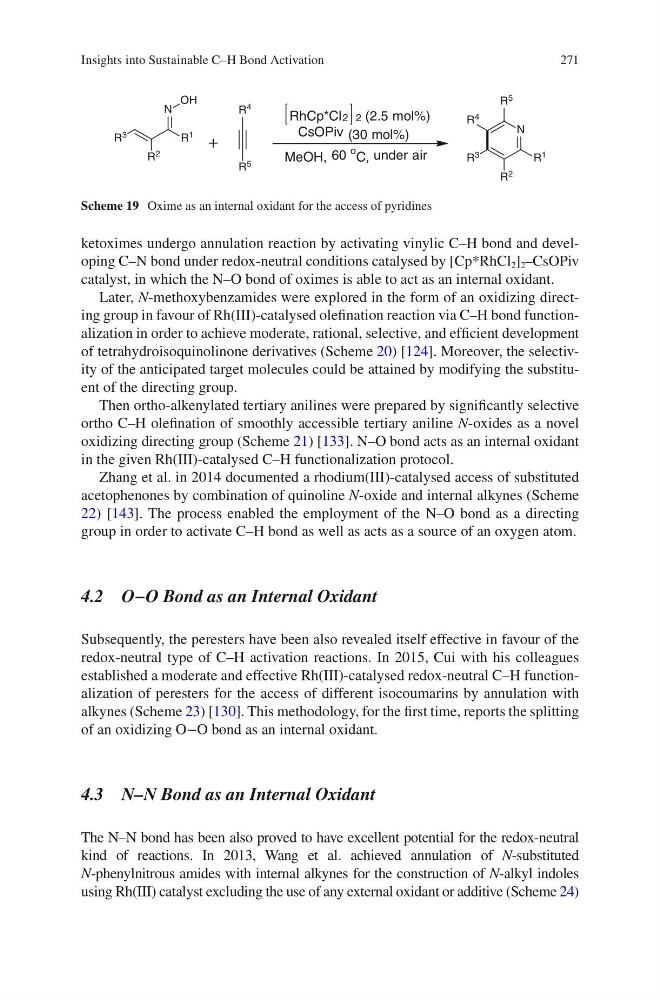
ketoximes undergo annulation reaction by activating vinylic C–H bond and developing C–N bond under redox-neutral conditions catalysed by [Cp*RhCl 2 ] 2 –CsOPiv
catalyst, in which the N–O bond of oximes is able to act as an internal oxidant.
Later, N-methoxybenzamides were explored in the form of an oxidizing directing group in favour of Rh(III)-catalysed olefination reaction via C–H bond functionalization in order to achieve moderate, rational, selective, and efficient development
of tetrahydroisoquinolinone derivatives (Scheme 20) [124]. Moreover, the selectivity of the anticipated target molecules could be attained by modifying the substituent of the directing group.
Then ortho-alkenylated tertiary anilines were prepared by significantly selective
ortho C–H olefination of smoothly accessible tertiary aniline N-oxides as a novel
oxidizing directing group (Scheme 21) [133]. N–O bond acts as an internal oxidant
in the given Rh(III)-catalysed C–H functionalization protocol.
Zhang et al. in 2014 documented a rhodium(III)-catalysed access of substituted
acetophenones by combination of quinoline N-oxide and internal alkynes (Scheme
22) [143]. The process enabled the employment of the N–O bond as a directing
group in order to activate C–H bond as well as acts as a source of an oxygen atom.
4.2 O−O Bond as an Internal Oxidant
Subsequently, the peresters have been also revealed itself effective in favour of the
redox-neutral type of C–H activation reactions. In 2015, Cui with his colleagues
established a moderate and effective Rh(III)-catalysed redox-neutral C–H functionalization of peresters for the access of different isocoumarins by annulation with
alkynes (Scheme 23) [130]. This methodology, for the first time, reports the splitting
of an oxidizing O−O bond as an internal oxidant.
4.3 N–N Bond as an Internal Oxidant
The N–N bond has been also proved to have excellent potential for the redox- neutral
kind of reactions. In 2013, Wang et al. achieved annulation of N-substituted
N-phenylnitrous amides with internal alkynes for the construction of N-alkyl indoles
using Rh(III) catalyst excluding the use of any external oxidant or additive (Scheme 24)
N
RhCp*Cl2 2 (2.5 mol%)
CsOPiv (30 mol%)
MeOH, 60
o C, under air
R 4
R 5
N
R 5
R 1
R 2
OH
R 1
R 2
R 3
R 4
R 3
Scheme 19 Oxime as an internal oxidant for the access of pyridines
Insights into Sustainable C–H Bond Activation
ketoximes undergo annulation reaction by activating vinylic C–H bond and developing C–N bond under redox-neutral conditions catalysed by [Cp*RhCl 2 ] 2 –CsOPiv
catalyst, in which the N–O bond of oximes is able to act as an internal oxidant.
Later, N-methoxybenzamides were explored in the form of an oxidizing directing group in favour of Rh(III)-catalysed olefination reaction via C–H bond functionalization in order to achieve moderate, rational, selective, and efficient development
of tetrahydroisoquinolinone derivatives (Scheme 20) [124]. Moreover, the selectivity of the anticipated target molecules could be attained by modifying the substituent of the directing group.
Then ortho-alkenylated tertiary anilines were prepared by significantly selective
ortho C–H olefination of smoothly accessible tertiary aniline N-oxides as a novel
oxidizing directing group (Scheme 21) [133]. N–O bond acts as an internal oxidant
in the given Rh(III)-catalysed C–H functionalization protocol.
Zhang et al. in 2014 documented a rhodium(III)-catalysed access of substituted
acetophenones by combination of quinoline N-oxide and internal alkynes (Scheme
22) [143]. The process enabled the employment of the N–O bond as a directing
group in order to activate C–H bond as well as acts as a source of an oxygen atom.
4.2 O−O Bond as an Internal Oxidant
Subsequently, the peresters have been also revealed itself effective in favour of the
redox-neutral type of C–H activation reactions. In 2015, Cui with his colleagues
established a moderate and effective Rh(III)-catalysed redox-neutral C–H functionalization of peresters for the access of different isocoumarins by annulation with
alkynes (Scheme 23) [130]. This methodology, for the first time, reports the splitting
of an oxidizing O−O bond as an internal oxidant.
4.3 N–N Bond as an Internal Oxidant
The N–N bond has been also proved to have excellent potential for the redox- neutral
kind of reactions. In 2013, Wang et al. achieved annulation of N-substituted
N-phenylnitrous amides with internal alkynes for the construction of N-alkyl indoles
using Rh(III) catalyst excluding the use of any external oxidant or additive (Scheme 24)
N
RhCp*Cl2 2 (2.5 mol%)
CsOPiv (30 mol%)
MeOH, 60
o C, under air
R 4
R 5
N
R 5
R 1
R 2
OH
R 1
R 2
R 3
R 4
R 3
Scheme 19 Oxime as an internal oxidant for the access of pyridines
Insights into Sustainable C–H Bond Activation