

270
necessity for an external oxidizing agent, furthermore developing the total ‘greenness’ of the method.
Directing group as an internal oxidant usually comprises a covalent bond, that is
capable for oxidation of the metal with lower valency to sustain the turnover of the
catalyst (for instance, via an oxidative addition), but is discrete from the C–H activated and functionalized position. The preliminary models of the internal oxidant
applied an N–O bond of N-oxide, N-pivaloyloxy and N-methoxy functionality considering demanding shaft for C–N bond construction as well as catalyst turnover
also. With the advancement of the internal oxidant approach, N–N, N–S, S–Cl and
Si–H bonds were also recognized for this purpose. An initial emphasize by Patureau
and Glorius [128] set attention for examining the merits proposed by redox-neutral
tactic as compared to the analogous conversions which utilize external oxidants.
The nitrogen-oxygen, nitrogen-nitrogen and oxygen-oxygen bonds are increasingly
prevailing in the class of the established oxidative directing groups with the release
of a small molecule like water, alcohol, carboxylic acid, and amide, that were
employed for the turnover of Rh, Pd, Ru catalysts in redox-neutral coupling reactions [129–136]. However, other covalent bonds comprising heteroatoms are less
efficient in the redox-neutral C–H functionalization reactions [137]. In comparison
with the application of external oxidants, this technique can induce enhanced standards of reactivity and selectivity in addition to a wider scope. The approach is
expanding within the field of C–H activation and it is successfully recognized for
benign conditions and higher selectivity, thus, being of great synthetic value. In this
view, this segment of the book chapter emphasises on the progress of this modern
approach with some established protocols.
4.1 N−O Bond as an Internal Oxidant
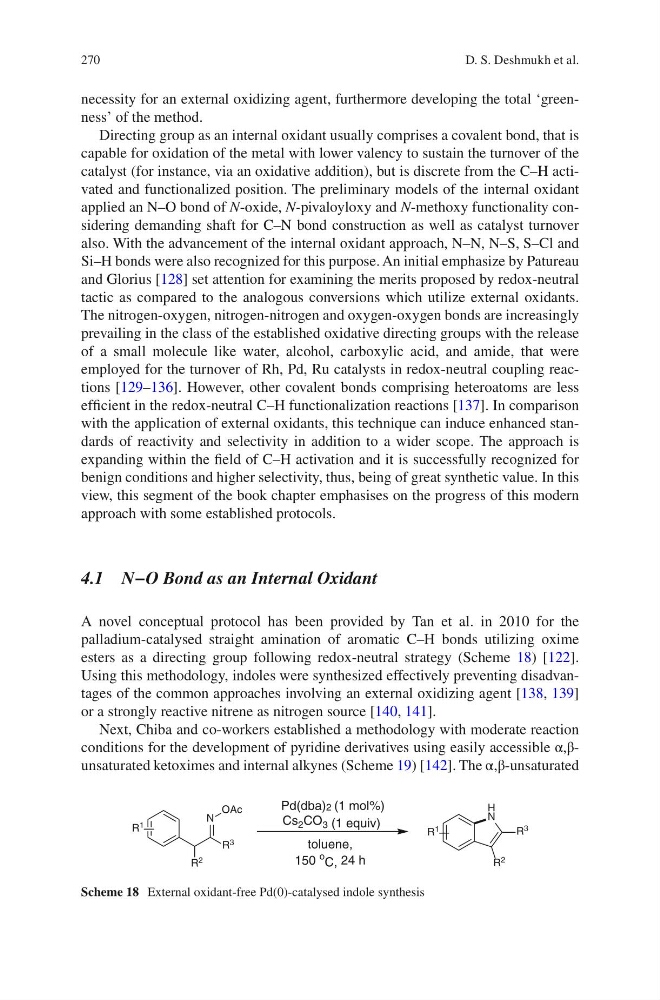
A novel conceptual protocol has been provided by Tan et al. in 2010 for the
palladium- catalysed straight amination of aromatic C–H bonds utilizing oxime
esters as a directing group following redox-neutral strategy (Scheme 18) [122].
Using this methodology, indoles were synthesized effectively preventing disadvantages of the common approaches involving an external oxidizing agent [138, 139]
or a strongly reactive nitrene as nitrogen source [140, 141].
Next, Chiba and co-workers established a methodology with moderate reaction
conditions for the development of pyridine derivatives using easily accessible α,βunsaturated ketoximes and internal alkynes (Scheme 19) [142]. The α,β-unsaturated
R 1
Pd(dba)2 (1 mol%)
Cs 2 CO 3 (1 equiv)
toluene,
150
o C, 24 h
R 1
R 2
R 3
N
OAc
H
N
R 3
R 2
Scheme 18 External oxidant-free Pd(0)-catalysed indole synthesis
D. S. Deshmukh et al.
necessity for an external oxidizing agent, furthermore developing the total ‘greenness’ of the method.
Directing group as an internal oxidant usually comprises a covalent bond, that is
capable for oxidation of the metal with lower valency to sustain the turnover of the
catalyst (for instance, via an oxidative addition), but is discrete from the C–H activated and functionalized position. The preliminary models of the internal oxidant
applied an N–O bond of N-oxide, N-pivaloyloxy and N-methoxy functionality considering demanding shaft for C–N bond construction as well as catalyst turnover
also. With the advancement of the internal oxidant approach, N–N, N–S, S–Cl and
Si–H bonds were also recognized for this purpose. An initial emphasize by Patureau
and Glorius [128] set attention for examining the merits proposed by redox-neutral
tactic as compared to the analogous conversions which utilize external oxidants.
The nitrogen-oxygen, nitrogen-nitrogen and oxygen-oxygen bonds are increasingly
prevailing in the class of the established oxidative directing groups with the release
of a small molecule like water, alcohol, carboxylic acid, and amide, that were
employed for the turnover of Rh, Pd, Ru catalysts in redox-neutral coupling reactions [129–136]. However, other covalent bonds comprising heteroatoms are less
efficient in the redox-neutral C–H functionalization reactions [137]. In comparison
with the application of external oxidants, this technique can induce enhanced standards of reactivity and selectivity in addition to a wider scope. The approach is
expanding within the field of C–H activation and it is successfully recognized for
benign conditions and higher selectivity, thus, being of great synthetic value. In this
view, this segment of the book chapter emphasises on the progress of this modern
approach with some established protocols.
4.1 N−O Bond as an Internal Oxidant
A novel conceptual protocol has been provided by Tan et al. in 2010 for the
palladium- catalysed straight amination of aromatic C–H bonds utilizing oxime
esters as a directing group following redox-neutral strategy (Scheme 18) [122].
Using this methodology, indoles were synthesized effectively preventing disadvantages of the common approaches involving an external oxidizing agent [138, 139]
or a strongly reactive nitrene as nitrogen source [140, 141].
Next, Chiba and co-workers established a methodology with moderate reaction
conditions for the development of pyridine derivatives using easily accessible α,βunsaturated ketoximes and internal alkynes (Scheme 19) [142]. The α,β-unsaturated
R 1
Pd(dba)2 (1 mol%)
Cs 2 CO 3 (1 equiv)
toluene,
150
o C, 24 h
R 1
R 2
R 3
N
OAc
H
N
R 3
R 2
Scheme 18 External oxidant-free Pd(0)-catalysed indole synthesis
D. S. Deshmukh et al.