

262
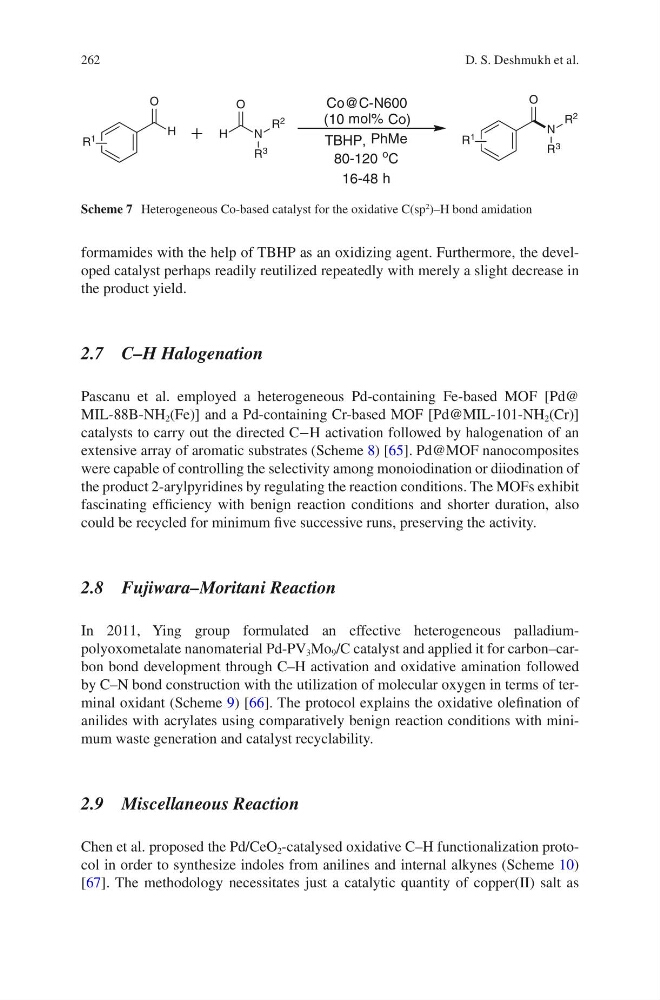
formamides with the help of TBHP as an oxidizing agent. Furthermore, the developed catalyst perhaps readily reutilized repeatedly with merely a slight decrease in
the product yield.
2.7 C–H Halogenation
Pascanu et al. employed a heterogeneous Pd-containing Fe-based MOF [Pd@
MIL-88B-NH 2 (Fe)] and a Pd-containing Cr-based MOF [Pd@MIL-101-NH 2 (Cr)]
catalysts to carry out the directed C−H activation followed by halogenation of an
extensive array of aromatic substrates (Scheme 8) [65]. Pd@MOF nanocomposites
were capable of controlling the selectivity among monoiodination or diiodination of
the product 2-arylpyridines by regulating the reaction conditions. The MOFs exhibit
fascinating efficiency with benign reaction conditions and shorter duration, also
could be recycled for minimum five successive runs, preserving the activity.
2.8 Fujiwara–Moritani Reaction
In 2011, Ying group formulated an effective heterogeneous palladiumpolyoxometalate nanomaterial Pd-PV 3 Mo 9 /C catalyst and applied it for carbon–carbon bond development through C–H activation and oxidative amination followed
by C–N bond construction with the utilization of molecular oxygen in terms of terminal oxidant (Scheme 9) [66]. The protocol explains the oxidative olefination of
anilides with acrylates using comparatively benign reaction conditions with minimum waste generation and catalyst recyclability.
2.9 Miscellaneous Reaction
Chen et al. proposed the Pd/CeO 2 -catalysed oxidative C–H functionalization protocol in order to synthesize indoles from anilines and internal alkynes (Scheme 10)
[67]. The methodology necessitates just a catalytic quantity of copper(II) salt as
Co@C-N600
(10 mol% Co)
TBHP, PhMe
80-120
o C
16-48 h
R 1
H
O
H
N
O
R 2
R 3
R 1
N
O
R 2
R 3
Scheme 7 Heterogeneous Co-based catalyst for the oxidative C(sp
2 )–H bond amidation
D. S. Deshmukh et al.
formamides with the help of TBHP as an oxidizing agent. Furthermore, the developed catalyst perhaps readily reutilized repeatedly with merely a slight decrease in
the product yield.
2.7 C–H Halogenation
Pascanu et al. employed a heterogeneous Pd-containing Fe-based MOF [Pd@
MIL-88B-NH 2 (Fe)] and a Pd-containing Cr-based MOF [Pd@MIL-101-NH 2 (Cr)]
catalysts to carry out the directed C−H activation followed by halogenation of an
extensive array of aromatic substrates (Scheme 8) [65]. Pd@MOF nanocomposites
were capable of controlling the selectivity among monoiodination or diiodination of
the product 2-arylpyridines by regulating the reaction conditions. The MOFs exhibit
fascinating efficiency with benign reaction conditions and shorter duration, also
could be recycled for minimum five successive runs, preserving the activity.
2.8 Fujiwara–Moritani Reaction
In 2011, Ying group formulated an effective heterogeneous palladiumpolyoxometalate nanomaterial Pd-PV 3 Mo 9 /C catalyst and applied it for carbon–carbon bond development through C–H activation and oxidative amination followed
by C–N bond construction with the utilization of molecular oxygen in terms of terminal oxidant (Scheme 9) [66]. The protocol explains the oxidative olefination of
anilides with acrylates using comparatively benign reaction conditions with minimum waste generation and catalyst recyclability.
2.9 Miscellaneous Reaction
Chen et al. proposed the Pd/CeO 2 -catalysed oxidative C–H functionalization protocol in order to synthesize indoles from anilines and internal alkynes (Scheme 10)
[67]. The methodology necessitates just a catalytic quantity of copper(II) salt as
Co@C-N600
(10 mol% Co)
TBHP, PhMe
80-120
o C
16-48 h
R 1
H
O
H
N
O
R 2
R 3
R 1
N
O
R 2
R 3
Scheme 7 Heterogeneous Co-based catalyst for the oxidative C(sp
2 )–H bond amidation
D. S. Deshmukh et al.