

261
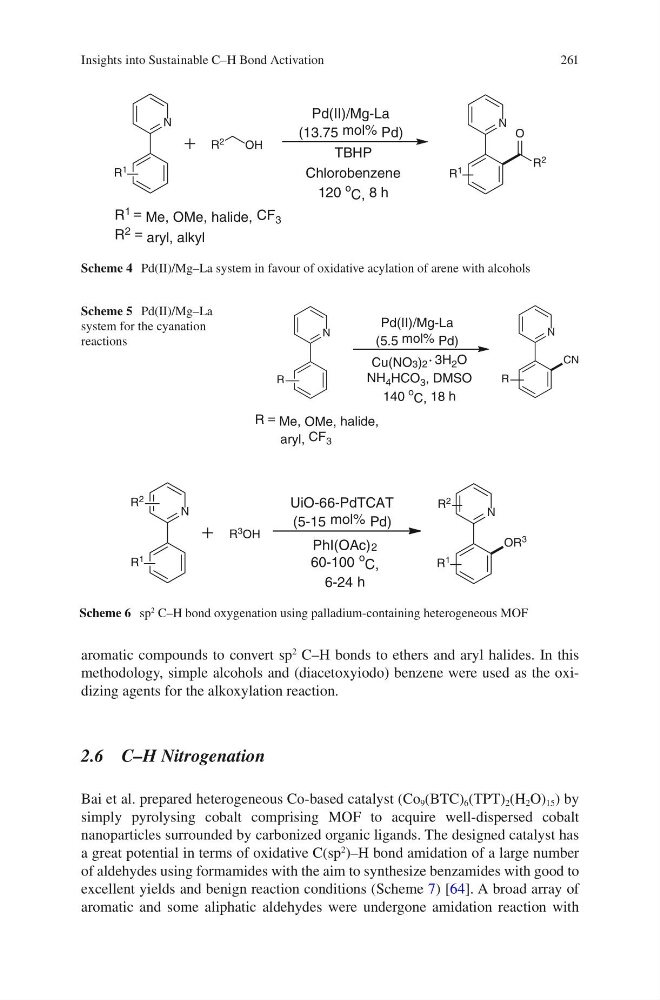
aromatic compounds to convert sp
2
C–H bonds to ethers and aryl halides. In this
methodology, simple alcohols and (diacetoxyiodo) benzene were used as the oxidizing agents for the alkoxylation reaction.
2.6 C–H Nitrogenation
Bai et al. prepared heterogeneous Co-based catalyst (Co 9 (BTC) 6 (TPT) 2 (H 2 O) 15 ) by
simply pyrolysing cobalt comprising MOF to acquire well-dispersed cobalt
nanoparticles surrounded by carbonized organic ligands. The designed catalyst has
a great potential in terms of oxidative C(sp
2
)–H bond amidation of a large number
of aldehydes using formamides with the aim to synthesize benzamides with good to
excellent yields and benign reaction conditions (Scheme 7) [64]. A broad array of
aromatic and some aliphatic aldehydes were undergone amidation reaction with
Pd(II)/Mg-La
(13.75 mol% Pd)
TBHP
Chlorobenzene
120
o C, 8 h
N
R 1
R 2
OH
N
R 1
R 2
O
R 1 = Me, OMe, halide, CF 3
R 2 = aryl, alkyl
Scheme 4 Pd(II)/Mg–La system in favour of oxidative acylation of arene with alcohols
Pd(II)/Mg-La
(5.5 mol% Pd)
Cu(NO3)2 3H 2 O
NH 4 HCO 3 , DMSO
140
o
C, 18 h
N
R
N
R
CN
R = Me, OMe, halide,
aryl, CF 3
Scheme 5 Pd(II)/Mg–La
system for the cyanation
reactions
UiO-66-PdTCAT
(5-15 mol% Pd)
PhI(OAc)2
60-100
o C,
6-24 h
N
R 1
R 3 OH
N
R 1
OR 3
R 2
R 2
Scheme 6 sp
2 C–H bond oxygenation using palladium-containing heterogeneous MOF
Insights into Sustainable C–H Bond Activation
aromatic compounds to convert sp
2
C–H bonds to ethers and aryl halides. In this
methodology, simple alcohols and (diacetoxyiodo) benzene were used as the oxidizing agents for the alkoxylation reaction.
2.6 C–H Nitrogenation
Bai et al. prepared heterogeneous Co-based catalyst (Co 9 (BTC) 6 (TPT) 2 (H 2 O) 15 ) by
simply pyrolysing cobalt comprising MOF to acquire well-dispersed cobalt
nanoparticles surrounded by carbonized organic ligands. The designed catalyst has
a great potential in terms of oxidative C(sp
2
)–H bond amidation of a large number
of aldehydes using formamides with the aim to synthesize benzamides with good to
excellent yields and benign reaction conditions (Scheme 7) [64]. A broad array of
aromatic and some aliphatic aldehydes were undergone amidation reaction with
Pd(II)/Mg-La
(13.75 mol% Pd)
TBHP
Chlorobenzene
120
o C, 8 h
N
R 1
R 2
OH
N
R 1
R 2
O
R 1 = Me, OMe, halide, CF 3
R 2 = aryl, alkyl
Scheme 4 Pd(II)/Mg–La system in favour of oxidative acylation of arene with alcohols
Pd(II)/Mg-La
(5.5 mol% Pd)
Cu(NO3)2 3H 2 O
NH 4 HCO 3 , DMSO
140
o
C, 18 h
N
R
N
R
CN
R = Me, OMe, halide,
aryl, CF 3
Scheme 5 Pd(II)/Mg–La
system for the cyanation
reactions
UiO-66-PdTCAT
(5-15 mol% Pd)
PhI(OAc)2
60-100
o C,
6-24 h
N
R 1
R 3 OH
N
R 1
OR 3
R 2
R 2
Scheme 6 sp
2 C–H bond oxygenation using palladium-containing heterogeneous MOF
Insights into Sustainable C–H Bond Activation