

260
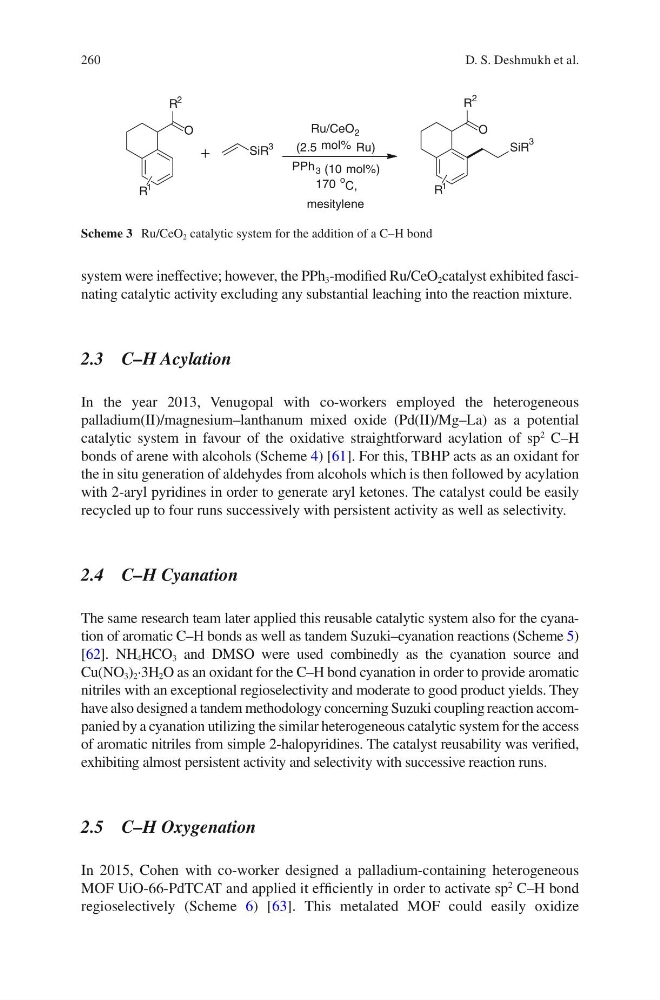
system were ineffective; however, the PPh 3 -modified Ru/CeO 2 catalyst exhibited fascinating catalytic activity excluding any substantial leaching into the reaction mixture.
2.3 C–H Acylation
In the year 2013, Venugopal with co-workers employed the heterogeneous
palladium(II)/magnesium–lanthanum mixed oxide (Pd(II)/Mg–La) as a potential
catalytic system in favour of the oxidative straightforward acylation of sp
2
C–H
bonds of arene with alcohols (Scheme 4) [61]. For this, TBHP acts as an oxidant for
the in situ generation of aldehydes from alcohols which is then followed by acylation
with 2-aryl pyridines in order to generate aryl ketones. The catalyst could be easily
recycled up to four runs successively with persistent activity as well as selectivity.
2.4 C–H Cyanation
The same research team later applied this reusable catalytic system also for the cyanation of aromatic C–H bonds as well as tandem Suzuki–cyanation reactions (Scheme 5)
[62]. NH 4 HCO 3 and DMSO were used combinedly as the cyanation source and
Cu(NO 3 ) 2 ·3H 2 O as an oxidant for the C–H bond cyanation in order to provide aromatic
nitriles with an exceptional regioselectivity and moderate to good product yields. They
have also designed a tandem methodology concerning Suzuki coupling reaction accompanied by a cyanation utilizing the similar heterogeneous catalytic system for the access
of aromatic nitriles from simple 2-halopyridines. The catalyst reusability was verified,
exhibiting almost persistent activity and selectivity with successive reaction runs.
2.5 C–H Oxygenation
In 2015, Cohen with co-worker designed a palladium-containing heterogeneous
MOF UiO-66-PdTCAT and applied it efficiently in order to activate sp
2
C–H bond
regioselectively (Scheme 6) [63]. This metalated MOF could easily oxidize
Ru/CeO 2
(2.5 mol% Ru)
PPh 3 (10 mol%)
170
o C,
mesitylene
O
R
2
SiR
3
O
R
2
SiR
3
R
1
R
1
Scheme 3 Ru/CeO 2 catalytic system for the addition of a C–H bond
D. S. Deshmukh et al.
system were ineffective; however, the PPh 3 -modified Ru/CeO 2 catalyst exhibited fascinating catalytic activity excluding any substantial leaching into the reaction mixture.
2.3 C–H Acylation
In the year 2013, Venugopal with co-workers employed the heterogeneous
palladium(II)/magnesium–lanthanum mixed oxide (Pd(II)/Mg–La) as a potential
catalytic system in favour of the oxidative straightforward acylation of sp
2
C–H
bonds of arene with alcohols (Scheme 4) [61]. For this, TBHP acts as an oxidant for
the in situ generation of aldehydes from alcohols which is then followed by acylation
with 2-aryl pyridines in order to generate aryl ketones. The catalyst could be easily
recycled up to four runs successively with persistent activity as well as selectivity.
2.4 C–H Cyanation
The same research team later applied this reusable catalytic system also for the cyanation of aromatic C–H bonds as well as tandem Suzuki–cyanation reactions (Scheme 5)
[62]. NH 4 HCO 3 and DMSO were used combinedly as the cyanation source and
Cu(NO 3 ) 2 ·3H 2 O as an oxidant for the C–H bond cyanation in order to provide aromatic
nitriles with an exceptional regioselectivity and moderate to good product yields. They
have also designed a tandem methodology concerning Suzuki coupling reaction accompanied by a cyanation utilizing the similar heterogeneous catalytic system for the access
of aromatic nitriles from simple 2-halopyridines. The catalyst reusability was verified,
exhibiting almost persistent activity and selectivity with successive reaction runs.
2.5 C–H Oxygenation
In 2015, Cohen with co-worker designed a palladium-containing heterogeneous
MOF UiO-66-PdTCAT and applied it efficiently in order to activate sp
2
C–H bond
regioselectively (Scheme 6) [63]. This metalated MOF could easily oxidize
Ru/CeO 2
(2.5 mol% Ru)
PPh 3 (10 mol%)
170
o C,
mesitylene
O
R
2
SiR
3
O
R
2
SiR
3
R
1
R
1
Scheme 3 Ru/CeO 2 catalytic system for the addition of a C–H bond
D. S. Deshmukh et al.