

263
Pd@MOF
(4 mol% Pd)
NIS (2.3 equiv)
AcOH,
40-50
o C, 8-16 h
N
R 1
R 2
Pd@MOF
(4 mol% Pd)
PTSA (0.5 equiv)
THF
80
o C, 8-16 h
N
R 1
R 2
N
R 1
R 2
I
I
I
NIS (3 equiv)
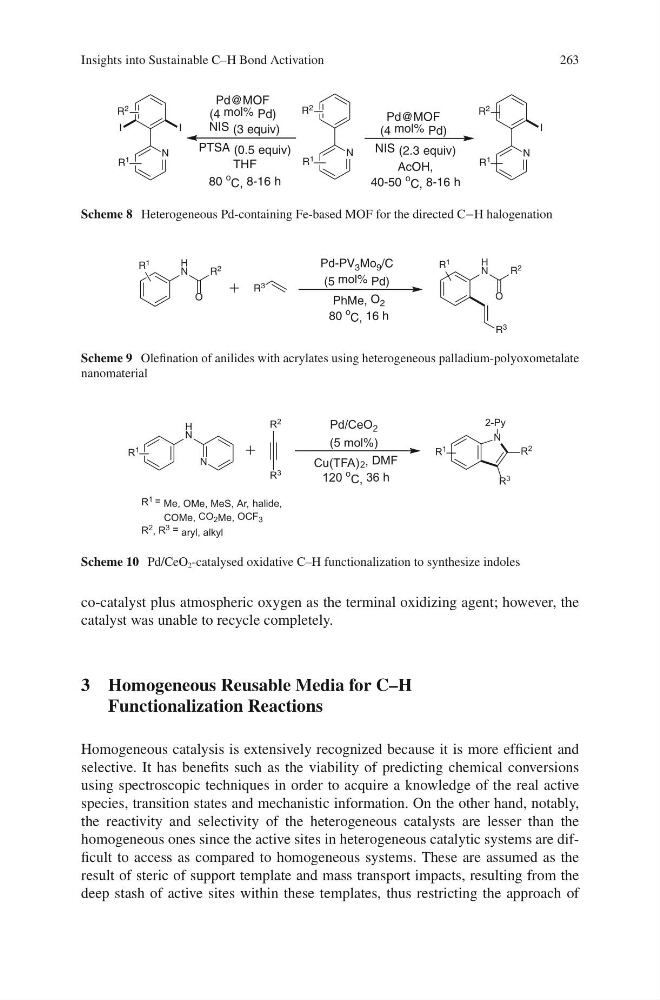
Scheme 8 Heterogeneous Pd-containing Fe-based MOF for the directed C−H halogenation
Pd-PV 3 Mo 9 /C
(5 mol% Pd)
PhMe, O 2
80
o C, 16 h
R 3
H
N
R 2
O
R 1
H
N
R 2
O
R 1
R 3
Scheme 9 Olefination of anilides with acrylates using heterogeneous palladium-polyoxometalate
nanomaterial
Pd/CeO 2
(5 mol%)
Cu(TFA)2 , DMF
120
o C, 36 h
R 1
R 1
R 1 = Me, OMe, MeS, Ar, halide,
COMe, CO 2Me, OCF 3
R 2 , R 3 = aryl, alkyl
H
N
N
R 2
R 3
N
R 2
R 3
2-Py
Scheme 10 Pd/CeO 2 -catalysed oxidative C–H functionalization to synthesize indoles
co-catalyst plus atmospheric oxygen as the terminal oxidizing agent; however, the
catalyst was unable to recycle completely.
3 Homogeneous Reusable Media for C–H
Functionalization Reactions
Homogeneous catalysis is extensively recognized because it is more efficient and
selective. It has benefits such as the viability of predicting chemical conversions
using spectroscopic techniques in order to acquire a knowledge of the real active
species, transition states and mechanistic information. On the other hand, notably,
the reactivity and selectivity of the heterogeneous catalysts are lesser than the
homogeneous ones since the active sites in heterogeneous catalytic systems are difficult to access as compared to homogeneous systems. These are assumed as the
result of steric of support template and mass transport impacts, resulting from the
deep stash of active sites within these templates, thus restricting the approach of
Insights into Sustainable C–H Bond Activation
Pd@MOF
(4 mol% Pd)
NIS (2.3 equiv)
AcOH,
40-50
o C, 8-16 h
N
R 1
R 2
Pd@MOF
(4 mol% Pd)
PTSA (0.5 equiv)
THF
80
o C, 8-16 h
N
R 1
R 2
N
R 1
R 2
I
I
I
NIS (3 equiv)
Scheme 8 Heterogeneous Pd-containing Fe-based MOF for the directed C−H halogenation
Pd-PV 3 Mo 9 /C
(5 mol% Pd)
PhMe, O 2
80
o C, 16 h
R 3
H
N
R 2
O
R 1
H
N
R 2
O
R 1
R 3
Scheme 9 Olefination of anilides with acrylates using heterogeneous palladium-polyoxometalate
nanomaterial
Pd/CeO 2
(5 mol%)
Cu(TFA)2 , DMF
120
o C, 36 h
R 1
R 1
R 1 = Me, OMe, MeS, Ar, halide,
COMe, CO 2Me, OCF 3
R 2 , R 3 = aryl, alkyl
H
N
N
R 2
R 3
N
R 2
R 3
2-Py
Scheme 10 Pd/CeO 2 -catalysed oxidative C–H functionalization to synthesize indoles
co-catalyst plus atmospheric oxygen as the terminal oxidizing agent; however, the
catalyst was unable to recycle completely.
3 Homogeneous Reusable Media for C–H
Functionalization Reactions
Homogeneous catalysis is extensively recognized because it is more efficient and
selective. It has benefits such as the viability of predicting chemical conversions
using spectroscopic techniques in order to acquire a knowledge of the real active
species, transition states and mechanistic information. On the other hand, notably,
the reactivity and selectivity of the heterogeneous catalysts are lesser than the
homogeneous ones since the active sites in heterogeneous catalytic systems are difficult to access as compared to homogeneous systems. These are assumed as the
result of steric of support template and mass transport impacts, resulting from the
deep stash of active sites within these templates, thus restricting the approach of
Insights into Sustainable C–H Bond Activation