

233
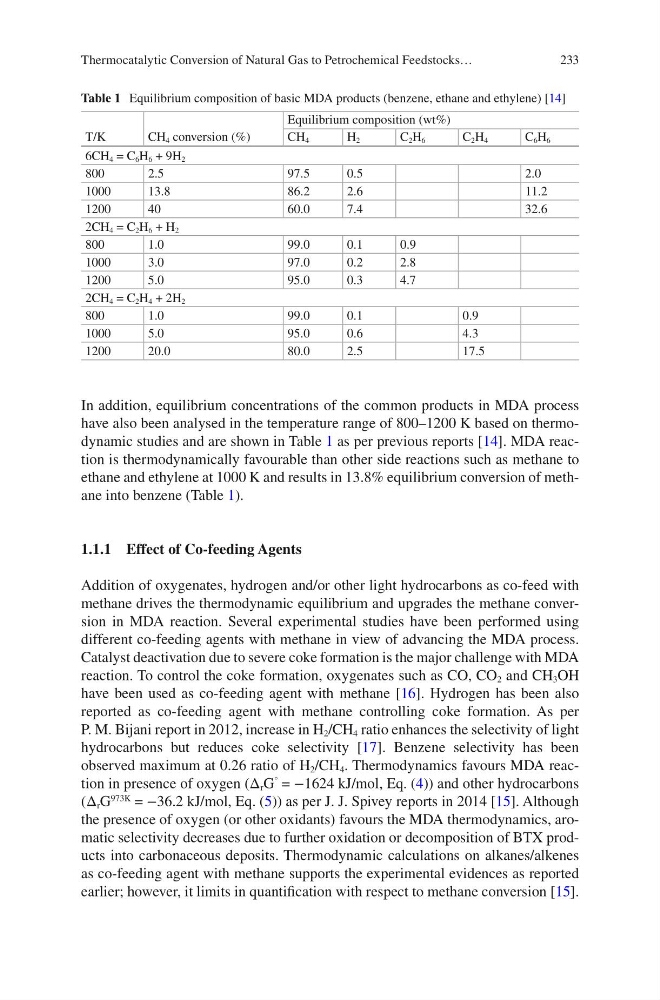
In addition, equilibrium concentrations of the common products in MDA process
have also been analysed in the temperature range of 800–1200 K based on thermodynamic studies and are shown in Table 1 as per previous reports [14]. MDA reaction is thermodynamically favourable than other side reactions such as methane to
ethane and ethylene at 1000 K and results in 13.8% equilibrium conversion of methane into benzene (Table 1).
1.1.1 Effect of Co-feeding Agents
Addition of oxygenates, hydrogen and/or other light hydrocarbons as co-feed with
methane drives the thermodynamic equilibrium and upgrades the methane conversion in MDA reaction. Several experimental studies have been performed using
different co-feeding agents with methane in view of advancing the MDA process.
Catalyst deactivation due to severe coke formation is the major challenge with MDA
reaction. To control the coke formation, oxygenates such as CO, CO 2 and CH 3 OH
have been used as co-feeding agent with methane [16]. Hydrogen has been also
reported as co-feeding agent with methane controlling coke formation. As per
P. M. Bijani report in 2012, increase in H 2 /CH 4 ratio enhances the selectivity of light
hydrocarbons but reduces coke selectivity [17]. Benzene selectivity has been
observed maximum at 0.26 ratio of H 2 /CH 4 . Thermodynamics favours MDA reaction in presence of oxygen (Δ r G
°
= −1624 kJ/mol, Eq. (4)) and other hydrocarbons
(Δ r G
973K
= −36.2 kJ/mol, Eq. (5)) as per J. J. Spivey reports in 2014 [15]. Although
the presence of oxygen (or other oxidants) favours the MDA thermodynamics, aromatic selectivity decreases due to further oxidation or decomposition of BTX products into carbonaceous deposits. Thermodynamic calculations on alkanes/alkenes
as co-feeding agent with methane supports the experimental evidences as reported
earlier; however, it limits in quantification with respect to methane conversion [15].
Table 1 Equilibrium composition of basic MDA products (benzene, ethane and ethylene) [14]
T/K
CH 4 conversion (%)
Equilibrium composition (wt%)
CH 4
H 2
C 2 H 6
C 2 H 4
C 6 H 6
6CH 4 = C 6 H 6 + 9H 2
800
2.5
97.5
0.5
2.0
1000
13.8
86.2
2.6
11.2
1200
40
60.0
7.4
32.6
2CH 4 = C 2 H 6 + H 2
800
1.0
99.0
0.1
0.9
1000
3.0
97.0
0.2
2.8
1200
5.0
95.0
0.3
4.7
2CH 4 = C 2 H 4 + 2H 2
800
1.0
99.0
0.1
0.9
1000
5.0
95.0
0.6
4.3
1200
20.0
80.0
2.5
17.5
Thermocatalytic Conversion of Natural Gas to Petrochemical Feedstocks…
In addition, equilibrium concentrations of the common products in MDA process
have also been analysed in the temperature range of 800–1200 K based on thermodynamic studies and are shown in Table 1 as per previous reports [14]. MDA reaction is thermodynamically favourable than other side reactions such as methane to
ethane and ethylene at 1000 K and results in 13.8% equilibrium conversion of methane into benzene (Table 1).
1.1.1 Effect of Co-feeding Agents
Addition of oxygenates, hydrogen and/or other light hydrocarbons as co-feed with
methane drives the thermodynamic equilibrium and upgrades the methane conversion in MDA reaction. Several experimental studies have been performed using
different co-feeding agents with methane in view of advancing the MDA process.
Catalyst deactivation due to severe coke formation is the major challenge with MDA
reaction. To control the coke formation, oxygenates such as CO, CO 2 and CH 3 OH
have been used as co-feeding agent with methane [16]. Hydrogen has been also
reported as co-feeding agent with methane controlling coke formation. As per
P. M. Bijani report in 2012, increase in H 2 /CH 4 ratio enhances the selectivity of light
hydrocarbons but reduces coke selectivity [17]. Benzene selectivity has been
observed maximum at 0.26 ratio of H 2 /CH 4 . Thermodynamics favours MDA reaction in presence of oxygen (Δ r G
°
= −1624 kJ/mol, Eq. (4)) and other hydrocarbons
(Δ r G
973K
= −36.2 kJ/mol, Eq. (5)) as per J. J. Spivey reports in 2014 [15]. Although
the presence of oxygen (or other oxidants) favours the MDA thermodynamics, aromatic selectivity decreases due to further oxidation or decomposition of BTX products into carbonaceous deposits. Thermodynamic calculations on alkanes/alkenes
as co-feeding agent with methane supports the experimental evidences as reported
earlier; however, it limits in quantification with respect to methane conversion [15].
Table 1 Equilibrium composition of basic MDA products (benzene, ethane and ethylene) [14]
T/K
CH 4 conversion (%)
Equilibrium composition (wt%)
CH 4
H 2
C 2 H 6
C 2 H 4
C 6 H 6
6CH 4 = C 6 H 6 + 9H 2
800
2.5
97.5
0.5
2.0
1000
13.8
86.2
2.6
11.2
1200
40
60.0
7.4
32.6
2CH 4 = C 2 H 6 + H 2
800
1.0
99.0
0.1
0.9
1000
3.0
97.0
0.2
2.8
1200
5.0
95.0
0.3
4.7
2CH 4 = C 2 H 4 + 2H 2
800
1.0
99.0
0.1
0.9
1000
5.0
95.0
0.6
4.3
1200
20.0
80.0
2.5
17.5
Thermocatalytic Conversion of Natural Gas to Petrochemical Feedstocks…