

234
6
9 2
9
4
2
6 6
2
CH g
O g
C H g
H O g
( )+
( ) →
( )+
( )
/
(4)
∆
∆
r
r
G
k J mol
H
k J mol
°
°
= −
= −
1624
1846
/
,
/
2
6
4
410
6 6
2
CH g
C H g
C H g
H g
( )+ −
( ) →
( )+ ( )
n
(5)
∆
∆
r
K
r
K
G
k J mol
H
k J mol
973
973
36 2
396
= −
= +
.
/
,
/
1.1.2 Effect of Hydrogen Removal in MDA
In attempts of equilibrium shift of methane to benzene conversion in MDA reaction,
in situ removal of hydrogen (H 2 ) from the reaction mixture is an effective step to
adjust thermodynamic conversion of methane. Hydrogen is the major by-product
along with carbonaceous species at 973 K and atmosphere pressure in MDA reaction. Increase in temperature does not affect the equilibrium constant of MDA reaction which shows that MDA reaction is strongly limited by thermodynamics.
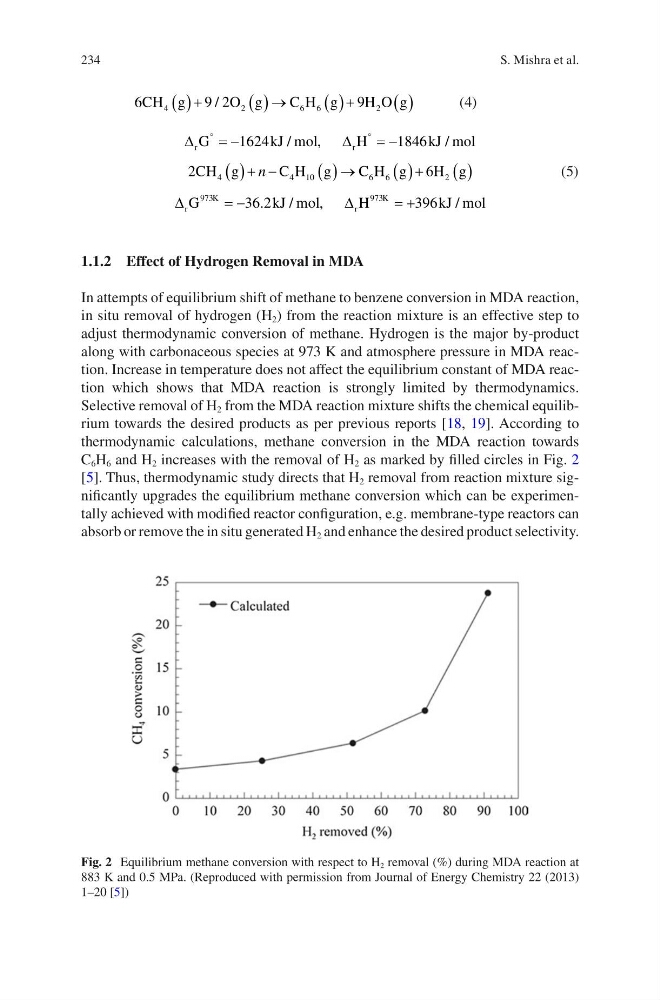
Selective removal of H 2 from the MDA reaction mixture shifts the chemical equilibrium towards the desired products as per previous reports [18, 19]. According to
thermodynamic calculations, methane conversion in the MDA reaction towards
C 6 H 6 and H 2 increases with the removal of H 2 as marked by filled circles in Fig. 2
[5]. Thus, thermodynamic study directs that H 2 removal from reaction mixture significantly upgrades the equilibrium methane conversion which can be experimentally achieved with modified reactor configuration, e.g. membrane-type reactors can
absorb or remove the in situ generated H 2 and enhance the desired product selectivity.
Fig. 2 Equilibrium methane conversion with respect to H 2 removal (%) during MDA reaction at
883 K and 0.5 MPa. (Reproduced with permission from Journal of Energy Chemistry 22 (2013)
1–20 [5])
S. Mishra et al.
6
9 2
9
4
2
6 6
2
CH g
O g
C H g
H O g
( )+
( ) →
( )+
( )
/
(4)
∆
∆
r
r
G
k J mol
H
k J mol
°
°
= −
= −
1624
1846
/
,
/
2
6
4
410
6 6
2
CH g
C H g
C H g
H g
( )+ −
( ) →
( )+ ( )
n
(5)
∆
∆
r
K
r
K
G
k J mol
H
k J mol
973
973
36 2
396
= −
= +
.
/
,
/
1.1.2 Effect of Hydrogen Removal in MDA
In attempts of equilibrium shift of methane to benzene conversion in MDA reaction,
in situ removal of hydrogen (H 2 ) from the reaction mixture is an effective step to
adjust thermodynamic conversion of methane. Hydrogen is the major by-product
along with carbonaceous species at 973 K and atmosphere pressure in MDA reaction. Increase in temperature does not affect the equilibrium constant of MDA reaction which shows that MDA reaction is strongly limited by thermodynamics.
Selective removal of H 2 from the MDA reaction mixture shifts the chemical equilibrium towards the desired products as per previous reports [18, 19]. According to
thermodynamic calculations, methane conversion in the MDA reaction towards
C 6 H 6 and H 2 increases with the removal of H 2 as marked by filled circles in Fig. 2
[5]. Thus, thermodynamic study directs that H 2 removal from reaction mixture significantly upgrades the equilibrium methane conversion which can be experimentally achieved with modified reactor configuration, e.g. membrane-type reactors can
absorb or remove the in situ generated H 2 and enhance the desired product selectivity.
Fig. 2 Equilibrium methane conversion with respect to H 2 removal (%) during MDA reaction at
883 K and 0.5 MPa. (Reproduced with permission from Journal of Energy Chemistry 22 (2013)
1–20 [5])
S. Mishra et al.