

232
observations resulted from previous studies in MDA reaction are fast catalyst deactivation, lower per pas methane conversion, dependency on catalytic constituents
and reactor configuration [10]. A variety of catalysts based on different 3d, 4d transition metal anchored inside microchannels of zeolite have been studied [5]. In the
investigation, it has been observed that HZSM-5/HMCM-22-supported molybdenum is the most selective catalyst for MDA reaction resulting in higher methane
conversion and benzene yield at 700 °C [11]. Fast catalyst deactivation in MDA
reaction is supposed to be due to severe coke deposits in the form of poly- aromatichydrocarbons (PAH) and/or graphitic carbon during the course of reaction [12].
This is the major limitation which restricts its commercialization. Nevertheless,
research community working in the area of MDA process has incorporated remarkable modifications in the process upgrading catalytic constituents, reactant feeding
(oxygenates with methane) and reactor configurations, which significantly controls
methane conversion, benzene yield and catalyst stability. This chapter discusses the
current scenario in the development of the MDA process by providing molecular
insights of catalytic constituents (Mo/Zeolite) which controls the key steps such as
methane activation, aromatization and coking of MDA reaction. Simultaneously,
reaction parameters and reactor configurations which direct the kinetics of the reaction are also covered in this chapter.
1.1 Thermodynamics of MDA
Methane hydrocarbon is a stable molecule and exhibits high C–H bond dissociation
energy (439 kJ/mol) [13]. In MDA reaction, methane conversion into benzene is
thermodynamically unfavourable at lower temperatures. In addition, pyrolysis of
methane at highly endothermic conditions (MDA reaction condition) results in coke
formation which is a major side reaction, simultaneously occurring at MDA reaction conditions [14]. Despite this, a considerable amount of benzene is formed
between the temperature range 700–900 °C at atmospheric pressure. As per
Z. R. Ismagilov and J. J. Spivey reports in 2008 and 2014 respectively [14, 15],
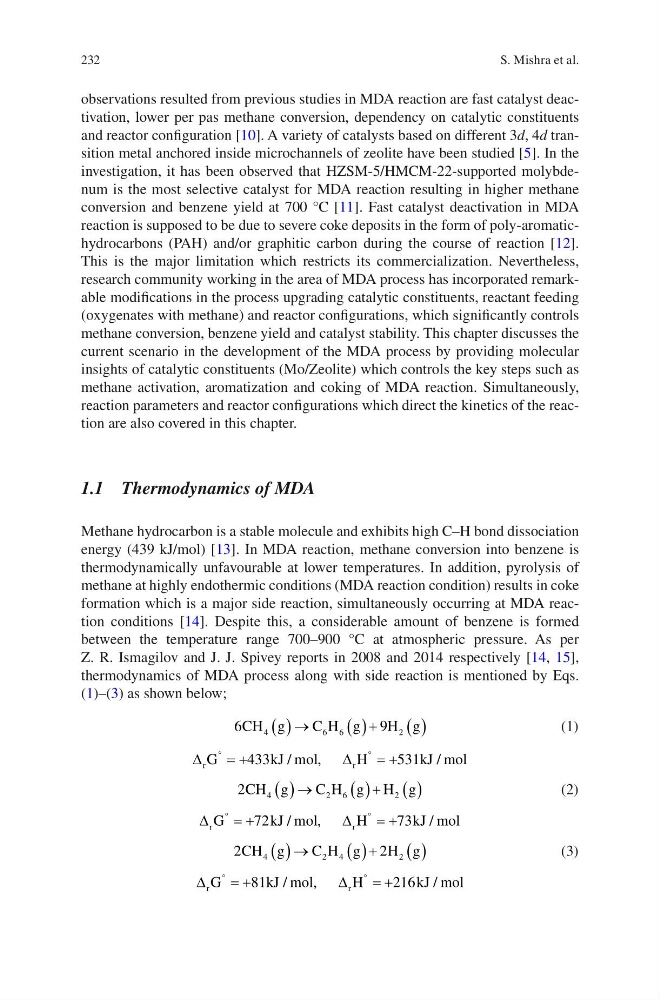
thermodynamics of MDA process along with side reaction is mentioned by Eqs.
(1)–(3) as shown below;
6
9
4
6 6
2
CH g
C H g
H g
( ) →
( )+ ( )
(1)
∆
∆
r
r
G
k J mol
H
k J mol
°
°
= +
= +
433
531
/
,
/
2 4
2 6
2
CH g
C H g H g
( ) →
( )+ ( )
(2)
∆
∆
r
r
G
k J mol
H
k J mol
°
°
= +
= +
72
73
/
,
/
2
2
4
2 4
2
CH g
C H g
H g
( ) →
( )+ ( )
(3)
∆
∆
r
r
G
kJ mol
H
k J mol
°
°
= +
= +
81
216
/
,
/
S. Mishra et al.
observations resulted from previous studies in MDA reaction are fast catalyst deactivation, lower per pas methane conversion, dependency on catalytic constituents
and reactor configuration [10]. A variety of catalysts based on different 3d, 4d transition metal anchored inside microchannels of zeolite have been studied [5]. In the
investigation, it has been observed that HZSM-5/HMCM-22-supported molybdenum is the most selective catalyst for MDA reaction resulting in higher methane
conversion and benzene yield at 700 °C [11]. Fast catalyst deactivation in MDA
reaction is supposed to be due to severe coke deposits in the form of poly- aromatichydrocarbons (PAH) and/or graphitic carbon during the course of reaction [12].
This is the major limitation which restricts its commercialization. Nevertheless,
research community working in the area of MDA process has incorporated remarkable modifications in the process upgrading catalytic constituents, reactant feeding
(oxygenates with methane) and reactor configurations, which significantly controls
methane conversion, benzene yield and catalyst stability. This chapter discusses the
current scenario in the development of the MDA process by providing molecular
insights of catalytic constituents (Mo/Zeolite) which controls the key steps such as
methane activation, aromatization and coking of MDA reaction. Simultaneously,
reaction parameters and reactor configurations which direct the kinetics of the reaction are also covered in this chapter.
1.1 Thermodynamics of MDA
Methane hydrocarbon is a stable molecule and exhibits high C–H bond dissociation
energy (439 kJ/mol) [13]. In MDA reaction, methane conversion into benzene is
thermodynamically unfavourable at lower temperatures. In addition, pyrolysis of
methane at highly endothermic conditions (MDA reaction condition) results in coke
formation which is a major side reaction, simultaneously occurring at MDA reaction conditions [14]. Despite this, a considerable amount of benzene is formed
between the temperature range 700–900 °C at atmospheric pressure. As per
Z. R. Ismagilov and J. J. Spivey reports in 2008 and 2014 respectively [14, 15],
thermodynamics of MDA process along with side reaction is mentioned by Eqs.
(1)–(3) as shown below;
6
9
4
6 6
2
CH g
C H g
H g
( ) →
( )+ ( )
(1)
∆
∆
r
r
G
k J mol
H
k J mol
°
°
= +
= +
433
531
/
,
/
2 4
2 6
2
CH g
C H g H g
( ) →
( )+ ( )
(2)
∆
∆
r
r
G
k J mol
H
k J mol
°
°
= +
= +
72
73
/
,
/
2
2
4
2 4
2
CH g
C H g
H g
( ) →
( )+ ( )
(3)
∆
∆
r
r
G
kJ mol
H
k J mol
°
°
= +
= +
81
216
/
,
/
S. Mishra et al.