

213
of Pt surfaces, the dehydrogenation radical species formation was competitive with
the butene, which obviously prefers low selectivity towards butene formation;
thereby the butanes will be the primary products. Among the reaction pathways,
di-σ mode of the interaction was further strongly supported by additional
experimental [47] and theoretical [48] works (Fig. 2). Experimental results from
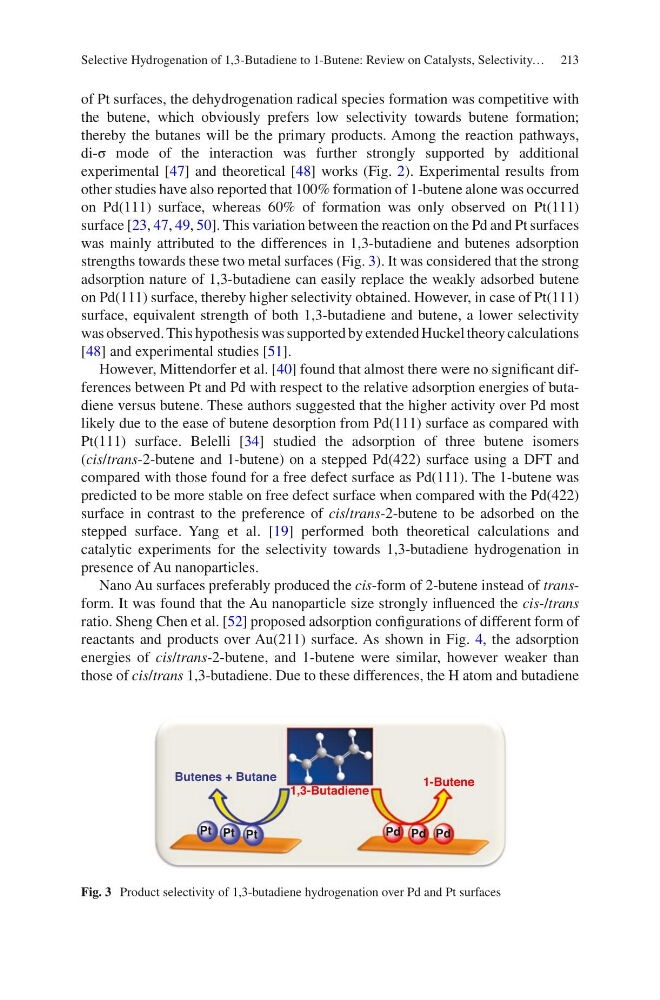
other studies have also reported that 100% formation of 1-butene alone was occurred
on Pd(111) surface, whereas 60% of formation was only observed on Pt(111)
surface [23, 47, 49, 50]. This variation between the reaction on the Pd and Pt surfaces
was mainly attributed to the differences in 1,3-butadiene and butenes adsorption
strengths towards these two metal surfaces (Fig. 3). It was considered that the strong
adsorption nature of 1,3-butadiene can easily replace the weakly adsorbed butene
on Pd(111) surface, thereby higher selectivity obtained. However, in case of Pt(111)
surface, equivalent strength of both 1,3-butadiene and butene, a lower selectivity
was observed. This hypothesis was supported by extended Huckel theory calculations
[48] and experimental studies [51].
However, Mittendorfer et al. [40] found that almost there were no significant differences between Pt and Pd with respect to the relative adsorption energies of butadiene versus butene. These authors suggested that the higher activity over Pd most
likely due to the ease of butene desorption from Pd(111) surface as compared with
Pt(111) surface. Belelli [34] studied the adsorption of three butene isomers
(cis/trans-2-butene and 1-butene) on a stepped Pd(422) surface using a DFT and
compared with those found for a free defect surface as Pd(111). The 1-butene was
predicted to be more stable on free defect surface when compared with the Pd(422)
surface in contrast to the preference of cis/trans-2-butene to be adsorbed on the
stepped surface. Yang et al. [19] performed both theoretical calculations and
catalytic experiments for the selectivity towards 1,3-butadiene hydrogenation in
presence of Au nanoparticles.
Nano Au surfaces preferably produced the cis-form of 2-butene instead of transform. It was found that the Au nanoparticle size strongly influenced the cis-/trans
ratio. Sheng Chen et al. [52] proposed adsorption configurations of different form of
reactants and products over Au(211) surface. As shown in Fig. 4, the adsorption
energies of cis/trans-2-butene, and 1-butene were similar, however weaker than
those of cis/trans 1,3-butadiene. Due to these differences, the H atom and butadiene
Pt
Pt
Pt
Pd Pd Pd
1-Butene
Butenes + Butane 1,3-Butadiene
Fig. 3 Product selectivity of 1,3-butadiene hydrogenation over Pd and Pt surfaces
Selective Hydrogenation of 1,3-Butadiene to 1-Butene: Review on Catalysts, Selectivity…
of Pt surfaces, the dehydrogenation radical species formation was competitive with
the butene, which obviously prefers low selectivity towards butene formation;
thereby the butanes will be the primary products. Among the reaction pathways,
di-σ mode of the interaction was further strongly supported by additional
experimental [47] and theoretical [48] works (Fig. 2). Experimental results from
other studies have also reported that 100% formation of 1-butene alone was occurred
on Pd(111) surface, whereas 60% of formation was only observed on Pt(111)
surface [23, 47, 49, 50]. This variation between the reaction on the Pd and Pt surfaces
was mainly attributed to the differences in 1,3-butadiene and butenes adsorption
strengths towards these two metal surfaces (Fig. 3). It was considered that the strong
adsorption nature of 1,3-butadiene can easily replace the weakly adsorbed butene
on Pd(111) surface, thereby higher selectivity obtained. However, in case of Pt(111)
surface, equivalent strength of both 1,3-butadiene and butene, a lower selectivity
was observed. This hypothesis was supported by extended Huckel theory calculations
[48] and experimental studies [51].
However, Mittendorfer et al. [40] found that almost there were no significant differences between Pt and Pd with respect to the relative adsorption energies of butadiene versus butene. These authors suggested that the higher activity over Pd most
likely due to the ease of butene desorption from Pd(111) surface as compared with
Pt(111) surface. Belelli [34] studied the adsorption of three butene isomers
(cis/trans-2-butene and 1-butene) on a stepped Pd(422) surface using a DFT and
compared with those found for a free defect surface as Pd(111). The 1-butene was
predicted to be more stable on free defect surface when compared with the Pd(422)
surface in contrast to the preference of cis/trans-2-butene to be adsorbed on the
stepped surface. Yang et al. [19] performed both theoretical calculations and
catalytic experiments for the selectivity towards 1,3-butadiene hydrogenation in
presence of Au nanoparticles.
Nano Au surfaces preferably produced the cis-form of 2-butene instead of transform. It was found that the Au nanoparticle size strongly influenced the cis-/trans
ratio. Sheng Chen et al. [52] proposed adsorption configurations of different form of
reactants and products over Au(211) surface. As shown in Fig. 4, the adsorption
energies of cis/trans-2-butene, and 1-butene were similar, however weaker than
those of cis/trans 1,3-butadiene. Due to these differences, the H atom and butadiene
Pt
Pt
Pt
Pd Pd Pd
1-Butene
Butenes + Butane 1,3-Butadiene
Fig. 3 Product selectivity of 1,3-butadiene hydrogenation over Pd and Pt surfaces
Selective Hydrogenation of 1,3-Butadiene to 1-Butene: Review on Catalysts, Selectivity…