

214
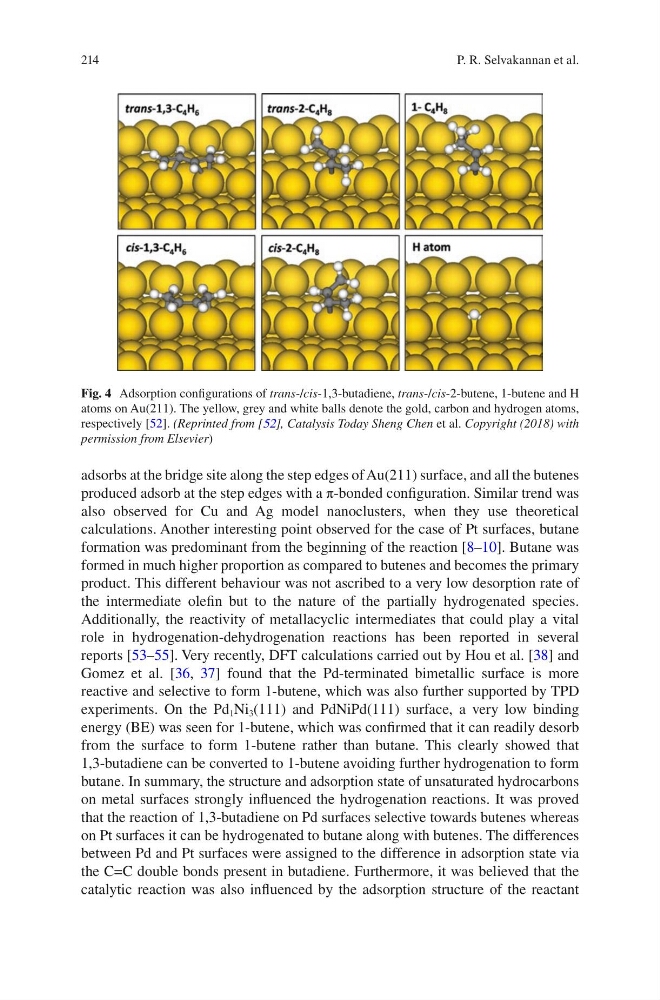
adsorbs at the bridge site along the step edges of Au(211) surface, and all the butenes
produced adsorb at the step edges with a π-bonded configuration. Similar trend was
also observed for Cu and Ag model nanoclusters, when they use theoretical
calculations. Another interesting point observed for the case of Pt surfaces, butane
formation was predominant from the beginning of the reaction [8–10]. Butane was
formed in much higher proportion as compared to butenes and becomes the primary
product. This different behaviour was not ascribed to a very low desorption rate of
the intermediate olefin but to the nature of the partially hydrogenated species.
Additionally, the reactivity of metallacyclic intermediates that could play a vital
role in hydrogenation-dehydrogenation reactions has been reported in several
reports [53–55]. Very recently, DFT calculations carried out by Hou et al. [38] and
Gomez et al. [36, 37] found that the Pd-terminated bimetallic surface is more
reactive and selective to form 1-butene, which was also further supported by TPD
experiments. On the Pd 1 Ni 3 (111) and PdNiPd(111) surface, a very low binding
energy (BE) was seen for 1-butene, which was confirmed that it can readily desorb
from the surface to form 1-butene rather than butane. This clearly showed that
1,3-butadiene can be converted to 1-butene avoiding further hydrogenation to form
butane. In summary, the structure and adsorption state of unsaturated hydrocarbons
on metal surfaces strongly influenced the hydrogenation reactions. It was proved
that the reaction of 1,3-butadiene on Pd surfaces selective towards butenes whereas
on Pt surfaces it can be hydrogenated to butane along with butenes. The differences
between Pd and Pt surfaces were assigned to the difference in adsorption state via
the C=C double bonds present in butadiene. Furthermore, it was believed that the
catalytic reaction was also influenced by the adsorption structure of the reactant
Fig. 4 Adsorption configurations of trans-/cis-1,3-butadiene, trans-/cis-2-butene, 1-butene and H
atoms on Au(211). The yellow, grey and white balls denote the gold, carbon and hydrogen atoms,
respectively [52]. (Reprinted from [52], Catalysis Today Sheng Chen et al. Copyright (2018) with
permission from Elsevier)
P. R. Selvakannan et al.
adsorbs at the bridge site along the step edges of Au(211) surface, and all the butenes
produced adsorb at the step edges with a π-bonded configuration. Similar trend was
also observed for Cu and Ag model nanoclusters, when they use theoretical
calculations. Another interesting point observed for the case of Pt surfaces, butane
formation was predominant from the beginning of the reaction [8–10]. Butane was
formed in much higher proportion as compared to butenes and becomes the primary
product. This different behaviour was not ascribed to a very low desorption rate of
the intermediate olefin but to the nature of the partially hydrogenated species.
Additionally, the reactivity of metallacyclic intermediates that could play a vital
role in hydrogenation-dehydrogenation reactions has been reported in several
reports [53–55]. Very recently, DFT calculations carried out by Hou et al. [38] and
Gomez et al. [36, 37] found that the Pd-terminated bimetallic surface is more
reactive and selective to form 1-butene, which was also further supported by TPD
experiments. On the Pd 1 Ni 3 (111) and PdNiPd(111) surface, a very low binding
energy (BE) was seen for 1-butene, which was confirmed that it can readily desorb
from the surface to form 1-butene rather than butane. This clearly showed that
1,3-butadiene can be converted to 1-butene avoiding further hydrogenation to form
butane. In summary, the structure and adsorption state of unsaturated hydrocarbons
on metal surfaces strongly influenced the hydrogenation reactions. It was proved
that the reaction of 1,3-butadiene on Pd surfaces selective towards butenes whereas
on Pt surfaces it can be hydrogenated to butane along with butenes. The differences
between Pd and Pt surfaces were assigned to the difference in adsorption state via
the C=C double bonds present in butadiene. Furthermore, it was believed that the
catalytic reaction was also influenced by the adsorption structure of the reactant
Fig. 4 Adsorption configurations of trans-/cis-1,3-butadiene, trans-/cis-2-butene, 1-butene and H
atoms on Au(211). The yellow, grey and white balls denote the gold, carbon and hydrogen atoms,
respectively [52]. (Reprinted from [52], Catalysis Today Sheng Chen et al. Copyright (2018) with
permission from Elsevier)
P. R. Selvakannan et al.